Who Are the Top Quality Gurus?

Many prominent quality gurus have emerged within the quality field, but some have stood out as key figures of quality. Most have passed away, but their memory still lives on in the ideas, concepts, and methods that shape quality thinking today.
Who are the top quality gurus? The answer depends on whether you are looking at statistical control, management philosophy, lean production, problem solving, or constraint management, but the same names appear again and again because their methods still show up in modern quality systems.
What Are Quality Gurus?
Quality gurus are the thinkers, statisticians, engineers, consultants, and managers whose ideas changed how organizations define, measure, improve, and sustain quality. They gave companies a practical vocabulary for process control, customer satisfaction, employee involvement, prevention, variation, waste, and continual improvement.
In a competitive market, high-quality products and services rarely happen by accident. They come from systems that are designed, tested, measured, corrected, and improved over time. The quality gurus below helped build that operating discipline.
Listed below are the top ten quality gurus who have shaped quality as it is commonly understood today.
Who Was Dr. Walter Shewhart?

First among the top quality gurus is Dr. Walter Shewhart, who developed the Plan, Do, Check, Act cycle, also known in some circles as Plan, Do, Study, Act. He also advanced theories of process control and the Shewhart transformation process.
Shewhart is widely considered the father of statistical quality control and statistical process control. His work helped organizations distinguish normal process variation from signals that something had changed, which is the foundation behind control charts and many later quality methods.
The practical value of Shewhart’s work is simple: managers cannot improve what they cannot understand. By separating common-cause variation from special-cause variation, a company can stop overreacting to noise and start improving the actual process.
Who Was Dr. W. Edwards Deming?
Regarded as the father of the quality revolution, W. Edwards Deming emphasized statistical analysis, process improvement, management responsibility, and the need to understand variation. His pioneering ideas transformed the way organizations approached quality control.
Deming introduced a broad management philosophy that shaped Total Quality Management and popularized the Deming Cycle, also known as the Plan, Do, Study, Act cycle. The Deming Institute’s overview of his 14 Points remains a useful summary of how he connected leadership, systems, learning, and improvement.
Deming also developed a complete philosophy of management, which he encapsulated in his fourteen points and the seven deadly diseases of management. He advanced the state of quality, originally based on work done by Shewhart, with explanations of variation, the use of control charts, and his theories on knowledge, psychology, and variation.
One of Deming’s most durable contributions was his insistence that quality belongs to management. Workers can improve within the system, but leaders are responsible for designing, measuring, and improving the system itself.
Who Was Dr. Joseph M. Juran?
Dr. Joseph M. Juran is renowned for his contributions to quality management, particularly in the fields of quality planning and quality improvement. Juran advocated the idea that quality does not happen by chance; it must be planned and managed.
He developed the quality trilogy: quality planning, quality improvement, and quality control. The Juran Trilogy remains a common way to explain how organizations design quality into products and services, improve performance, and then control the gains so they do not fade.
Juran emphasized the need for organizations to focus on customer satisfaction and a structured approach to quality management. Quality assurance policy statement and procedures help turn quality intentions into repeatable work, which is the point where planning becomes operational control.
Who Was Dr. Armand V. Feigenbaum?
Dr. Armand V. Feigenbaum developed the idea of total quality control. His approach emphasized that quality is not the job of a single inspection department; it is an organization-wide responsibility that touches design, purchasing, production, service, and management.
Feigenbaum described three steps to quality: quality leadership, modern quality technology, and organizational commitment. He also developed the idea of the hidden plant or hidden factory, the part of an organization’s effort that is consumed by rework, scrap, correction, and avoidable failures.
The hidden factory concept is still useful because it makes poor quality visible. If people are spending time correcting preventable errors, the business is paying for an invisible second operation that creates no customer value.
Who Was Dr. Kaoru Ishikawa?
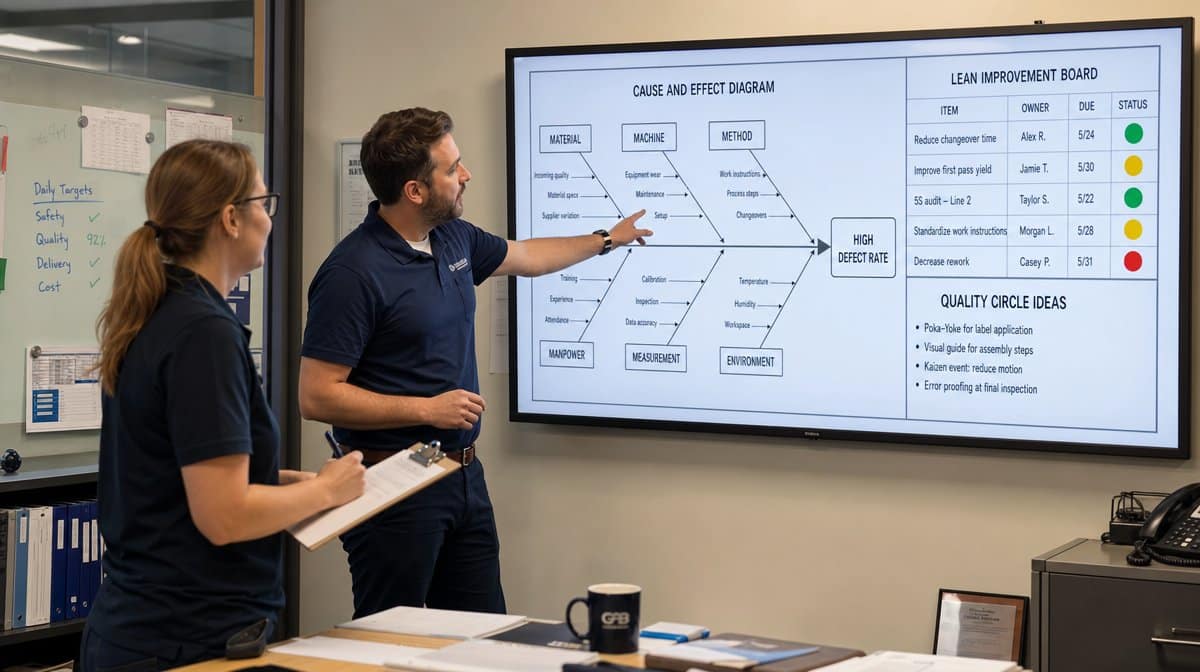
Dr. Kaoru Ishikawa made significant strides in quality assurance, particularly in the use of statistical tools and practical problem solving. He developed the Ishikawa diagram, also known as the fishbone or cause-and-effect diagram, which is widely used for identifying and analyzing the root causes of problems.
Ishikawa’s work popularized the use of statistical process control and provided a systematic approach to quality problem-solving. He also emphasized employee involvement and promoted quality circles, small groups of workers who identify, study, and improve work problems.
He is also associated with the seven basic tools of quality and the philosophy of total quality and the internal customer. These ideas helped move quality from a specialist function into daily management and team-level improvement.
Who Was Dr. Genichi Taguchi?
Dr. Genichi Taguchi developed the Taguchi methodology of robust design, which focused on making product and process design less sensitive to variation in manufacturing. Instead of only trying to control manufacturing variation after the fact, Taguchi pushed organizations to design quality into the product earlier.
Taguchi’s approach used Design of Experiments and introduced concepts such as the Taguchi Loss Function, which quantified the economic loss that results when performance deviates from the target value. This idea of designing in quality has become an important tenet of Six Sigma and modern quality engineering.
The broader lesson is that variation has a cost even when a product technically falls within specification. Robust design asks how the product or process can perform reliably despite unavoidable noise in materials, use conditions, equipment, and environment.
Who Was Dr. Shigeo Shingo?
Shigeo Shingo developed lean concepts such as Single Minute Exchange of Die, or SMED, which reduces setup times instead of relying on larger batch sizes. He also advanced Poka-Yoke, or mistake proofing, to eliminate obvious opportunities for mistakes before they create defects.
Shingo worked with Taiichi Ohno to refine Just-In-Time manufacturing into an integrated manufacturing strategy. That work is widely used to define the lean manufacturing principles used in the Toyota Production System.
Shingo’s work matters because it connects quality to process design. If an error can be made repeatedly, training alone is not enough. A better process makes the correct action easier and the incorrect action harder.
Who Was Dr. Philip B. Crosby?
Dr. Philip B. Crosby developed the idea of Cost of Poor Quality to explain why quality is free. He argued that quality improvement pays for itself through savings from fewer defects, increased revenue from greater customer satisfaction, and stronger competitive advantage.
Crosby popularized zero defects as the goal of a quality program. This challenged organizations to aim for the elimination of defects rather than the reduction of defects to an acceptable quality level.
His philosophy emphasized prevention rather than detection. Crosby believed the costs associated with poor quality outweigh the investments required for prevention, which helped create a cultural shift toward continuous improvement and zero tolerance for avoidable defects.
Who Was Dr. Eliyahu M. Goldratt?
Dr. Eliyahu M. Goldratt developed the Theory of Constraints, which focuses on the single element in a process chain that has the greatest leverage for improvement. In practical terms, one constraint can determine the throughput of the entire system.
Goldratt’s view compares with the Pareto principle, which states that a small number of factors often produce most of the effect on a process. Theory of Constraints sharpens that logic by asking managers to identify, exploit, elevate, and then reassess the current bottleneck.
The method is valuable because it prevents improvement work from scattering across every possible problem. If the constraint is not improved, many local improvements will make individual departments look better without improving the whole system.
Who Was Taiichi Ohno?
Taiichi Ohno developed the seven wastes (muda), which are used in lean to describe non-value-added activity. He also developed manufacturing improvements with Shigeo Shingo that evolved into the Toyota Production System.
Ohno’s work is central to lean because it made waste visible in everyday operations. Overproduction, waiting, transport, overprocessing, inventory, motion, and defects are not abstract ideas; they are practical categories managers can use to see where time and money disappear.
The Toyota Production System connected quality, flow, respect for people, Just-In-Time, and problem solving into one operating model. That is why Ohno remains one of the most important quality gurus for organizations trying to make quality part of daily work.
How Do Quality Gurus Shape Quality Management Today?
The field of quality control and assurance owes much of its advancement to the pioneering work of these quality gurus. From statistical analysis and systematic improvement approaches to preventive strategies and customer-centric philosophies, their contributions have shaped modern quality management practices.
Quality gurus like Shewhart, Deming, Juran, Ishikawa, Taguchi, Shingo, Crosby, Goldratt, and Ohno guided organizations toward better ways to maximize customer satisfaction and drive continuous improvement. Their methods differ, but they share one operating assumption: quality improves when the system that creates the work improves.
As organizations continue to evolve, it is essential to honor the legacy of these quality gurus and build on their insights. The lasting lesson is that quality is not a slogan, inspection step, or department. Quality is a managed system of leadership, process design, measurement, learning, prevention, and sustained improvement.
Frequently Asked Questions
Who Are the Top Quality Gurus?
The top quality gurus are the major thinkers who shaped modern quality management, including Walter Shewhart, W. Edwards Deming, Joseph M. Juran, Armand Feigenbaum, Kaoru Ishikawa, Genichi Taguchi, Shigeo Shingo, Philip Crosby, Eliyahu Goldratt, and Taiichi Ohno.
Why Is W. Edwards Deming Important to Quality Management?
W. Edwards Deming is important because he connected statistical thinking, management responsibility, systems thinking, and continuous improvement. His 14 Points helped move quality away from inspection alone and toward leadership-owned process improvement.
What Did Joseph Juran Contribute to Quality?
Joseph Juran contributed the quality trilogy: quality planning, quality control, and quality improvement. His work emphasized that quality must be planned, measured, improved, and sustained rather than left to chance.
What Is the Difference Between PDCA and PDSA?
PDCA stands for Plan, Do, Check, Act, while PDSA stands for Plan, Do, Study, Act. Both describe an iterative improvement cycle, but PDSA stresses learning from the results before standardizing the next action.
How Do Quality Gurus Influence Modern Businesses?
Quality gurus influence modern businesses through methods such as statistical process control, control charts, root cause analysis, quality circles, zero defects, mistake proofing, lean waste reduction, and Theory of Constraints. These methods help organizations improve quality by improving the processes that create products and services.