How ISO 9001 Can Make Your Company More Competitive

Some organizations still treat ISO 9001 as a document nightmare or a plaque to earn and forget. That misses the business value. Used as a management system, ISO can make your company more competitive by improving how work is defined, measured, reviewed, and corrected. The standard has limited prescriptive document requirements, so implementation should focus on operating discipline rather than document volume.
The competitive question is practical: can your organization reduce wasted efforts, respond to changing demands, understand customer requirements sooner, and make better supplier decisions? A well-run quality management system can help, but only when it is used as an improvement tool rather than a certification exercise.
What Is ISO 9001?
ISO 9001 is an internationally recognized standard that defines requirements for a quality management system, or QMS. The current ISO 9001 standard overview explains that organizations of any size or sector can use it to improve performance, meet customer expectations, and continually improve their systems.
Why say implementing ISO 9001 instead of becoming certified? Gaining certification for your quality management system can be valuable, but it should not be the ultimate point of using the standard. Organizations that view gaining certification as the reason for using ISO 9001 are missing a great opportunity for improvement. ISO 9001 is a journey, not a destination, and certification is optional.
If you sincerely start implementing ISO 9001 as a business improvement tool, gaining certification sometime down the line, if you choose to do so, should become a simpler step. The framework is broadly recognized as a proven method of using a systems and process approach to make a business more effective and therefore more competitive.
How Can Implementing ISO 9001 Make Your Company More Competitive?
What causes problems in your organization? Wasted efforts due to changing demands and requirements? A lack of strategic vision that prevents the organization from pulling in the same direction? Poorly defined processes and poorly defined responsibilities? Supplier problems? These common issues can be improved using ISO 9001 because the system connects objectives, processes, evidence, responsibilities, and corrective action.
Using the Process Approach
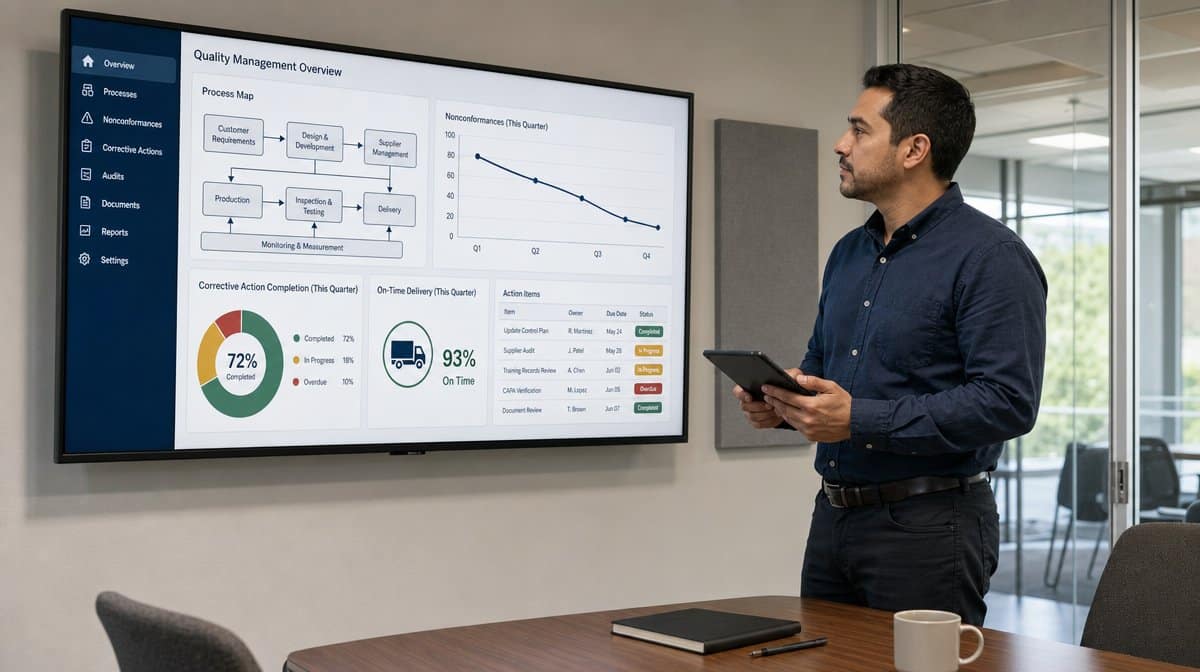
One of the first steps in implementing ISO 9001 is to define and determine the core processes of the organization. Imagine the benefit of simply conducting this reflective exercise: identifying what is important to the organization and to its customers, clarifying inputs and outputs, assigning process owners, and deciding what evidence will show that the process is working.
When you attach goals and objectives to these processes and communicate them throughout the organization, everyone can understand what is important and what they should be focused on and working toward. A defined process also gives managers a stable baseline. Without that baseline, recurring delays and defects are discussed as isolated incidents instead of being treated as signals that the system needs attention.
That shared process view also clarifies responsibility. People can see where work begins, what information must be available, which activities add value, who approves exceptions, and where the output goes next. Instead of relying on memory or individual heroics, the organization can train against a common method and improve it when evidence shows that requirements are not being met.
How Does PDCA Turn Work Into Continual Improvement?

Framed this way, using the process approach to understand organizational functions can produce positive results. Now consider using a continually improving process approach, another foundation of ISO 9001. This cycle is also referred to as PDCA, or Plan Do Check Act:
- Plan: A clear plan is created for how each process should be conducted, what it should accomplish, who owns it, and how results will be measured.
- Do: Process activities are carried out while capturing key information about quality, time, cost, customer requirements, and exceptions.
- Check: Process results are regularly reviewed by comparing actual results with the plan, objectives, and customer or regulatory requirements.
- Act: Lessons learned as a result of reviews are used to correct causes, standardize improvements, and improve performance.
The strength of PDCA in ISO 9001 is not the four labels. It is the repeated discipline of planning work, observing what actually happens, and acting on evidence. That turns improvement from an occasional project into a normal management habit.
Why Does Customer Focus Improve Competitiveness?
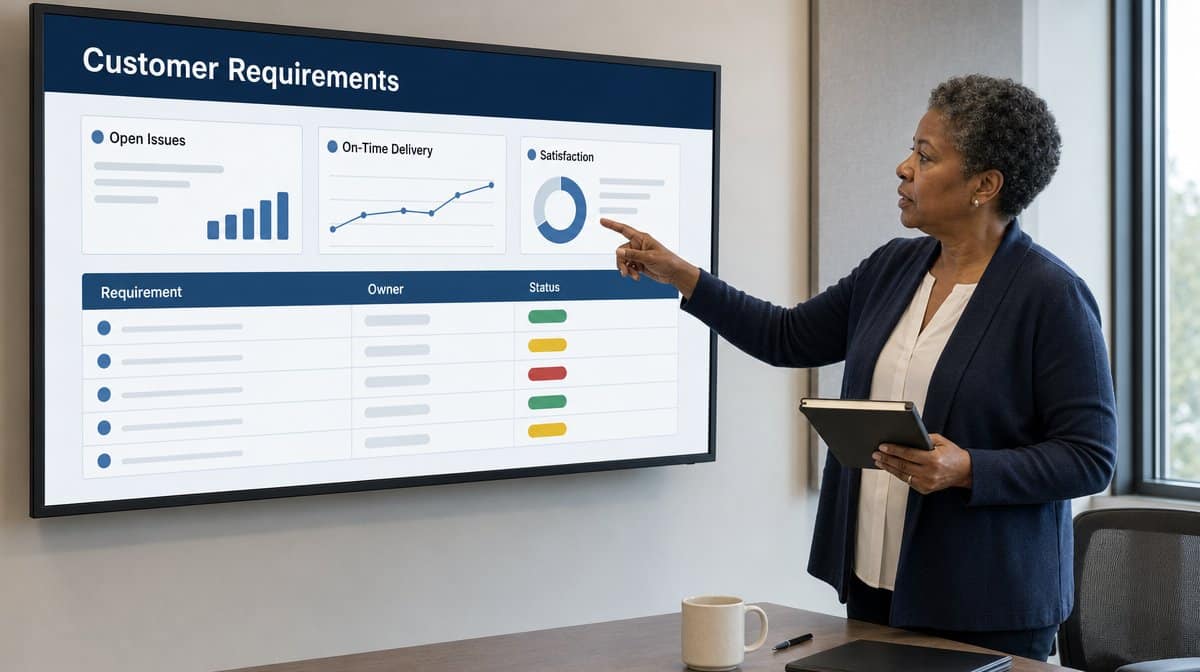
Another key element of ISO 9001 that can improve competitiveness is understanding customer requirements. The system calls for organizations to determine, review, and communicate requirements for products and services, then monitor information about whether customer needs and expectations have been met.
How many times has your organization been caught off-guard because it did not understand what a customer wanted and needed? How many more times do you want that to happen? A stronger customer focus, combined with a continually improving process philosophy, catches ambiguity earlier and makes repeated mistakes less likely.
The earlier that misconceptions or mistakes in customer requirements are caught, the easier and cheaper they usually are to correct. Quality professionals often describe this with the 1-10-100 rule: a mistake may cost roughly ten times more to fix in production than in design and roughly one hundred times more after it reaches the customer. The exact multipliers are a rule of thumb, but the direction matches the cost-of-quality model: prevention and early correction avoid internal and external failure costs.
Improving the focus on customer requirements provides two important benefits. First, it creates significant savings by catching errors and oversights sooner. Second, it can increase customer satisfaction because customers receive products and services that more reliably match what they agreed to buy. Those two effects improve competitiveness through lower failure cost, stronger trust, and more consistent delivery.
Customer focus also improves the quality of commercial commitments. Sales, operations, purchasing, and quality teams can review requirements before promising a delivery date or accepting a specification. When a requirement changes, the change can be evaluated, communicated, and recorded before it creates scrap, rework, expedited freight, or dissatisfaction. That is how a quality system protects both the customer relationship and operating margin.
How Do Supplier Relationships Improve Total Cost?

Along with customer focus, ISO quality management principles emphasize relationship management. Supplier evaluation should therefore consider a total-cost perspective. A nearby supplier with a higher per-unit price may be more competitive than a distant lower-price supplier once quality, lead time, communication, inventory, freight, and disruption costs are incorporated.
How expensive is it to deal with delays and dissatisfaction caused by defective or wrong material, especially if it takes 4 to 6 weeks for replacements to arrive because of supplier distance? What about the cost of sending quality and purchasing managers halfway around the world to deal with supplier issues, not to mention the lost time they could have spent on more productive and valuable tasks?
Suppliers are an integral part of many businesses. Creating strong relationships with good suppliers while avoiding poor supplier relationships provides a firm supply chain competitive advantage. By implementing ISO 9001, your organization can discern stronger suppliers from weaker ones through regular supplier evaluation, evidence-based selection, performance monitoring, and corrective action.
A supplier scorecard should support decisions rather than become another reporting ritual. Measures such as defect rate, on-time delivery, lead-time stability, responsiveness, corrective-action closure, and total cost reveal whether a low purchase price is producing real value. Regular reviews also give good suppliers clear feedback and a fair opportunity to improve before problems become chronic.
When Does ISO 9001 Create a Competitive Advantage?
ISO 9001 creates an advantage when the quality management system changes everyday decisions. Leaders use process results to allocate resources. Process owners act on defects and delays. Employees understand responsibilities. Customer requirements are reviewed before commitments are made. Suppliers are managed according to total value rather than unit price alone.
If you believe that defining and continually improving key processes, understanding what customers want, and determining the best supplier on total cost will help the organization, then ISO 9001 can support a more competitive operating system. The point is not just getting a plaque. It is getting better, making improvement visible, and sustaining what works.
Frequently Asked Questions
What Is ISO 9001?
ISO 9001 is an international standard that specifies requirements for a quality management system. Organizations use it to define and control processes, meet customer and applicable requirements, evaluate performance, and continually improve.
Does a Company Need Certification to Benefit From ISO 9001?
No. An organization can implement ISO 9001 requirements and improve its quality management system without seeking third-party certification. Certification can provide external assurance, but operational improvement should remain the primary goal.
How Does PDCA Improve Competitiveness?
PDCA creates a repeatable cycle for planning work, performing it, checking actual results, and acting on lessons learned. This helps an organization reduce recurring waste, correct causes, and make process performance more predictable.
How Does ISO 9001 Improve Customer Satisfaction?
ISO 9001 emphasizes determining customer requirements, controlling delivery processes, reviewing feedback, and correcting failures. These disciplines reduce misunderstandings and help products and services match customer expectations more consistently.
How Does Supplier Evaluation Reduce Total Cost?
Supplier evaluation looks beyond unit price to quality, delivery reliability, lead time, communication, and corrective-action performance. This helps an organization avoid failure costs and build stronger relationships with suppliers that reliably create value.