What are Document Compliance Manager Responsibilities?

A Document Compliance Manager manages policies, procedures, work instructions, job aids, and compliance records so people can find and use the correct approved information. The role connects document control, record control, quality management, technical writing, training, and compliance auditing.
Document compliance manager responsibilities cover the full information lifecycle: drafting and classifying documents, coordinating reviews and approvals, controlling access and revisions, communicating changes, preserving records, and supporting audits. In a smaller company, the same work may be assigned to a document control manager, quality manager, document manager, or someone in quality control.
What Does a Document Compliance Manager Do?
The manager establishes a consistent way to create, approve, issue, change, retrieve, retain, and dispose of controlled information. This includes understanding the difference among policies, procedures, work instructions, forms, and records, then applying the right controls to each type.
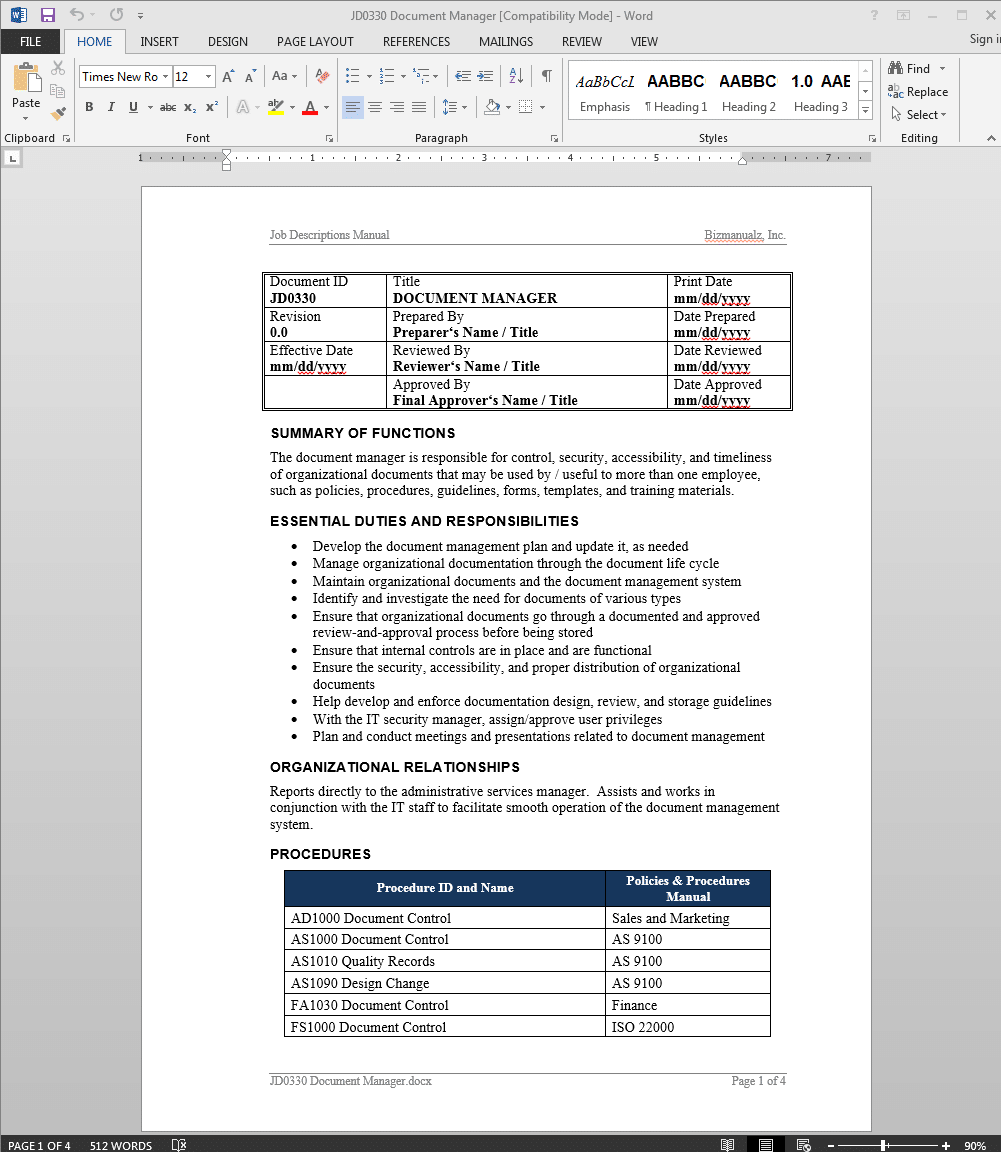
The role does not simply store files. It assigns ownership, confirms approval status, keeps obsolete copies out of use, protects records, and helps employees understand which version applies. A Document Manager Job Description can help a smaller organization turn these responsibilities into a defined position.
Common Document Compliance Manager Responsibilities
The following ten responsibility areas preserve the practical scope of the job while separating authoring work from approval authority and document control from record control.
1. Document Compliance Standards
Documents and records are used throughout a company, so the Document Compliance Manager should understand the requirements that actually apply to the organization. Examples may include Good Manufacturing Practices (GMP) in an applicable regulated industry, the current ISO 9001 quality management requirements, Sarbanes-Oxley internal-control requirements for covered reporting companies, or FDA requirements for medical-device manufacturers.
Applicability matters. The SEC describes Sarbanes-Oxley Section 404 in terms of management assessment of internal control over financial reporting. FDA now calls revised 21 CFR Part 820 the Quality Management System Regulation, which incorporates ISO 13485:2016 by reference. The manager maps the applicable requirement to a real control instead of treating every standard as universal.
2. Compliance Document Management
Knowledge of quality documents, the documentation process, quality forms and records is crucial to a document compliance program. The manager organizes documents for reliable retrieval, assigns owners, maintains identification and approval status, and applies access, retention, and disposition rules.
A well-designed repository helps employees retrieve current information quickly, but storage alone is not control. The manager defines how documents, records, forms, and work instructions enter and leave the system, then checks that the process is followed.
3. Document Compliance Writing
A Document Compliance Manager may act as a technical writer or coordinate document compliance writing. Familiarity with process mapping, process design, and policy and procedure writing helps the manager turn operational knowledge into usable instructions.
Technical writing conveys process information through active voice, instructional design, and appropriate desktop publishing methods. The manager also checks that each draft follows the approved template, uses consistent terms, identifies responsibilities, and enters the formal review process.
4. Document Compliance Software
The work may include creating and editing documents in Microsoft Word, Excel, PowerPoint, and Visio. Those tools support writing, data collection, presentations, process mapping, and process design, but they do not by themselves provide a controlled document lifecycle.
Configured document compliance software can support permissions, review workflows, revision history, release status, retrieval, and an audit trail. The manager selects or configures the system around the organization’s controls, then verifies that users follow the process.
5. Compliance Management
The manager works with process owners and other teams to improve established company policies and procedures. This may include developing standard operating procedures, coordinating quality policies, identifying document owners, and improving business process communication.
Document work supports the broader compliance management system. The manager translates requirements into controlled information and monitors whether that information is current, available, and used as intended.
6. Document Compliance Communications
Document compliance communications include training document users, explaining why controls matter, announcing approved changes, and confirming that employees understand their responsibilities. The manager must be able to interpret instructions and identify unclear, conflicting, or obsolete content before it reaches users.
Communication continues after release. When a procedure changes, affected employees need the current version, an explanation of the change, any required training, and a clear effective date.
7. Document Control
A Document Compliance Manager may also serve as the Document Control Manager responsible for document control practices and document revision control. Core activities include review, approval, issue, distribution, controlled change, and removal of obsolete copies.
Document control is a key priority because an unapproved or outdated instruction can cause inconsistent work. A practical improve document control program gives each controlled document an owner, status, version, approval record, and defined audience.
8. Compliance Auditing
Ensuring conformance and evaluating compliance effectiveness are important aspects of the job. The manager may prepare for compliance auditing, retrieve evidence, review audit reports, and make sure document control audit findings receive owners, corrective actions, and follow-up.
The objective is not to make the filing system look complete. It is to show that required controls operate, exceptions are identified, and corrective work is verified.
9. Record Control
The compliance system relies on data collection. Business process data is recorded on forms, and completed records provide evidence that an activity occurred. The manager controls how records are identified, protected, retrieved, retained, stored, preserved, and disposed of.
Records are not managed exactly like editable documents. A controlled procedure may be revised, while a completed record normally remains evidence of the activity as performed. FDA guidance likewise emphasizes that applicable current Good Manufacturing Practice records must remain available for inspection in an appropriate records-management system.
10. Compliance Support
As a member of the quality and compliance team, the Document Compliance Manager supports the Compliance Officer, Quality Manager, Audit Manager, and other process owners. This may include preparing controlled documents, locating records, tracking approvals, monitoring overdue reviews, and maintaining the quality management system.
Support is most effective when responsibility remains clear. The document manager coordinates the system, while designated owners approve content and accountable leaders decide how requirements apply.
Document Compliance Manager Responsibility Checklist
The example lifecycle below turns the ten responsibility areas into a repeatable operating sequence. Adapt the controls, approval authority, and retention periods to the standards, regulations, contracts, and business needs that apply to your organization.
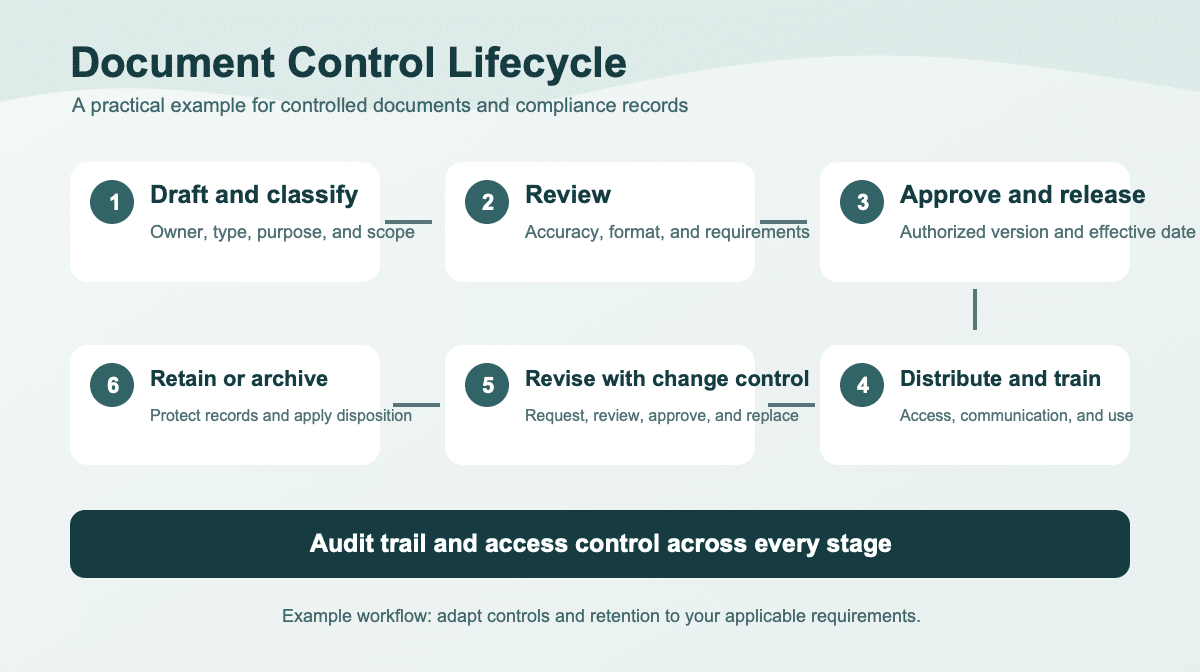
Open the document control lifecycle at full size for a readable reference.
- Identify the document or record type, owner, purpose, and applicable requirement.
- Review content for accuracy, clarity, format, and operational fit.
- Record approval, version, release status, and effective date.
- Control distribution, access, communication, and training.
- Process revisions through documented change control.
- Protect records and apply approved retention and disposition rules.
- Maintain the audit trail and access controls across every stage.
Document Compliance Manager Responsibilities
The Document Compliance Manager is responsible for the document control and record control of company-wide policies, procedures, work instructions, job aids, forms, and compliance records. The role helps assure continuing conformance with the standards and regulations that apply to the organization.
In a smaller company, the same person may also be the document control manager, quality manager, or a member of quality control. Whatever the title, the work succeeds when approved information is clear and available, obsolete information is removed from use, completed records stay protected, and audit findings lead to verified follow-up.