What is the Difference Between Policy, Process, Procedure, SOP, or Work Instruction?
All companies run on business processes. Some are carefully documented, but many are ad hoc, which leaves employees guessing at what they are supposed to do. Ask yourself a simple question: if a rule is never written down, does the policy really exist? The moment you try to answer, the differences between a policy, a process, a procedure, an SOP, and a work instruction start to matter.
Here we explain the differences between policies, procedures, processes, SOPs, and work instructions, and how each is used in a business setting. They are not interchangeable words. Each one sits at a different level of documentation, carries a different amount of detail, and answers a different question about how your organization actually operates.
What Is the Difference Between a Policy, Process, Procedure, SOP, and Work Instruction?
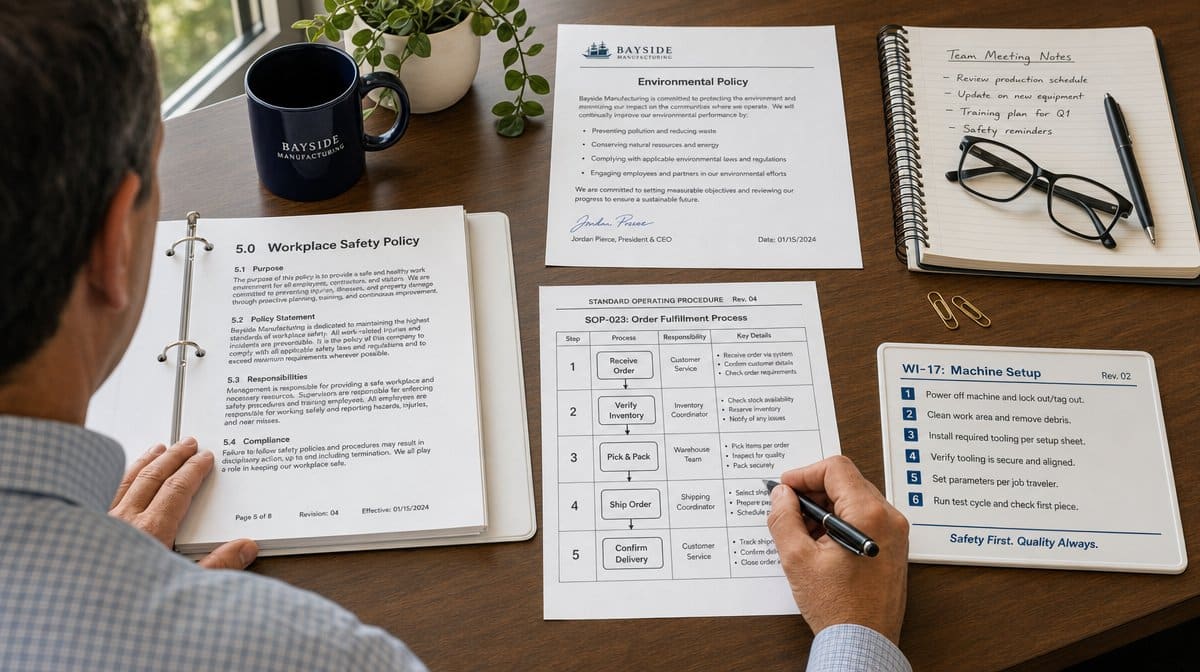
Think of these five terms as connected levels of documentation rather than competing labels. A policy is an organizing principle that provides direction. A process defines the key areas of work and converts an input into an output. A procedure describes that process in more detail, adding responsibilities, objectives, and methods. A Standard Operating Procedure (SOP) is a documented procedure written to a common format. A work instruction provides the most detail of all, spelling out how a single task is literally performed. Together they form a document pyramid, moving from broad direction at the top to precise, step level detail at the bottom.

The level of detail you choose is driven by the complexity of the work you are trying to describe. A simple task may need only a short procedure, while a complex, high risk activity may need a full SOP supported by several work instructions. Getting the layers right is what keeps your operating model consistent as the company grows.
What Is the Difference Between a Process and a Procedure?
The differences between a process and a procedure are not many, but they are important. A process defines the key areas of a business, while a procedure describes those process elements with more information, adding responsibilities, objectives, and methods. Used together, they complement each other, playing different roles in defining your operating business model.

Process Versus Procedure
A process is the conversion of an input into an output, which becomes the standard for performing a task. To create consistency, all employees should follow a standard process, which is typically documented in a procedure. The process tells you what has to happen; the procedure captures how it is done so the result does not depend on who is doing the work.
What Is a Procedure or SOP?
A procedure is a term that defines a series of steps that achieve a planned result. Procedures are also called Standard Operating Procedures (SOP), good manufacturing practice (GMP), or a best practice. Procedures are frequently used to demonstrate compliance, support training, and retain important organizational knowledge so you prevent errors. A process can be described by as few as one procedure, but more complex processes can have many procedures.

Writing Standard Operating Procedures (SOP)
Writing Standard Operating Procedures, also known as an SOP, allows you to standardize your processes. Start with an SOP template to provide everyone with a common format. A good template gives people a strong start, saving a lot of time in selecting fonts, margins, and other common structural elements so the team can focus on the content. Consistent procedures also underpin quality systems such as the ISO 9001 quality management standard, which expects documented information that keeps outputs predictable.
What Is the Difference Between Procedures and Work Instructions?
Procedures are not the same as work instructions. Procedures describe a process, while work instructions are used to provide greater detail when performing the individual transaction steps. If a procedure says to inspect an item, the work instruction tells the operator exactly how to inspect it, in what order, and what a pass or fail looks like.

Work instructions matter most where accuracy and safety are on the line, which is why they often double as training aids and as the records regulators expect to see. For work that must be traceable, following documented instructions is part of staying compliant with rules such as OSHA’s recordkeeping requirements. The level of detail is driven by the complexity of the process you are trying to describe.
What Is the Difference Between Policies and Procedures?
A policy is an organizing principle that can represent rules to guide employees (employee policies) or a mission statement used to guide a process or procedure. Management sets policy to provide direction and guide decision making by employees. In other words, a policy is where leadership states the intent that everything below it has to serve.
Policies are different than procedures in that they provide the direction (what we are doing), while the procedures provide the general process details (how we do it), and then the work instructions provide the most detail (how we literally do it). Business Policy Deployment ties these together, connecting your strategy, policies, procedures, and work instructions into one aligned system. The level of detail at each layer is driven by the complexity of the process.
Examples of Policies and Procedures
Anyone writing policies and procedures who would like some free examples of what policies and procedures look like can download many free sample policies and procedures templates, available in Microsoft Word or PDF. Seeing a finished example makes the difference between the layers concrete, and a ready made procedure manual template gives you a proven format to adapt instead of starting from a blank page.
Frequently Asked Questions
What Is the Main Difference Between a Policy and a Procedure?
A policy provides direction and states what the organization intends to do, while a procedure provides the general process details that explain how the work is actually done. Policy is the organizing principle; the procedure is the documented series of steps that carries it out.
Is an SOP the Same as a Procedure?
An SOP is a procedure. Standard Operating Procedure is simply the formal name for a procedure documented to a common format so that everyone performs the task the same way. Procedures are also referred to as good manufacturing practice (GMP) or a best practice in some industries.
What Is the Difference Between a Process and a Procedure?
A process is the conversion of an input into an output that defines a key area of the business. A procedure describes that process in more detail, adding responsibilities, objectives, and methods so the standard process can be followed consistently.
When Do You Need a Work Instruction Instead of a Procedure?
You need a work instruction when a single transaction step requires greater detail than the procedure provides. Work instructions describe how a task is literally performed and are most valuable where accuracy, safety, or compliance depend on doing the step exactly right.
How Much Detail Should Each Document Include?
The level of detail is driven by the complexity of the process you are trying to describe. Policies stay high level, procedures capture the general process details, and work instructions provide the most detail. Matching the detail to the complexity keeps the documentation useful rather than overwhelming.