What Cybersecurity Skills are Needed for Your Business?

Cybersecurity skills are needed wherever a business relies on digital tools for task assignment, project management, cloud-based collaboration, accounting, resource management, or customer service. The essential capabilities are risk assessment and analytics, secure network and cloud operations, careful use of AI-assisted security tools, authorized penetration testing, and disciplined system and software maintenance.
You do not necessarily need a separate full-time employee for every capability. Your business can assign accountable employees, use an external provider, or combine both approaches. NIST advises small businesses to shape the security team around budget, capabilities, risk, and requirements in its guidance on building a cybersecurity team.
The Cybersecurity Skills Your Business Needs
Rapid advancements in technology have turned network security and cyber security into a business imperative. Companies are leveraging digital tools for practically every process, but every digital aspect can also introduce security risks. Data breaches, leaks, theft of sensitive business and customer data, and system malfunctions can interrupt the digital interactions a company relies on.
That makes cybersecurity a business responsibility as well as a technical one. The NIST NICE Framework supplies a common language for cybersecurity tasks, knowledge, skills, work roles, and competency areas, which can help a company define what work must be covered before deciding who will perform it. See the NICE workforce framework.
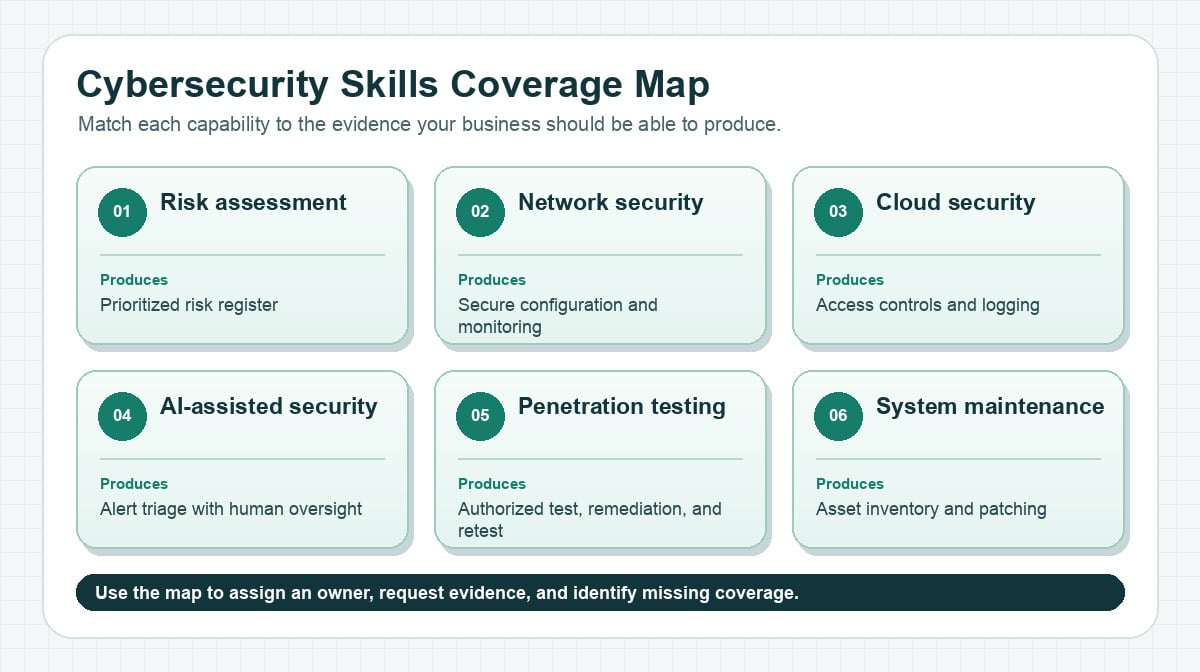
The coverage map connects each skill to a practical output. Use it to identify gaps, assign ownership, and decide whether an employee, a service provider, or a mixed team should produce the result.
Risk Assessment and Analytics Skills
Risk assessment calls for tremendous responsibility because every business has systems, data, people, suppliers, and customer touchpoints that can become a risk source. The work starts by identifying important assets and internal security protocols, then examining threats, vulnerabilities, business impact, and the controls already in place.
A capable assessment expert turns that analysis into a prioritized risk register, detailed risk evaluations, advice on how to minimize risk, and a plan for what to do in case of a security breach. NIST explains that risk assessments inform leadership decisions about how to respond to identified risks in its risk assessment guide. A small business can also conduct a cybersecurity audit to compare documented practices with what is happening in daily operations.
Managing and Updating Network Security
Working online means your business needs a secure network that permits access through appropriate credentials and limits each user or device to what it needs. Network security skills include secure configuration, access control, monitoring, log review, vulnerability management, and the ability to recognize when unusual activity needs investigation.
Keeping the network secure requires ongoing maintenance, monitoring, and authorized testing. The same owner or provider must handle those network-related tasks, document changes, configure effective security controls, and show everyone connected to the network how to keep devices and communication safe. Smaller teams may assign the work internally or use managed network security. What matters is clear accountability, not a particular job title or certification.
Cloud-Based Management
Modern-day tools allow a company to combine on-site hardware with advanced cloud environments. Cloud-based collaboration supports hybrid collaboration models, remote workers, and home-based teams, but built-in security modules do not remove the customer’s responsibilities. Keeping a cloud environment in order is a complex task involving a variety of responsibilities. The CISA Cloud Security Technical Reference Architecture explains that customer and provider duties vary across software, platform, and infrastructure service models. Your cloud security lead must understand those boundaries. See the cloud security architecture.
Useful cloud management skills include identity and access administration, secure configuration, logging, backup and recovery, supplier review, and incident handling. These controls support remote-worker data protection during a cloud migration and after the move.
Working with AI-Based Security Tools
Artificial intelligence has many implications for cyber security. AI-driven tools can help analysts automate certain processes, sort alerts, detect patterns, summarize technical information, and focus attention on events that require investigation. NIST notes that AI can augment defensive capabilities while also creating new cybersecurity risks and challenges. That combination makes evaluation and oversight part of the skill, not an optional extra. See NIST’s work on cybersecurity, privacy, and AI.
Professionals should know how to use AI without assuming its output is correct. They need to protect confidential inputs, validate recommendations against source data, monitor false positives and missed signals, and keep a qualified person responsible for the final decision. The goal is useful human oversight, not the elimination of bias or human error. Businesses exploring the broader topic can review how to use AI in a small business.
Penetration Testing Skills
Penetration testing uses authorized simulations to find exploitable weaknesses and show how security controls respond. The work needs written scope, permission, rules of engagement, safe handling of test data, and coordination with the people who operate the affected systems.
NIST SP 800-115 describes technical security testing as a way to identify vulnerabilities and verify compliance while recognizing that each technique has benefits and limitations. A useful engagement ends with clear findings, remediation work, and a retest, not simply a report. Review the technical security testing guide.
System and Software Maintenance
On the most basic level, customer-facing platforms, laptops, servers, phones, network devices, management software, and other software tools and solutions all need an identified owner. Employees in certain tech industries may manage their own devices properly, but most organizations still need someone accountable for internal systems. Maintenance skills include keeping an asset inventory, tracking supported versions, applying security patches and system upgrades, testing important changes, and confirming that updates succeeded.
CISA explains that software updates patch security weaknesses, which is why delayed or unmanaged updates can increase exposure. See its software update guidance. Regular maintenance cannot prevent every security or compliance problem, but it reduces avoidable risk and gives employees a safer foundation for their core tasks.
Cybersecurity Skills Are Needed for Your Business
The right mix of cybersecurity skills depends on the systems and information your business must protect. These specific abilities prepare people for different security jobs, while key traits such as attention to detail, a desire to keep learning, and problem-solving skills help build a stronger security culture. Start with the six capability areas above, name an accountable owner for each output, and collect evidence that the work is happening.
| Capability | Evidence to Look For | Possible Owner |
|---|---|---|
| Risk assessment and analytics | Prioritized risk register and treatment plan | Operations leader, security lead, or advisor |
| Network security | Secure configuration standard, monitoring, and access review | IT employee or managed provider |
| Cloud management | Responsibility map, access review, logs, and recovery test | Cloud administrator or provider |
| AI-assisted security | Approved use, protected inputs, validated outputs, and human review | Security analyst and data owner |
| Penetration testing | Authorized scope, findings, remediation, and retest | Qualified independent tester |
| System maintenance | Asset inventory, update schedule, and completion records | System owner or IT provider |
Review the matrix against your information security policies. If an output has no owner or no evidence, treat it as a gap to resolve. Complementary capabilities such as behavioral analytics can be added where the risk and available data justify them.
If your business needs to improve its security in the digital realm, align people, service providers, internal policies and procedures, and industry requirements. That alignment helps your experts do their jobs effectively and gives management a practical way to verify that important responsibilities are covered.
Frequently Asked Questions
Does Every Small Business Need a Full-Time Cybersecurity Specialist?
No. A small business can use an accountable employee, an external provider, or a mixed team. The choice should reflect the business’s budget, capabilities, risk, and requirements, while every important security responsibility still has a named owner.
Which Cybersecurity Skills Can a Business Outsource?
A business can outsource specialized work such as monitoring, cloud configuration review, incident support, and penetration testing. Internal management still needs to define expectations, approve access, review findings, assign remediation, and verify completion.
What Should You Ask a Network or Cloud Security Provider?
Ask which systems and responsibilities are in scope, how access is controlled, what is monitored, how incidents are escalated, how backups are tested, what evidence you will receive, and which duties remain with your business.
Is Penetration Testing the Same as a Vulnerability Scan?
No. A vulnerability scan uses automated checks to identify potential weaknesses. An authorized penetration test goes further by attempting controlled exploitation within an agreed scope, then documenting business impact, remediation, and retesting needs.
How Often Should a Business Review Its Cybersecurity Skill Coverage?
Review coverage whenever important systems, suppliers, staff responsibilities, or risks change, and include it in the regular management review cycle. The useful test is whether every critical output still has an owner, current evidence, and a path for fixing gaps.