What are the Similarities and Differences between Lean and Six Sigma?
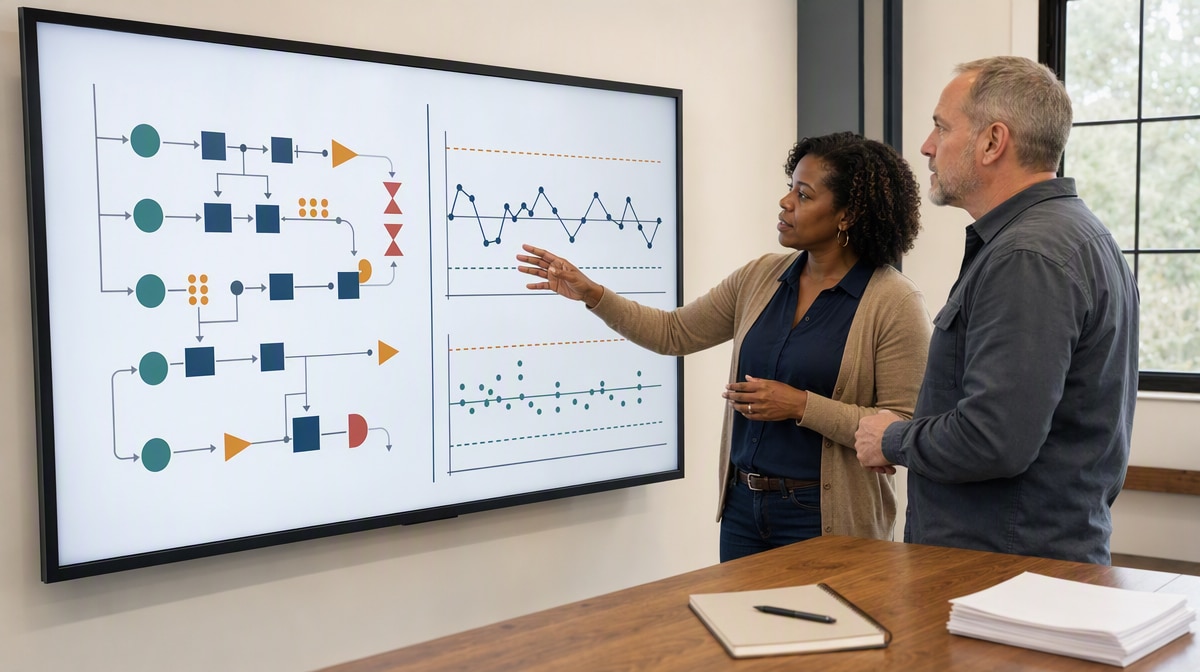
Lean and Six Sigma share the goal of improving processes so customers receive more consistent value. The main difference is emphasis: Lean primarily removes waste and improves flow, while Six Sigma primarily reduces process variation and defects.
You do not have to treat the methods as rivals. The right choice depends on the problem you can see, the evidence you can collect, and the capability of the team doing the work. This guide explains the similarities and differences between Lean and Six Sigma, when each method fits, and how they can work together.
What Do Lean and Six Sigma Have in Common?
There are a lot of different process improvement programs available, and many consultants advocate one method as the answer to every organizational problem. But no method works in every situation. Specific situations are better suited to a particular approach, so the first task is to understand the problem rather than choose a favorite program.
Both methods treat work as a process that can be observed, measured, improved, and controlled. Both ask teams to define customer value, understand the current process, identify causes of poor performance, test a better way of working, and sustain the gain. Neither method succeeds as a one-time event. Discipline, leadership support, employee involvement, and a continuing review cycle matter.
Lean and Six Sigma also overlap in the tools they may use. A process map can expose delays, handoffs, rework, and unnecessary movement. Data can then show whether the change actually improved cycle time, quality, or stability. Standard work and visual controls help maintain the new process after the team makes an improvement.
Both Lean and Six Sigma require discipline, time, and capable people to deploy and manage. A subject matter expert may help with a difficult project, but employees who perform the work must understand the change. Each method can eliminate waste and reduce variation, although what counts as obvious waste or meaningful variation differs by process.
They sit beside other process improvement programs, including Theory of Constraints (TOC), ISO 9001 quality management systems, Total Quality Management (TQM), the Toyota Production System (TPS), Just-In-Time (JIT), and benchmarking. These approaches can complement one another, but this article focuses on the decision between Lean and Six Sigma.
How Are Lean and Six Sigma Different?
Lean begins by asking what the customer values and which activities do not create that value. It makes visible waste easier to see and remove. A lean visual factory, takt time, standard work, Total Productive Maintenance, 5S, and value-stream thinking can reveal queues, excess inventory, defects, delays, overprocessing, unnecessary motion, and other waste.
Six Sigma begins with a defined performance problem and trustworthy data. It uses measurement and statistical analysis to understand variation, identify root causes, improve the process, and keep the improvement under control. Statistical process control, design of experiments (DOE), and process capability analysis can help when the cause is not obvious. Design for Six Sigma (DFSS) is a related family of methods for designing a new process or product rather than improving an existing one.
| Decision Point | Lean | Six Sigma | Combined Approach |
|---|---|---|---|
| Problem pattern | Visible delays, queues, excess movement, inventory, or rework | Recurring defects or unstable results with no obvious cause | Waste and variation reinforce each other |
| Evidence available | Direct observation, process map, work-in-process, and cycle time | Reliable defect, transaction, timing, or measurement data | Observation plus enough data to test the causes |
| Best first move | Make the current flow and waste visible | Define the problem and validate the measurement | Remove obvious obstacles, then analyze remaining variation |
| Primary success measure | Flow, lead time, work-in-process, and customer value | Variation, defects, capability, and stable performance | Faster flow with stable, capable results |
| Skills required | Facilitation, observation, mapping, and employee participation | Measurement discipline and statistical problem solving | A cross-functional team with both operating and analytical skills |
| When to combine | When waste removal exposes a harder variation problem | When analysis identifies a solution that also needs better flow | When one improvement backlog should address both |
This scorecard is practical editorial guidance, not a universal rule. Start with the problem, evidence, risk, and team capability in your organization.

When Should You Use Lean?
Use Lean when the waste is visible and the team can learn by observing the work. The eight common wastes provide a practical lens for finding waiting, overproduction, excess processing, defects, unnecessary movement, transportation, inventory, and unused talent. These are often the most accessible starting points for an improvement team.
Lean is more than a set of tools. It is also a culture and a way of thinking about customer value, work flow, and continual improvement. If you make queues, rework, delays, and unclear standard work visible, the employees who perform the process can help improve it. A small experiment can be useful, but the time and investment required still depend on the scope of the change.
Lean works well when you want to sensitize the company to waste and teach continual improvement. It can help regular employees see unnecessary actions, unsold inventory, product defects, delays, and excess movement in the work environment. These visible problems are often the low-hanging fruit on a quality tree, but a company-wide rollout still needs leadership, training, and follow-through.
Visual controls make the waste obvious so workers can stop, examine the condition, and fix the process rather than work around it. Takt time can help a team compare demand with production pace. Standard work, 5S, and Total Productive Maintenance can reduce avoidable disruption and establish a clearer baseline for the next improvement.
Lean thinking can be a good starting point for a new quality system, especially when the organization needs employee participation and a shared improvement language. It is not automatically the first method for every problem. A high-risk or data-intensive defect may call for Six Sigma analysis sooner.

When Should You Use Six Sigma?
Use Six Sigma when the solution is not obvious, the performance gap matters, and the team can collect reliable data. It is especially useful for recurring variation or defects in a process with many transactions, measurable outcomes, or expensive errors. The method can also work in service and administrative processes, not only in manufacturing.
Six Sigma presents a structured way of looking at process variance. In a high-transaction environment, defect data and trends may reveal a pattern that observation alone misses. The analysis filters routine noise from the vital data hidden within that noise, allowing the team to focus on inputs that may explain the performance obstacle.
In statistics, sigma refers to standard deviation, a measure of dispersion. The conventional Six Sigma performance goal is 3.4 defects per million opportunities. That benchmark depends on distribution and mean-shift assumptions, so it should not be described as a literal guarantee that only 3.4 points fall beyond six standard deviations.
Another way to look at variance is to ask how far individual data points deviate from the mean of the data set and whether the pattern changes over time. Standard deviation describes dispersion, while a control chart helps detect instability and process drift. A higher calculated sigma level can describe fewer defects against a defined specification, but it does not automatically mean greater forecasting accuracy for every future outcome.
Statistical process control can help distinguish routine process noise from signals that warrant investigation. NIST explains that points outside control limits or nonrandom patterns can indicate that a process has lost statistical control. Control does not by itself prove that a process meets the customer target, but it gives the team a more reliable basis for improvement.
Six Sigma programs often use trained project leaders, including Green Belts and Black Belts, but the right level of expertise depends on the project. The method may be too heavy for an isolated issue with an obvious fix and little usable data. In that case, a simpler problem-solving or Lean approach may be more proportionate.
The Six Sigma approach can be sophisticated, technical, and harder to implement than a simple waste-removal project. It may involve advanced math, statistical tools, a large population of transactions, and a measurement system that separates the core process from process noise. That rigor is useful for an intractable problem, but it should be proportionate to the risk and value of the decision.
Data-rich environments can include high-technology manufacturing, semiconductors, electronics, pharmaceuticals, or high-transaction service processes. These are examples, not a rule that excludes mature industries or a simple manufacturing process such as baking. What matters is whether the error environment is important, the defect can be defined, and enough observations can be collected for the analysis.
How Does DMAIC Work?
Six Sigma commonly improves an existing process through a structured five-step model. DMAIC stands for Define, Measure, Analyze, Improve, and Control.
- Define the problem, customer requirement, scope, and goal.
- Measure the current process and confirm that the data is trustworthy.
- Analyze the data to identify likely root causes of variation and defects.
- Improve the process by testing and implementing solutions that address those causes.
- Control the improved process with standard work, monitoring, and a response plan.
DMAIC and the PDCA learning loop are related iterative improvement frameworks, but they are not different names for the same method. DMAIC gives a data-driven Six Sigma project a defined sequence. PDCA provides a broader cycle for planning, trying, checking, and adjusting a change.
In a DMAIC project, the team does not collect data and apply statistical analysis without first defining the question. It establishes the baseline, analyzes the data for correlations and possible root causes, tests possible solutions, and then creates controls. Design of experiments may help isolate influential factors when many variables interact. DFSS or DMADV is used when the work involves designing a new product or process rather than improving an existing one.

How Would Lean and Six Sigma Improve Accounts Receivable?
Consider an accounts receivable process with a goal of collecting every receivable within 30 days. The current average is 35 days, and individual collections range from 25 to 90 days. Those numbers do not provide enough information to calculate a sigma level, but they make the performance gap and variation visible.
A Lean team would walk the process and look for waiting, duplicate approvals, incomplete invoices, unnecessary handoffs, batching, unclear responsibilities, and rework. It might simplify the flow, establish standard work, and make overdue items visible. The first question is, “Which steps delay value without helping the customer or controlling a real risk?”
A Six Sigma team would define the collection problem, verify the data, segment receivables, and analyze which inputs are associated with the longest delays. It might compare customer type, invoice accuracy, approval route, payment terms, dispute reason, or follow-up timing. The first question is, “Which measurable inputs explain the variation, and which change improves the result without creating a new problem?”
A combined project could remove obvious waiting and rework first, then apply deeper analysis to the remaining pattern. That sequence is a practical option, not a rule. If the business already has reliable data and faces a costly recurring defect, the analytical work may begin immediately.
The difference between the process average of 35 days and the goal of 30 days raises a capability question: can the current process consistently meet the target? The 25-to-90-day range raises a variation question: why are some receivables collected much later than others? Lean can simplify the path. Six Sigma can test which inputs are associated with the spread.
What Limits Should You Consider?
Lean is often described as fast and agile because a team can easily act on obvious waste. Some focused changes can be completed in days or even hours, but that does not mean every Lean application is quick. Changing the work environment, building a quality culture, training people, and applying standard work across an entire organization can take sustained effort.
Six Sigma is often associated with big problems, advanced calculations, and numbers-based organizations. That can lead teams to apply statistical tools where a simpler fix would work. It can also lead a small business to dismiss the method too early. The better question is whether the organization can collect data of sufficient quality and whether the amount of risk or recurring variation justifies the analysis.
A local optimization can create sub-optimization when one department or process is improved at the expense of another. Lean can remove waiting from one step while pushing inventory downstream. Six Sigma can improve one metric while missing a customer need outside the project boundary. Both methods require a system view, clear effectiveness criteria, and checks for unintended consequences.
Neither approach automatically produces a mature quality system. Employees must become accustomed to identifying problems, testing changes, and monitoring results. Technical experts can support the work, but company-wide improvement depends on leadership, regular employees, and process owners using the method consistently. The ability to sustain a change matters as much as the ability to find it.
How Can You Use Lean and Six Sigma Together?
Lean and Six Sigma can play complementary roles in a continuous improvement program. Lean can make the work and obvious waste visible. Six Sigma can examine the variation that remains after the simple causes have been addressed. Both methods can then use standard work, visual controls, and ongoing measurement to hold the gain.
Motorola developed the Six Sigma quality improvement process in 1986. Lean practices draw heavily from the Toyota Production System. Organizations later combined the two bodies of practice under the name Lean Six Sigma because many real process problems involve both flow and variation.
Start with a clear problem statement. If employees can see waste and act safely on it, use Lean observation and experiments. If performance is unstable and the cause is hidden in data, use DMAIC and the right statistical expertise. If both conditions are present, build one improvement backlog and choose the lightest tool that can answer each question. That is more useful than selecting a branded program before understanding the process.
It need not be a case of either Lean or Six Sigma. The whole can be greater than the sum of the parts when each method answers a different question and the team coordinates the changes. The combined label is not the value by itself. The value comes from removing waste, reducing harmful variation, and sustaining a process that meets its target.
For the next step, review the available quality improvement tools and decide how you will run a process improvement initiative with an owner, baseline, target, and follow-up plan.
Frequently Asked Questions
What is the main similarity between Lean and Six Sigma?
Both are disciplined process improvement approaches. They help a team understand current performance, identify causes of poor results, improve the work, and sustain better outcomes for the customer.
What is the main difference between Lean and Six Sigma?
Lean emphasizes customer value, waste removal, and flow. Six Sigma emphasizes reliable measurement, variation reduction, defect prevention, and process control.
Should a small business start with Lean or Six Sigma?
Start with the problem, not the label. Lean is often proportionate when waste is visible and the team can test a simpler flow. Six Sigma is often proportionate when a recurring, important problem has reliable data and no obvious cause.
Does every Six Sigma project require a Black Belt?
No single role fits every project. A complex DMAIC project may need a trained Black Belt or another statistical expert, while a smaller improvement may be led by a Green Belt or experienced facilitator with appropriate support.
Can service businesses use Lean and Six Sigma?
Yes. Service and administrative work also contains processes, handoffs, waiting, errors, and variation. The methods should be adapted to the customer requirement, available evidence, risk, and capability of the organization.