Process Improvement Initiatives: Examples and How To Run Them
Ask a management team what they are doing to improve operations and you will usually get a list of intentions. The team wants to reduce quoting time, tidy up onboarding, stop the month-end scramble, and fix whatever caused last quarter’s customer complaint. Ask which of those is actually a funded piece of work with an owner, a start date, and a number attached, and the list gets much shorter.
That gap is what separates an improvement idea from a process improvement initiative. An initiative has a defined scope, a named owner, a measured baseline, and an end state somebody has agreed to. It is the unit of work that turns a general wish to operate better into a change the business can point at.
This article defines what a process improvement initiative is, gives twelve concrete examples drawn from the areas most businesses actually struggle with, explains the methodologies that sit behind them, and walks through how to select, run, measure, and sustain one. The examples are deliberately ordinary. The initiatives that produce the most value in a small or mid-sized business are rarely the exciting ones.
What Is a Process Improvement Initiative?
A process improvement initiative is a scoped, owned, and measured effort to change how a specific business process operates so that it produces a better result: faster, cheaper, more accurate, more consistent, or better controlled. It has a defined start and end, a documented baseline, a target, and a person accountable for delivering it.
The word initiative carries the weight here. A process can be improved informally by a capable employee who quietly fixes a step. An initiative is deliberate: the organization has decided the process matters, allocated attention to it, and agreed how it will know whether the change worked.
An Initiative Is Scoped Work, Not a Standing Intention
“Improve customer service” is not an initiative. “Reduce first-response time on inbound support email from 14 hours to under 4 hours by the end of the quarter, owned by the service manager” is. The difference is not bureaucratic. Scope, ownership, and a number are what allow the work to be prioritized against everything else competing for the same people.
Where Initiatives Come From
- Customer signals: complaints, churn reasons, repeated escalations, and delivery misses.
- Operating pain: overtime, backlogs, rework queues, and the spreadsheets people maintain to compensate for a system.
- Audit and compliance findings: missing approvals, undocumented procedures, and control failures.
- Growth pressure: a process that worked at one volume and breaks at three times that volume.
- Cost review: a line item that has grown faster than the revenue it supports.
- Employee feedback: the people doing the work usually know which step is the problem.
Businesses that treat these signals as a standing input rather than an annual event tend to build a backlog of candidate initiatives, which is a far healthier position than searching for something to improve when a budget cycle demands it. That habit is the practical form of continuous improvement.
12 Process Improvement Initiative Examples
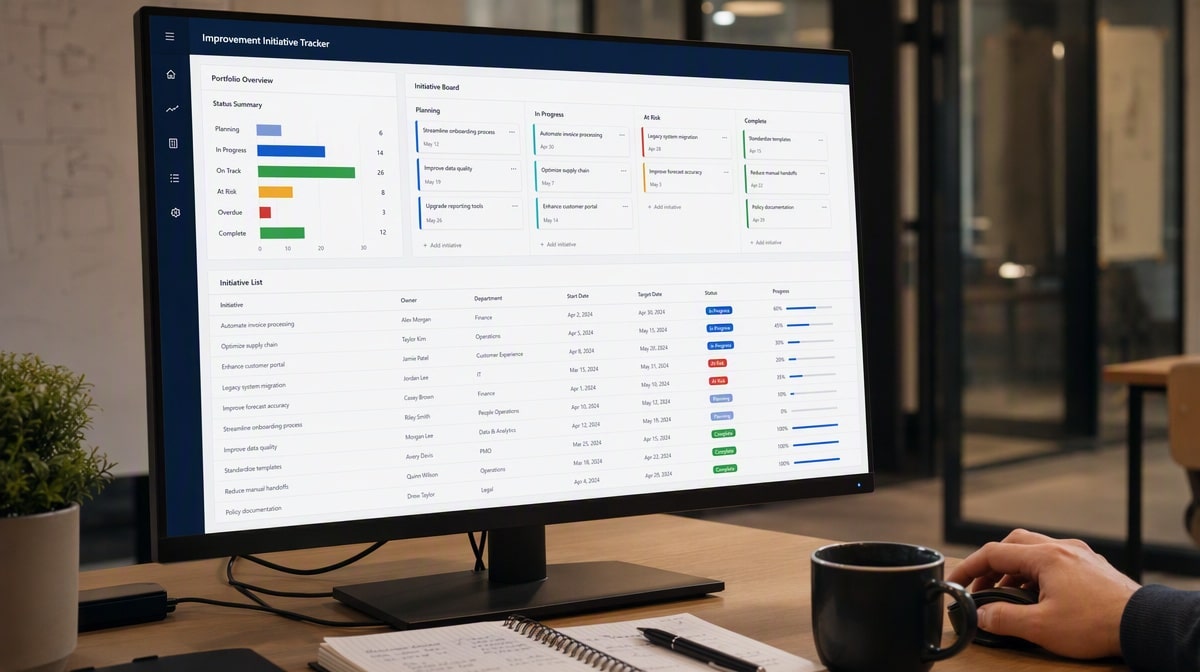
The following examples are the initiatives that come up most often in small and mid-sized businesses. Each one is stated the way it should appear on a plan: a specific process, a specific change, and the result it is meant to produce.
1. Standardize a Process That Three People Run Three Ways
Pick a recurring process where output quality depends on who happens to run it, document the best current method, and train everyone to it. Standardization is unglamorous and it is usually the highest-return initiative available, because variation is the source of most rework.
2. Cut Approval Layers Out of a Routine Transaction
Map every approval on a purchase requisition, expense claim, or discount request and ask what risk each one controls. Raise thresholds, remove approvals that duplicate a control applied elsewhere, and keep the ones that genuinely protect the business. Cycle time usually drops sharply.
3. Rebuild Employee Onboarding as a Defined Sequence
Replace the informal handover of a new hire with a defined sequence covering equipment, access, payroll, training, and the first review point. The measure is time to productivity and the number of items still incomplete after week one.
4. Reduce Order-to-Cash Cycle Time
Trace the time from the customer’s order to cash received and identify where it waits: credit checks, incomplete order data, invoicing delays, and dispute handling. Shortening this cycle improves cash position without any change to sales volume.
5. Eliminate Duplicate Data Entry Between Two Systems
Find the point where someone retypes data from one system into another, establish which system owns the record, and connect them or restructure the handoff. This removes both the labor and the transcription errors that generate downstream corrections.
6. Fix the Root Cause Behind a Recurring Customer Complaint
Take the single most frequent complaint category, trace it to the process step that produces it, and change that step. Complaint handling is a compensating activity; the initiative should target the process that creates the complaint, not the queue that absorbs it.
7. Shorten the Month-End Close
Sequence the close, identify which tasks are waiting on information rather than on effort, and move that information gathering earlier in the month. Most close cycles are long because of dependency timing, not because the accounting takes days.
8. Reduce Inventory Held Against Uncertain Demand
Review reorder points, lead times, and safety stock against actual demand variability rather than against habit. The initiative frees working capital and often exposes a supplier reliability problem that was being masked by stock.
9. Document Procedures for a Single Point of Failure
Identify a process that only one person can perform, document it to the point where a trained colleague could execute it, and prove that by having them do so. This is a risk initiative as much as an efficiency one.
10. Redesign a Handoff Between Two Departments
Sales to operations, operations to finance, and service to engineering are where work stalls. Define what information must accompany the handoff, who confirms receipt, and what happens when the package is incomplete. Most handoff failures are specification failures.
11. Introduce a Quality Check Earlier in the Process
Move an inspection or verification step upstream so defects are caught before further work is added to them. The cost of a correction rises the further it travels, so early detection reduces total effort even though it adds a step.
12. Automate a High-Volume, Rules-Based Step
Once a process has been simplified and stabilized, automate the repetitive step that remains: routing, notification, document generation, or data transfer. Automation belongs at the end of the improvement sequence, not the beginning, because automating an unnecessary step makes the waste permanent.
Notice the pattern across the list. Ten of the twelve remove, clarify, or resequence work before any technology is involved. That ordering is not an accident, and reversing it is the most common way an improvement program spends money without changing a result.
Which Process Improvement Methodologies Support These Initiatives?
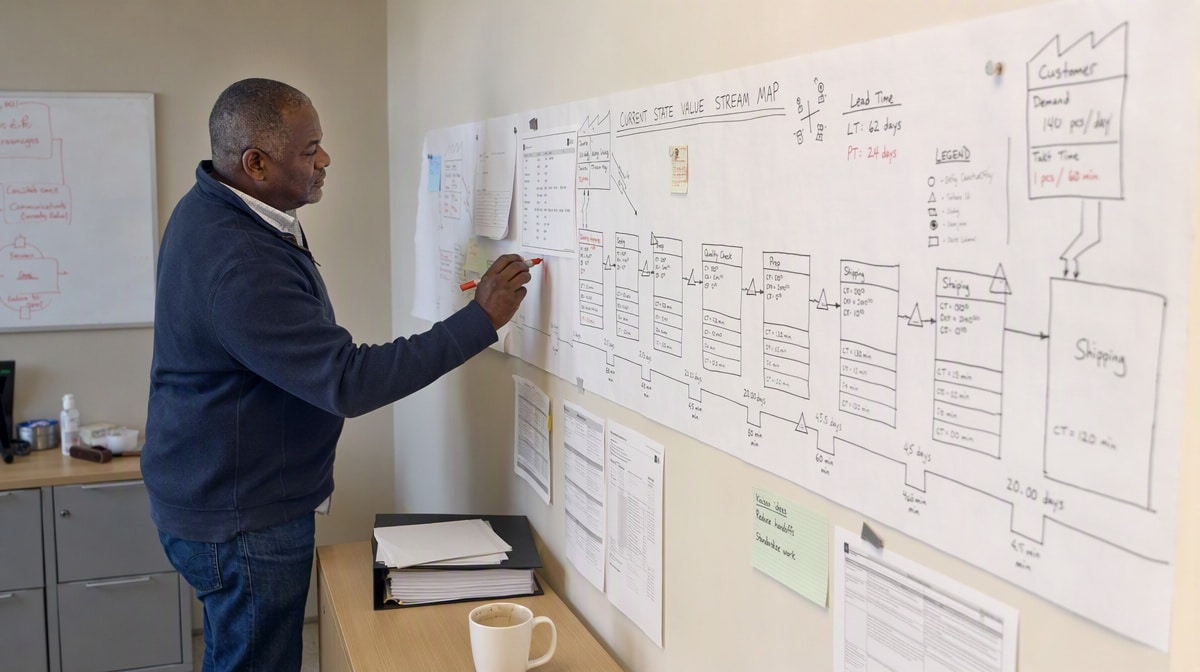
A methodology gives an initiative a structure for diagnosis and a discipline for evidence. None of them is mandatory, and adopting one wholesale is rarely the right first move for a smaller business. Borrow the tool that fits the problem.
Lean
Lean targets waste: waiting, overproduction, unnecessary movement, excess inventory, defects, over-processing, and unused employee capability. Its signature tool is value stream mapping, which lays out the whole flow and exposes where time is spent not adding value. The NIST Manufacturing Extension Partnership’s material on lean and process improvement is a useful public reference for how the toolset is applied in practice. For a fuller treatment of the philosophy, see what lean process improvement means in a business context.
Six Sigma and DMAIC
Six Sigma targets variation and defects using a statistical approach, structured through the DMAIC cycle: define, measure, analyze, improve, control. It suits processes with enough volume and data to support measurement, and it is heavier than most small-business initiatives need. The DMAIC sequence itself, however, is a sound skeleton for almost any initiative.
Kaizen
Kaizen is the practice of frequent small improvements made by the people who do the work, often run as a short focused event on a single process. It is the cheapest methodology to start and the one most dependent on management actually implementing what the team surfaces.
PDCA
Plan, do, check, act is a general-purpose improvement loop: plan the change, run it on a limited scope, check the result against the baseline, and either standardize it or adjust. It is the minimum viable structure for an initiative and it underpins most management system standards.
Theory of Constraints
This approach argues that a system’s throughput is governed by a single constraint, so improvement effort spent anywhere else produces no gain. Find the constraint, exploit it, subordinate everything else to it, then elevate it. It is a valuable corrective to programs that improve many steps and change no outcome.
Business Process Management
Business process management is less a fixing technique than an operating discipline: processes are documented, owned, measured, and reviewed on a cadence. It is what an organization uses to hold gains after the initiative team has moved on, and it is the reason some companies improve steadily while others improve in bursts and slide back.
How Do You Choose Which Initiative to Run First?
Most businesses have more candidate initiatives than capacity, and the selection decision does more to determine the result than the execution does. Score candidates rather than argue about them.
- Business impact: the size of the cost, delay, risk, or customer harm the process currently produces.
- Frequency: how often the process runs, because a small saving on a daily process beats a large saving on an annual one.
- Feasibility: whether the change is within the team’s control or depends on a system replacement, a supplier, or a regulator.
- Data availability: whether a baseline can be established without a measurement project of its own.
- Ownership: whether a named person will still be accountable for the process a year from now.
- Time to result: whether the first evidence arrives in weeks or in quarters.
For a first initiative, weight feasibility and time to result heavily. An organization that has never completed one needs a finished example more than it needs an ambitious target. Companies with clearly stated process improvement aspirations find this ranking easier, because the aspiration supplies the tie-breaker when two candidates score similarly.
How Do You Run a Process Improvement Initiative Step by Step?

The sequence below works for a single process at a small or mid-sized company. It is deliberately light. A heavier method is available if the process warrants one, but most initiatives fail from lack of follow-through rather than lack of rigor.
Step 1: Define the Problem and the Scope
Write down which process is in scope, where it starts, where it ends, what is explicitly excluded, and what problem the initiative is solving. A scope that is not written down expands, and an expanded scope is the most reliable predictor of an initiative that never finishes.
Step 2: Name the Owner and the Team
Assign one accountable owner, ideally the manager who will still run the process afterward, plus two or three people who actually perform the work. Improvement designed entirely by people who have never executed the process produces procedures nobody follows.
Step 3: Map How the Work Actually Moves
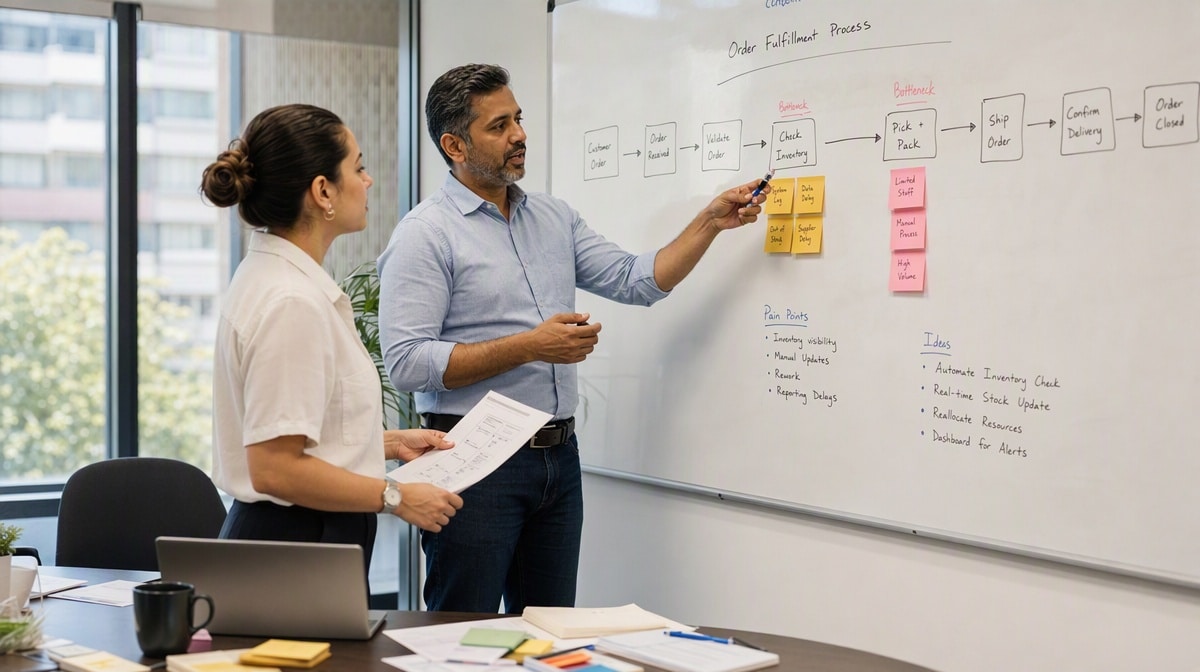
Map the current process from trigger to result, including the parts nobody wrote down: the workaround spreadsheets, the informal check somebody added after an incident, the email that has to be chased. The map should describe reality, not the procedure people believe they follow.
Step 4: Establish the Baseline
Record current cycle time, error rate, rework volume, labor hours, and exception rate before anything changes. Without a baseline the team will judge the new process by how modern it feels, which is not evidence. It is also worth agreeing at this point how much time process improvement will require from the people involved, because underestimating that is how initiatives quietly stall.
Step 5: Find the Cause Before Designing the Fix
Identify where the time, error, or cost actually accumulates and why. Ask why repeatedly until the answer names something the business controls. Teams that skip this step tend to implement the first solution somebody proposed in the kickoff meeting, and then discover the problem was elsewhere.
Step 6: Design the Change and Pilot It
Design the revised process, then run it on one team, one location, one product line, or one transaction type before the full rollout. Define the pilot’s duration, participants, measures, and the conditions that would stop it. A limited pilot surfaces design problems while they are still cheap to fix.
Step 7: Standardize, Document, and Train
Once the pilot holds, update the written procedure, the responsibilities, the training material, and the management reporting. Explain the problem the change addresses. Employees adopt a new method far more willingly when they can see which obstacle it removes.
Step 8: Hand Over and Close
Hand the improved process to its owner with the rules documented, the measures in the normal management review, and a date for the first check-back. Then close the initiative formally. An initiative that is never closed is never evaluated, and the organization learns nothing from it.
How Do You Measure Whether an Initiative Worked?

Measure the outcome the process exists to produce, not the volume of activity the initiative generated. Meetings held, maps drawn, and steps redesigned are effort measures, and effort measures reward motion. Use a balanced set and watch what happens upstream and downstream, because a faster step frequently just relocates a queue.
- Time: end-to-end cycle time, waiting time, and on-time completion against the baseline.
- Quality: error rate, rework, corrections, and complaints attributable to the process.
- Cost and effort: labor hours, overtime, transaction cost, and the running cost of any new tooling.
- Flow: queue size, work in progress, aging, and whether the bottleneck moved rather than disappeared.
- Exceptions: the volume and categories of cases the new process does not handle cleanly.
- Control: missing approvals, policy exceptions, and audit findings.
- Adoption: the proportion of work that actually runs through the new method.
Adoption and exceptions are the two measures most often omitted and the two most diagnostic. A revised process that carries seventy percent of volume while an unmanaged manual path absorbs the rest has not improved anything; it has split the process in two. Check again at three months and at a year, because early gains fade once attention moves on.
Why Do Process Improvement Initiatives Fail?
The failure patterns repeat across industries and company sizes, and most of them are matters of discipline rather than expertise. The uncomfortable finding is that failure often arrives after the initiative appears to have succeeded.
Harvard Business Review’s account of making process improvements stick reports a study of 204 lean projects at a European bank in which only about a third of the projects had held their gains two years later. The improvements were real at the point of delivery. What was missing was the management attention that keeps a new method in place once the project team disbands.
- No baseline: nobody can demonstrate whether the change helped, so the result becomes a matter of opinion.
- Scope creep: the initiative grows until it is a transformation program with no delivery date.
- Solution first: a fix is chosen in the kickoff meeting and the diagnosis is fitted to it afterward.
- No owner after go-live: the project ends and nobody is accountable for the process.
- Excluding the people who do the work: the redesign misses the exceptions that make up a third of real cases.
- Improving a step that is not the constraint: local efficiency rises and total throughput does not move.
- Leading with headcount savings: guaranteeing that the people who understand the process best will not help you improve it.
- Automating before simplifying: making an unnecessary step faster instead of removing it.
- Never updating the documentation: the new method exists only in the memory of the people who attended the training.
- No review cadence: the process drifts back as staff, systems, and volumes change.
How Do You Turn Initiatives Into Continuous Improvement?
A single initiative fixes one process. A business that improves reliably has turned the initiative into a repeatable habit, which requires four things: a backlog, a cadence, an owner for every process, and a management review that looks at process measures rather than only at financial results.
Keep a Live Backlog
Maintain a visible list of candidate initiatives with their source, estimated impact, and owner. The backlog turns the annual scramble for improvement ideas into a standing queue, and it gives employees somewhere to put an observation that would otherwise be lost.
Run a Fixed Cadence
Commit to a small number of initiatives per quarter rather than a large number per year. A steady cadence builds the internal skill, and it keeps improvement work from being the first thing sacrificed when the operation gets busy. Executives who understand continuous process improvement tend to protect that cadence deliberately, because they have watched it disappear before.
Give Every Core Process an Owner
Name the person accountable for each core process, not just for each project. The owner maintains the procedure, watches the measures, handles exceptions, and raises the next initiative when the numbers drift. Processes without owners degrade quietly.
Review Process Measures, Not Only Results
Put cycle time, error rate, exception volume, and adoption on the management review agenda alongside revenue and margin. Financial results tell you that something is wrong several weeks after the process told you. Reviewing both is what converts a series of initiatives into an operating capability.
Handled this way, process improvement stops being an occasional project and becomes part of how the business is managed: notice the signal, scope the initiative, measure the baseline, find the cause, pilot the change, standardize what works, and hand it to an owner who will keep it. The improved method should end up easier to follow than the workaround it replaced, and the evidence that it still performs should be available without anyone having to go looking for it.
Frequently Asked Questions
What Is an Example of a Process Improvement Initiative?
A typical example is reducing the number of approvals required on a routine purchase requisition, with a named owner, a documented baseline cycle time, and a target reduction agreed in advance. Other common examples include standardizing a process that several people run differently, rebuilding employee onboarding as a defined sequence, and removing duplicate data entry between two systems.
What Are the Five Key Elements of Process Improvement?
The five elements common to every credible initiative are a defined scope, a named owner, a measured baseline, a diagnosed root cause, and a standardized method that is documented and reviewed after the change. An initiative missing any one of them tends either to stall or to lose its gains within the first year.
How Long Should a Process Improvement Initiative Take?
A single-process initiative in a small or mid-sized business should usually produce its first measured result within one quarter, including a pilot. Efforts that stretch beyond that are generally suffering from scope creep rather than from genuine complexity.
Who Should Lead a Process Improvement Initiative?
The owner should be the manager who will remain accountable for the process after the initiative closes, supported by two or three people who actually perform the work. External facilitators can help with method and analysis, but they should not hold the accountability.
How Do You Know Whether a Process Improvement Initiative Worked?
Compare performance against the documented baseline using cycle time, error and rework rates, labor hours, queue aging, exception volume, and adoption. Re-check at three months and at one year, because improvements frequently fade once management attention moves elsewhere.