How to Create an Effective Policy Procedure Manual

An effective policy procedure manual is clearly written, easy for employees to understand, and practical to use during real work. Its objective is to improve efficiency, establish business controls, preserve knowledge, and help people follow the requirements that apply to their roles.
A manual fails when employees cannot find the right procedure, understand the instruction, or tell which version is current. The strongest manuals solve those problems through reader-centered procedure writing, logical organization, clear ownership, training, and document control.
What Makes a Policy and Procedure Manual Effective?
There are many procedure-writing reasons, but the most important rule is simple: clarity and readability are much more important than style, perfect grammar, or a large vocabulary. The manual should help a person complete a task correctly without guessing what the writer meant.
That does not mean every organization needs the same amount of documentation. ISO guidance says the amount and detail of documented information should fit the organization, its processes, and the competence of the people doing the work. The documentation should support effective process operation and control, not become a system of documents that exists for its own sake. Review ISO guidance on documented information.
Procedure Writing
The procedure writer must put themselves in the position of the users at all times. Before drafting, identify who performs the work, what they already know, which decision points create risk, and what evidence shows the task is complete. If the process is difficult to explain, first simplify complex processes and then document the stable sequence.
Develop manual review criteria so procedure documents remain consistent and correct. The National Archives describes plain language as clear, concise, organized, and appropriate for the intended audience. Its guidance also recommends active voice and the use of headings, lists, and tables to make reading easier. See the plain-language principles.
- Explain new or unusual terms the first time they are used, or include them in a definitions section.
- Avoid jargon wherever possible, especially when training new employees.
- Avoid unneeded words that do not change the instruction.
- Avoid complex writing. Understanding is more important than showing the writer’s vocabulary.
- Use active verbs instead of passive phrases, and name the role responsible for each action.
- Write the way people speak at work, while keeping the instruction precise and professional.
The CDC Clear Communication Index applies the same ideas through a practical review: identify the primary audience and main message, use active voice and familiar language, and organize information with lists, chunks, and headings. Use the CDC clarity review as an additional check when a procedure must serve readers with different levels of experience.
Use Inclusive, Role-Based Language
Use language that includes every person who may perform the work. Singular they is a gender-neutral choice when a person’s gender is unknown or irrelevant. Review inclusive-language guidance. You can also recast sentences around a position or title, such as Applicant, Manager, Accountant, or Driver.
Role-based wording is usually more operational than a generic pronoun because it identifies responsibility. For example, write, “The Manager approves the request,” rather than, “It should be approved.” When writing business policies and procedures, use the same role name throughout the policy, procedure, forms, and training materials.
Number Usage in Your Procedures
Procedures often include dates, measurements, times, percentages, and numbered steps. Choose a house style and apply it consistently instead of treating one convention as universal. The NIH Style Guide, for example, generally spells out one through nine and uses numerals for 10 and above. Review the NIH numeral convention.
- Do not begin a sentence with a numeral. Rewrite the sentence or spell out the number.
- Use numerals for dimensions, decimals, times, and other values that employees must scan quickly.
- Place a zero before a decimal less than one, such as 0.5 percent.
- Use the same date and time format throughout the manual.
- Write percent as a word or use the symbol consistently under your chosen style.
How Should You Organize Policy and Procedure Ideas?
To help the procedure writer formulate and organize ideas for developing policy and procedure statements, outline the material before drafting. Outlining is a fast way to show a large amount of information in a concise form and expose missing decisions before they become gaps in the final manual.
Well-written policy and procedure statements should flow in a cohesive and logical sequence. A simple process map can show handoffs, approvals, alternate paths, and records before the writer converts the process into ordered instructions. For a deeper structural review, see how to structure a policy and procedure manual.
Plan Each Policy and Procedure Statement
Define the following areas before writing. Begin with five planning questions, then add ownership and review fields that turn the outline into a controlled working document.
- What is the objective of the policy and procedure statement?
- What is the company’s policy on this matter?
- Who does the business policy affect?
- Under what conditions is the policy or procedure appropriate?
- How will the objective be accomplished? Outline the major areas step by step in chronological order.
- Who owns the document, who approves it, and who may request a change?
- What version is current, and when will the organization review it again?
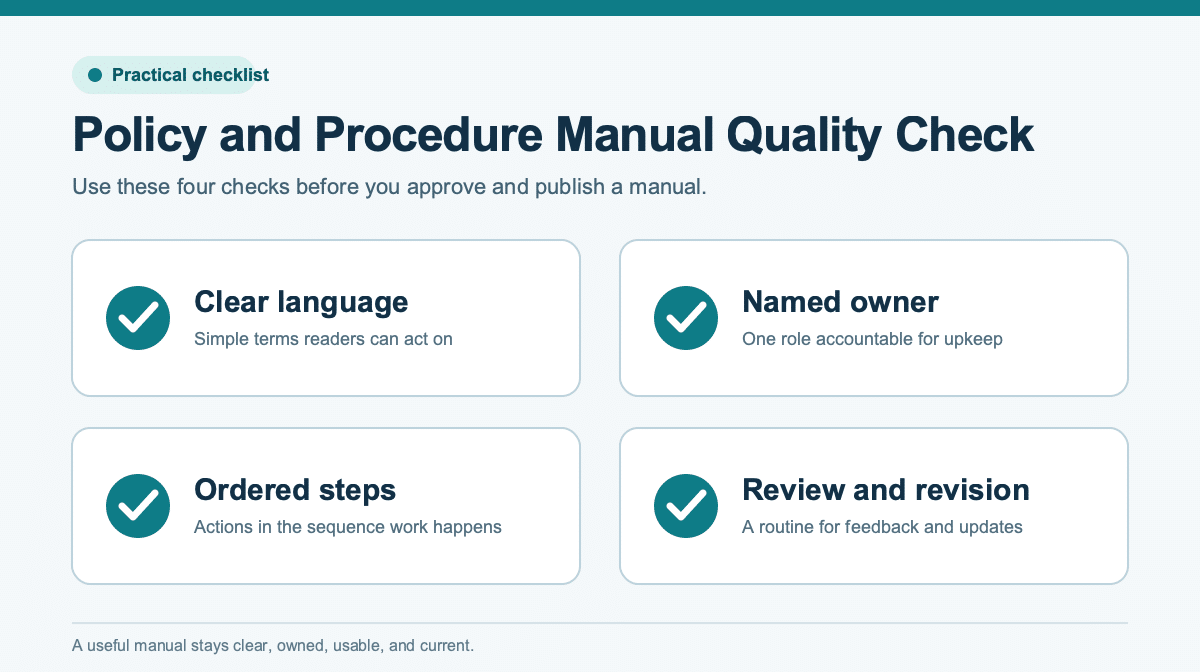
Practical review asset: use this list as a policy and procedure manual planning checklist. A draft is ready for employee review only when its purpose, audience, owner, ordered steps, approval path, version, and review date are clear.
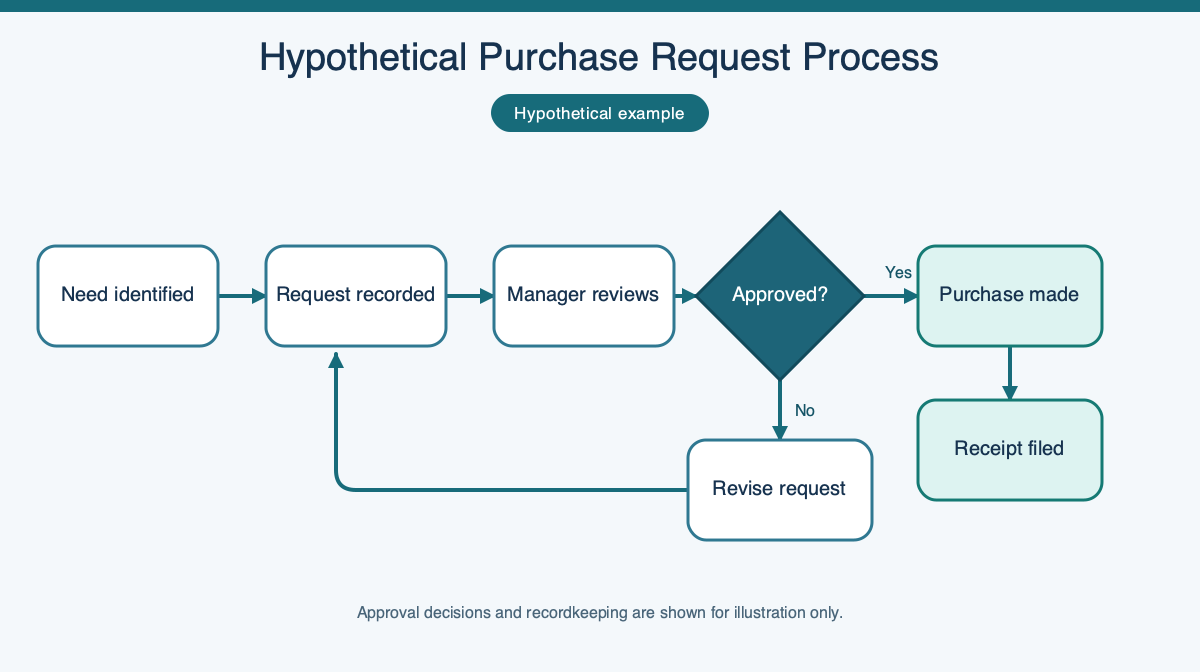
The process map above is a hypothetical example. It shows how a decision can return a request for revision instead of hiding that branch inside a long paragraph.
Procedure Outlining
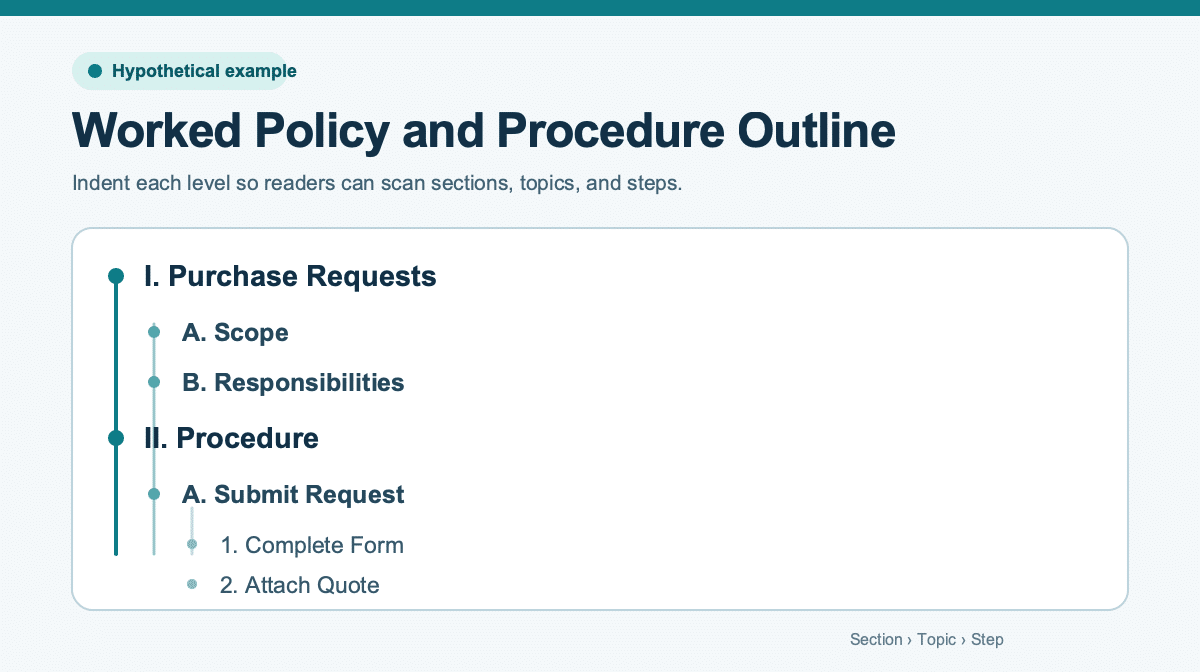
There are basic rules for effective and consistent procedure outlining. The hierarchy should make the relationship between policy, responsibility, and action obvious. A traditional four-level outline uses Roman numerals, capital letters, Arabic numerals, and lowercase letters:
- I. Major section
- A. Policy or responsibility
- 1. Ordered procedure step
- a. Supporting detail
There should be at least two items at a level when you subdivide it. Do not create an A without a B or a 1 without a 2. Keep indentation and punctuation uniform, but do not let formatting distract from the task sequence. The outline should mirror the order in which employees perform the work and should expose every important decision point.
Avoid Procedure Problems
If colleagues do not know that procedures exist, or if employees do not use the existing procedure, there is usually room for improvement in writing, communication, or document control. Ask what makes good procedures, then diagnose the specific failure instead of adding more pages.
Poorly Written Procedures
Procedures may be too long, confusing, difficult to use, poorly written, lacking verb power, or inaccurate. Employees ignore such procedures for good reason. Repair them by shortening the path to the task, naming the responsible role, using active verbs, testing the steps with a user, and correcting any result that differs from actual practice.
Poor Procedure Communication
Training and auditing methods may not create enough awareness. Procedure training should explain why a procedure matters, how employees find it, how they request a correction, and which business processes it supports. Ask employees to perform the task from the written procedure and validate written procedures through observation and feedback.
Poor Document Control
Without a reliable system to manage documents, people may use an obsolete copy or ignore the manual. Good procedure document control should help employees find the current version, identify its owner and approval, understand what changed, and retrieve required records. It should not add another bureaucratic maze.
ISO’s release notice for ISO 10013 explains that documented information can preserve organizational knowledge and support the operation of processes. It also recognizes electronic media and modern controls rather than prescribing one fixed hierarchy. Read the ISO 10013 release notice. A controlled system such as OnPolicy document management is one option, while a smaller organization may use a carefully managed shared repository. The control method should fit the risk and complexity of the process.
Create an Effective Policy Procedure Manual
An effective policy procedure manual is clearly written, easily understood by employees, and connected to the way work is actually performed. Start with the objective and affected roles, arrange the major areas in chronological order, review the instructions with users, train the people who rely on them, and control the current version.
Clarity and readability remain more important than style, perfect grammar, or a large vocabulary. Use the checklist and worked examples in this article to review one procedure at a time. You can also explore policy and procedure manual templates or download Free Policies and Procedures to see how editable Microsoft Word templates organize common manual sections.
Frequently Asked Questions
How often should a policy and procedure manual be reviewed?
Set a review interval based on process risk, change frequency, and applicable requirements. Review a procedure sooner when the work changes, an audit finds a gap, an employee reports that the steps are inaccurate, or a related requirement changes.
Who should own and approve manual updates?
Assign a document owner who understands the process and an approver with authority over the policy or control. Employees who perform the work should review the steps for usability, but the owner and approver remain accountable for the released version.
How do you make sure employees use the current procedure?
Maintain one controlled source, show the version and approval status, remove obsolete copies from points of use, and tell affected employees when a revision is released. Training and periodic observation confirm that the published procedure matches actual work.