How Do You Conduct a SWOT Analysis with Proper Example?

As a business owner, you may have work-related thoughts competing for attention at the same time. A SWOT analysis gives those thoughts a clear structure by separating your business’s strengths, weaknesses, opportunities, and threats. The result is a practical view of where the business stands and which strategic goals deserve attention first.
To conduct a SWOT analysis, gather internal and external evidence, bring a diverse team together, place the findings in a four-quadrant SWOT diagram, consolidate repeated points, and turn the highest-priority findings into owned actions. The chicken farm business example below shows how to move from observations to decisions.
How to Execute the Perfect SWOT Analysis (With Examples)
A SWOT analysis gives you a holistic overview of your business. This overview is useful for growth because you need to understand the present situation before you can create goals for the future. You do not have to be at a crossroads or trying to save a struggling small business. Review the analysis whenever important assumptions, resources, competitors, customer needs, or market conditions change.
What Is a SWOT Analysis?
A SWOT analysis is the process of organizing, analyzing, and acting on your business’s strengths, weaknesses, opportunities, and threats. Strengths and weaknesses are internal factors, which means your business can usually influence or control them. Opportunities and threats are external factors, which means the business can prepare and respond but cannot control the underlying force.
The University of Kansas Community Tool Box describes SWOT as a way to explore both internal and external factors and use that fuller view for strategic planning and decision-making. The distinction matters. A weak internal process requires a different response from a new competitor, economic shift, or regulatory change.
For example, customers leaving for a competitor is an external threat. This can matter to a B2B ecommerce business with long-term or contracted customers, but the customer mix differs by company. You cannot control a customer’s decision. You can still improve your response through better products, clearer positioning, and appropriate methods of customer service.

Conducting the Perfect SWOT Analysis
The aim of a SWOT analysis is to create a basis from which you can make strategic changes. It is a form of situational analysis that helps you identify useful capabilities, exposed weaknesses, promising openings, and dangers that need a response. The analysis should lead to choices, not remain a list that looks complete but changes nothing.
Compare strengths and weaknesses with opportunities and threats instead of reviewing each quadrant in isolation. This comparison shows which capabilities can help you capitalize on an opening, which weaknesses increase exposure to dangers, and which concerns could weaken your competitive advantage. Rank the resulting issues by operational impact, evidence, urgency, and the business’s ability to respond.
The Situational Analysis Procedure provides a structured way to examine how a company interacts with its business environment. The original procedure preview remains available as a reference.
Step 1: Gather Internal and External Evidence
The first step in conducting a SWOT analysis is to gather data or business intelligence from internal and external perspectives. For strengths and weaknesses, speak with employees and customers. Use conversations, surveys, interviews, operating measures, financial results, quality records, and recurring customer feedback to understand internal operations.
Gauging a holistic understanding of your business requires widespread research. Through conversations, surveys, and interviews, ask employees and customers which internal operations work well and which create friction. Differentiate between evidence and assumptions so the group can build strategic goals from a well-rounded view rather than from the loudest opinion.
For opportunities and threats, research beyond your immediate team and customers. Look for local, national, or global trends, then focus on the developments that could affect your industry. The U.S. Small Business Administration recommends examining market conditions, strengths and weaknesses, and the threat of new competitors or services when planning a business. National reports, supplier changes, customer behavior, legislation, and competitor activity can all help you test assumptions. A PEST analysis can provide another structure for political, economic, social, and technological forces.
Step 2: Build the SWOT Diagram With a Diverse Team
The second step is to put the evidence into a SWOT diagram. Select a team of people to meet and share observations. Go beyond the executives. Include people who work directly with customers, suppliers, operations, finance, and delivery so the diagram reflects multiple perspectives.
Capture enough points to represent the situation, then combine duplicates and remove vague statements. If you have “great customer reviews” and “hold on to long-standing customers” in the strengths section, summarize them as “good reputation with customers.” A concise matrix makes it easier to compare the four quadrants and decide what matters most.
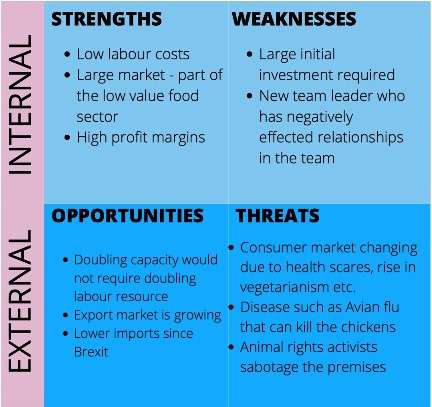
The original chicken farm business SWOT diagram illustrates the four quadrants. The worked example below carries that distinctive scenario forward in a more accessible action format. The observations are hypothetical and should be replaced with evidence from your own business.
Chicken Farm SWOT-to-Action Example
| SWOT category | Hypothetical observation | Why it matters | Next action | Owner | Review point |
|---|---|---|---|---|---|
| Strength | Good reputation with local customers | Trust can support repeat orders and referrals | Document the service practices customers mention most often and use them consistently | Sales manager | Next monthly sales review |
| Weakness | Limited cold-storage capacity | Capacity can restrict delivery volume during busy periods | Measure lost or delayed orders and compare rental, process, and equipment options | Operations manager | After four weeks of order data |
| Opportunity | Growing interest from nearby restaurants | A concentrated buyer group may support a new sales channel | Interview five restaurant buyers and test one small delivery route | Business owner | After the pilot route |
| Threat | Feed-cost volatility | Input changes can reduce margin | Track feed cost per unit, identify substitute suppliers, and set a margin trigger for pricing review | Finance lead | At each monthly close |
Questions to Ask While Conducting a SWOT Analysis
Use the following questions to brainstorm and test the evidence in each quadrant. The goal is not to fill every line. It is to surface the few conditions that can materially change a decision.
Use the SWOT Analysis Worksheet Template to record evidence and compare the four quadrants. The original worksheet preview remains available as a reference.
Strengths
- What are the advantages of your products and services?
- What experience does the business have?
- What advantages come from your geographical location?
- Which processes, skills, relationships, or resources are difficult for competitors to match?
Weaknesses
- Do you need to expand your team to gain more experience?
- Are there financial disadvantages or capacity constraints?
- What bad customer experiences occur repeatedly?
- Which process delays, skill gaps, or dependencies make the business vulnerable?
Opportunities
- Are there partnerships that deserve more investment?
- How could technological innovation benefit the business?
- Do political or regulatory changes open a useful path?
- Are customer needs, channels, or underserved segments changing?
Threats
- What would happen if the business lost a partner or supplier?
- Are new competitors entering the industry?
- Which policies could affect long-term costs?
- What market, staffing, technology, or concentration risks could disrupt the plan?
How to Use Your SWOT Analysis
Once you have the SWOT diagram, compare internal factors with external factors. Strengths and weaknesses describe present capabilities and constraints. Opportunities and threats describe outside conditions you can prepare for. Situational analysis adds value by bringing this information together and helping the organization evaluate and prioritize essential concerns.
Emphasize Strengths
Decide which strengths can support a current objective. If company culture is a strength, identify the behaviors that make it useful and consider how those behaviors could improve hiring, service, or marketing strategy.
Repair Weaknesses
Pick the most urgent weakness and act on it first. If productivity speed and communication in workforce management, or WFM, are both concerns, identify the bottleneck that causes the greatest operational consequence. Assign an owner, define a measure, and test one repair instead of assuming that a new system will solve the problem.
Capitalize on Opportunities
Prioritize the most tangible opportunity. Technological advancement may create an opening, but the opportunity belongs in the plan only when the team can explain the customer need, expected benefit, required investment, risk, and next test.
Respond to Threats
You may not control an external threat, but you can choose a response. If a competitor receives negative customer feedback, analyze the underlying problem rather than copying the competitor’s tactics. Then decide whether your business needs a preventive control, contingency plan, supplier option, customer message, or monitoring trigger.
Assign Owners and Review Points
For each selected action, record an owner, a first step, a measure, and a review point. Connect the resulting priorities to your management strategy. This turns the analysis into a short operating plan and makes it easier to revise assumptions when evidence changes.
Execute the Perfect SWOT Analysis
After the work of building a SWOT analysis, do not let it sit there and look pretty. Use the findings to create actionable initiatives and goals. Keep the diagram concise, preserve the evidence behind each point, and revisit the selected actions when conditions change. This is how SWOT can support decisions and increase business productivity without turning the exercise into an arbitrary checklist.
Frequently Asked Questions
What does SWOT stand for?
SWOT stands for strengths, weaknesses, opportunities, and threats. Strengths and weaknesses are internal factors, while opportunities and threats are external factors.
Who should participate in a SWOT analysis?
Include people with different views of the business, such as leaders and employees who work with customers, suppliers, finance, operations, and delivery.
How many items should each SWOT quadrant contain?
There is no required number. Capture enough evidence to describe the situation, combine duplicate points, and keep the final matrix concise enough to prioritize.
How often should a business update its SWOT analysis?
Update the analysis when an important assumption changes, such as a new competitor, customer shift, resource constraint, regulation, objective, or market condition.
What should happen after the SWOT matrix is complete?
Select the highest-priority findings, pair them with specific actions, assign owners, define measures, and set review points so the analysis becomes an operating plan.
Author bio: Grace Lau is the documented guest author of this article. Her original author portrait remains available with the article record. Her biography identifies her as Director of Growth Content at Dialpad, an AI-powered cloud communication platform for team collaboration. The biography states that she has more than 10 years of experience in content writing and strategy and is responsible for leading branded and editorial content strategies, partnering with SEO and Ops teams to build and nurture content. She has written for Zumvu.com and CrocoBlock. View her LinkedIn profile.