How to Increase Your Business Productivity

Consultants often improve business productivity by turning recurring work into clearly defined job tasks, work instructions, reports, forms, and job descriptions. The useful part is not the consultant’s binder. It is the repeatable operating system that helps employees know what to do, who owns the work, and what a good result looks like.
You can apply the same approach by documenting one important business process at a time. Start with work that causes delays, depends on one experienced employee, or produces inconsistent results. Then use a practical procedure template to capture the steps, decisions, records, and responsibilities needed to increase your business productivity.
There’s a Better Way to Productivity
Productivity is not simply asking people to work faster. A productive process makes the expected sequence visible, supplies the right inputs, reduces repeated explanations, and gives employees a clear standard for the finished work. That is why policies and procedures can be more useful than one-time advice: the organization keeps the instructions and can improve them as the work changes.
Reusable policy and procedure templates give you a structured starting point. They can reduce blank-page work, but they still need to be adapted to your roles, systems, risks, and approval rules. The goal is not to collect documents. The goal is to make recurring work easier to perform, teach, review, and improve.
Cover the Departments That Keep Work Moving
Business productivity depends on connected processes across the company. Start with the department where unclear handoffs create the most rework, then extend the same documentation method to other functions:
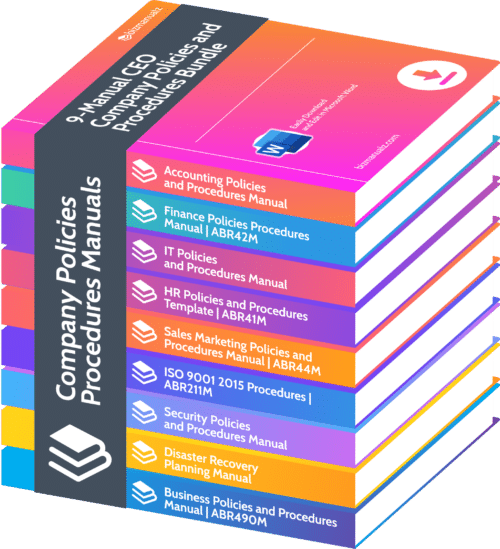
- Accounting Policies and Procedures for recurring controls and records;
- Finance methods and approvals;
- IT Policies and Procedures Manual for technology operations;
- Sales & Marketing processes;
- Human Resources work standards;
- Security Planning and protection;
- Disaster Recovery planning; and
- ISO 9001 2015 Procedures for a quality management system.

Increase Your Business Productivity One Process at a Time
Choose a process that is frequent, important, and frustrating. Observe how the work is actually completed before writing the ideal version. Ask the people who perform it where information arrives late, which decisions cause confusion, and which mistakes require the most rework.
Write the simplest complete procedure that another trained employee can follow. Identify the trigger, required inputs, numbered steps, decision points, expected output, records, owner, backup owner, and quality standard. Link supporting reports, forms, and checklists where the employee needs them. Then test the procedure during real work and revise unclear steps.
Clear procedures also help you effectively communicate management’s expectations. Employees can refer to the same approved method instead of relying on memory or different verbal instructions. Managers gain a practical basis for training, accountability, and process review.
Business Productivity Procedure Scorecard
Use this scorecard as a quick worked example. For one recurring process, mark each element Yes, Partial, or No. A process with several Partial or No answers is a strong candidate for documentation and testing.
| Procedure element | Question to ask | Example status |
|---|---|---|
| Documented steps | Can a trained backup follow the sequence without a verbal walkthrough? | Partial |
| Named owner | Is one role accountable for keeping the process current? | Yes |
| Required inputs | Are the forms, data, approvals, and tools identified? | No |
| Expected output | Does the procedure define what completion looks like? | Yes |
| Quality standard | Can an employee check accuracy before handoff? | Partial |
| Backup coverage | Can work continue during an absence or vacation? | No |
| Review cadence | Is there a trigger or schedule for updating the procedure? | Partial |
Ways Policies and Procedures Produce Immediate Results
- Employees have something in writing to refer to when someone is ill, a new employee needs training, or another person temporarily fills the position.
- A documented process can help employees learn responsibilities beyond the job they are in now.
- Backup coverage can make it easier for employees to take vacation without leaving coworkers to reconstruct the work.
- Managers can check that every task at every position is covered consistently and tied to clear quality standards.
You can also look at the cost of not documenting a process. How much time is spent explaining unclear policies and procedures instead of completing other work? How many customer or sales problems begin with an unclear handoff? Where would an absent employee stop a critical task? Publishing approved policies and procedures in an accessible location helps employees find the current instruction when they need it.
The CEO Policies and Procedures System

The CEO Policies and Procedures System provides editable Microsoft Word policy and procedure templates across major departments. Use the relevant documents as a starting point, assign a process owner, and tailor each procedure to the way your organization actually operates.
A practical policy and procedure manual brings policies and procedures together with sample reports, forms, checklists, exhibits, job descriptions, and work instructions covering the major departments that participate in a process. These supporting documents help you clearly and effectively communicate management’s expectations for specific job tasks. Used as part of real training and review, they can reduce employee confusion, increase accountability, simplify training, and support consistent quality standards.
A structured template library can help you stop worrying about how to write your policy manual from a blank page, where to place responsibilities and controls, and how to keep related forms with the procedure. The same method can support an Employee Handbook, department manuals, training materials, and continuity planning.
- Use accurate wording that matches the approved process, systems, and responsibilities.
- Increase company efficiency while reducing common worker complaints about unclear ownership or instructions.
- Keep proper documentation and records available when auditors or regulators need evidence of how work is controlled.
- Coordinate an Employee Handbook with health insurance and benefit programs, disciplinary actions, interview questions, and hiring and firing policies.
- Document how to protect assets, information, and employees from disasters or physical harm through the appropriate security and recovery procedures.
Begin with one high-friction process. Complete the scorecard, document the work, test it with a backup employee, and correct the unclear steps. That cycle turns policies and procedures from static files into a practical system for increasing your business productivity.