Hiring External Sales Reps: Procedures for Outside Sales Representation

External sales reps can extend your reach into new territories, channels, and customer accounts, but outside sales representation creates risk when goals, authority, compensation, and reporting are not documented. The representative speaks for your business, so a vague arrangement can produce inconsistent messages, disputed leads, poor handoffs, or activity that does not fit your sales process.
Before hiring sales representation, write a clear brief, ask every candidate to respond with an implementation plan, compare proposals against the same criteria, and put the agreed operating terms into a contract. Then provide training, approved sales materials, CRM access, escalation rules, and a regular performance review process.
What Is Outside Sales Representation?
Outside sales representation means using an individual representative or an external sales company to sell, develop accounts, or represent your brand outside your internal sales team. The arrangement may cover a defined territory, channel, customer group, product line, or campaign. It can supplement employees or provide a dedicated route to market, but it does not remove your responsibility to define the work and oversee the relationship.
Decide at the start whether the role is intended to be an employee position or an independent service arrangement. In the United States, the label in a contract does not decide worker status. The IRS worker-classification guidance says businesses must consider behavioral control, financial control, and the type of relationship, then weigh the full set of facts. State and local tests may differ, so obtain qualified advice for the jurisdictions involved.
The Brief for Outside Sales Representation
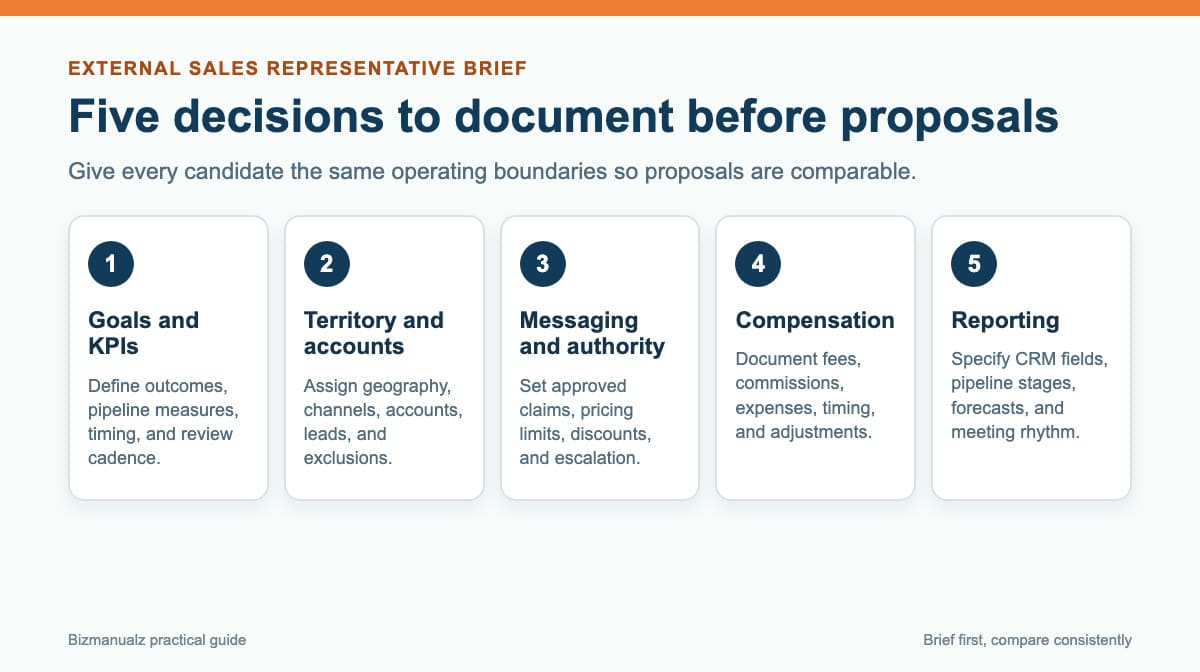
When hiring sales people or anyone to represent your business and brand, begin with a written brief. This serves much the same purpose as a job description for employees, while also defining the boundaries of an external service. You may be hiring an individual or a team of sales people, but every candidate should receive the same information so proposals are comparable.
Start with the responsibilities in your Sales Hiring Procedure and Sales Representative Job Description, then adapt them for an outside representative. The brief should identify the target customer, offer, sales process, expected activities, account ownership, authority limits, reporting cadence, and the resources your company will provide.
You need solid procedures in place before outside representatives begin work so they can coordinate efficiently and effectively with internal team members and represent your brand well. The job description should include enough detail for a representative to understand what success means, what they can decide, and when they need help.
Sales Goals and Expectations
Define the goals and objectives you expect the external sales reps to pursue. Include the time frame, sales or pipeline measures, customer-quality requirements, and the evidence that will be reviewed. Separate leading indicators, such as qualified meetings and complete CRM records, from lagging results, such as revenue or retained accounts.
Sales Territories and Limitations
Specify the territories, channels, named accounts, and product lines the representative may cover. Document what is off limits, who owns existing leads, how duplicate opportunities are resolved, and whether the representative may work for competitors. Sales people also need a clear view of your competitive landscape so they can position products and services without making unsupported claims.
Sales Tactics and Approved Messaging
Describe the pricing strategies, target market, approved messages, proof points, and approval limits. Include details on the specific tactics you wish to use within your business and make salespeople well aware of what is off limits. Your sales and marketing pipeline may include cold calling, door-to-door selling, trade shows, referrals, channel partners, or account development. Before authorizing a tactic, identify the audience, technology, and jurisdictions involved. The FTC Telemarketing Sales Rule guide explains that some business-to-business calls are exempt from parts of the federal rule, while other calls, disclosures, records, and prohibitions may still apply.
Company Representation Rules
Spell out the rules for representing your company. Cover acceptable communication, business etiquette, use of trademarks, approved claims, discounts, warranties, commitments, and situations that require escalation. Link these requirements to your Sales and Marketing Procedures so the representative can find the current source of truth instead of relying on memory.
Motivation, Compensation, and Expenses
Choose incentives that support the behavior and outcomes you need. Document base fees, commission, bonuses, payment timing, chargebacks or adjustments, reimbursable expenses, and the records required for payment. The Sales Compensation Procedure can provide a starting point, but the external agreement should reflect the actual scope and relationship.
Reporting and Key Performance Indicators
Define the CRM fields, pipeline stages, forecast definitions, activity records, and meeting rhythm the representative must follow. Assign an internal owner to review KPIs, unblock decisions, and correct data-quality problems. A Sales Management Procedure can help connect outside activity to the same review process used for your internal sales team.
How Hiring Sales Representation Works
The first step is to seek proposals from suitable companies or go to tender for a larger engagement. Some sales representation companies use a standard operating model, while others customize their services. Ask each candidate to take the brief and present a plan showing how the work will be implemented, staffed, measured, and handed back to your company.
Depending on the sales company you hire, it may have its own set of policies and procedures it will not deviate from, while other providers will customize services to suit your specific needs. The important part of the hiring process is to find the best possible match. When reviewing proposals, ensure each candidate presents a solution based on your product or service offerings, customer profiles, and potential marketplaces. Both parties should be confident in the plan, while recognizing that no plan guarantees results.
Compare Proposals With a Scorecard
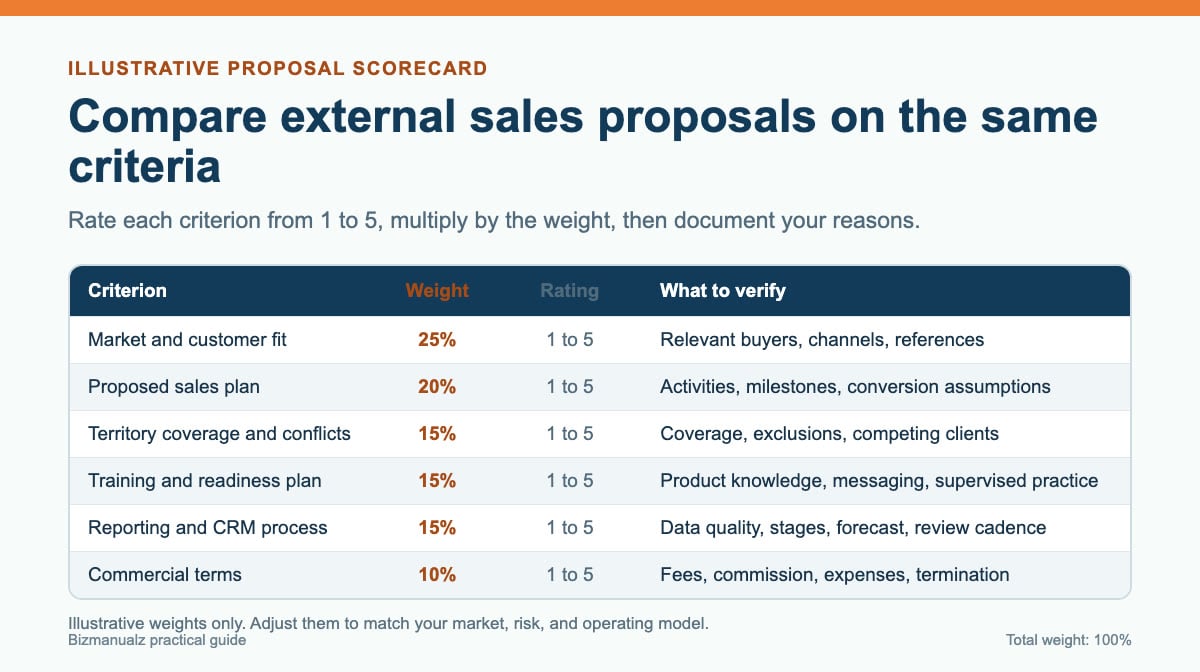
Review every proposal against your product or service offering, customer profiles, potential marketplaces, sales process, and internal capacity. The illustrative scorecard below uses six criteria. Rate each criterion from 1 to 5, multiply the rating by the weight, and record the evidence behind the score. Adjust the weights before proposals arrive so they reflect your priorities rather than a preferred vendor.
| Criterion | Weight | What to verify |
|---|---|---|
| Market and customer fit | 25% | Relevant buyers, channels, and references |
| Proposed sales plan | 20% | Activities, milestones, and conversion assumptions |
| Territory coverage and conflicts | 15% | Coverage, exclusions, and competing clients |
| Training and readiness plan | 15% | Product knowledge, messaging, and supervised practice |
| Reporting and CRM process | 15% | Data quality, stages, forecast, and review cadence |
| Commercial terms | 10% | Fees, commission, expenses, and termination |
Check Specialization and Conflicts of Interest
Many sales representation teams specialize in a specific niche. Industry knowledge and connections can shorten the learning curve, but specialization can also create a conflict of interest if the firm already represents a direct competitor. Ask for relevant references, current client categories, territory overlaps, exclusivity requests, and a written method for identifying and managing conflicts.
Document the Operating Agreement
When the final decision is made, ensure contracts are put in place so the arrangement is well documented. The contract should outline scope, territory, account and lead ownership, compensation, expenses, pricing authority, training requirements, reporting, confidentiality, data access, intellectual property, conflicts, termination clauses, and transition duties. Protect your own interests from a legal standpoint and use a lawyer or tax expert familiar with the field and jurisdictions involved. The IRS type-of-relationship guidance notes that contract wording alone is not sufficient to determine worker status, so confirm that the agreement and day-to-day practices are consistent.
How Should You Onboard and Manage External Sales Reps?
Training and Support
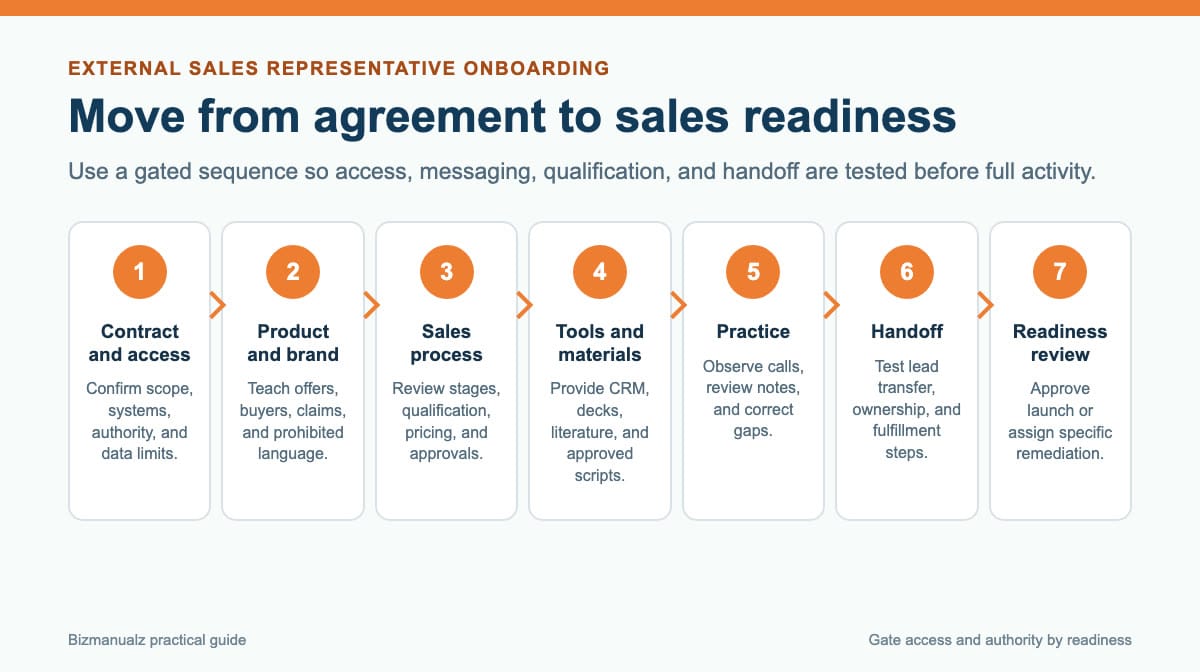
An experienced specialist sales representative should be well versed in general principles of sales and service, but they will not have the same knowledge of your products, services, terminology, culture, and fulfillment process. Each Sales Rep should receive adequate training and become familiar with the sales process before moving forward. Provide documented policies and procedures, then test understanding through message practice, supervised calls, CRM review, and a readiness decision. This supports a smooth handover from sales to fulfillment. A Sales Training Procedure can help you define the sequence.
Sales Materials and Resources
To function effectively, external sales reps need appropriate tools and resources. These may include presentation materials, slide decks, CRM systems, product literature, sales process documentation, approved scripts, or videos in your sales funnel. Depending on the sales company, it may provide some of the required resources and request that you produce other resources. Do not assume anything. State which party provides each resource, who approves changes, where the current version is located, and what must be returned or disabled when the relationship ends.
Customer Data and System Access
Give each representative only the information and system access needed for the assigned work. It is important to have clear policies for storage so Sales Reps know where everything is located and private information remains secure. The FTC guide to protecting personal information recommends identifying who can access sensitive information and following the principle of least privilege. Document approved devices and systems, security expectations, incident reporting, record retention, and access removal. Review compliance instead of leaving external service providers to their own devices or assuming their procedures are sufficient.
Lead Qualification and Fulfillment Handoff
Define when a lead becomes qualified, what information must be complete, who accepts the handoff, and what happens when the receiving team rejects it. The Qualifying Leads Procedure can help establish common criteria. A tested handoff prevents misunderstandings and culture clashes further down the line.
Performance Review and Offboarding
Review activity, pipeline quality, conversion, forecast accuracy, customer feedback, and compliance at the cadence defined in the brief. Be prepared to test, measure, and tweak the approach so you can create incremental improvements in your sales process. If the relationship ends, transfer open opportunities, customer communications, records, and sales materials; revoke system access; confirm the return or destruction of protected information; and document any continuing obligations.
Outside Sales Representation
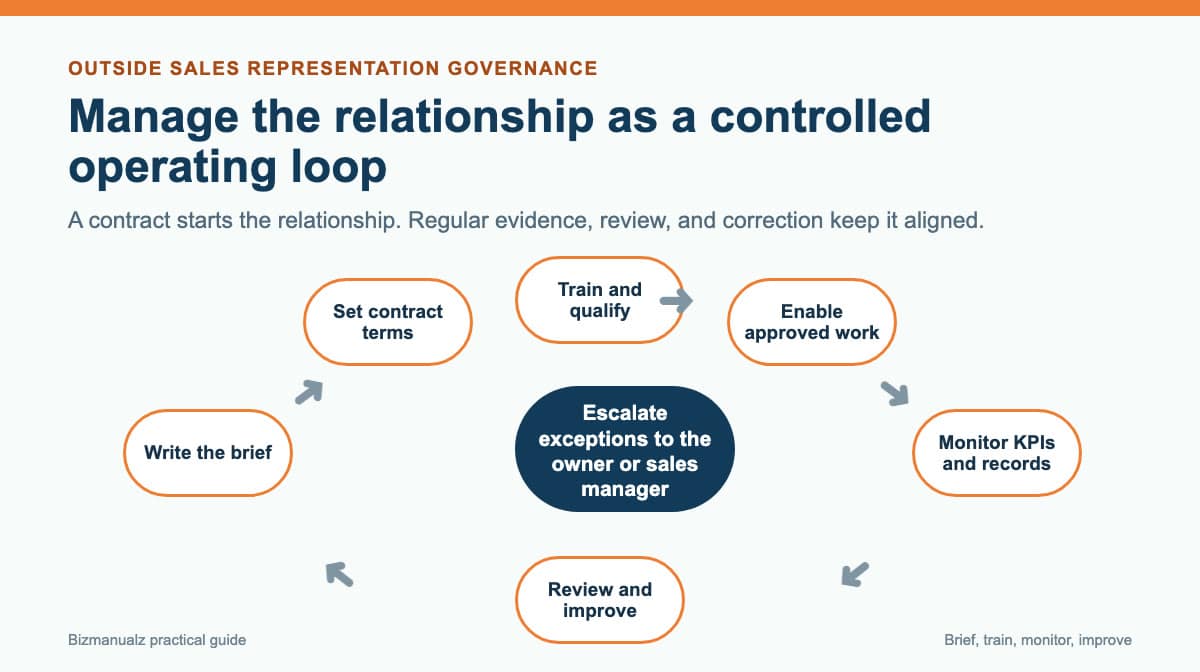
Outside sales representation can fit a business that needs specialized market access, territory coverage, or additional selling capacity, but the model still requires management. The strongest arrangements connect a clear brief, comparable proposals, documented terms, practical training, controlled access, and regular performance evidence.
External sales representatives will not begin with the same understanding of your company as an internal team. Give them the instructions and resources needed to represent your brand, define what they may decide, and make escalation easy when a potential customer asks a question they cannot address. These controls connect the representative to your broader sales and marketing cycle and support incremental improvement without promising results that the process cannot guarantee.