How to Grow Your Business in a Lean Way

Growing too slowly can starve a startup of momentum, but uncontrolled rapid startup growth can strain cash, people, and processes. Growing your business in a lean way means testing where work creates customer value, reducing waste, and adding capacity only when the evidence supports it.
The practical choices are not limited to cutting expenses. You need to decide what to keep in-house, when to automate, when to outsource, where culture deserves investment, and which marketing activities earn a larger commitment.
What Is a Lean Business Model?
A lean business model organizes work around customer value, continuous learning, and the removal of waste. The Lean Enterprise Institute defines lean as creating needed value with fewer resources and less waste. That makes lean thinking a process discipline, not a blanket instruction to spend less.
For a growing business, the goal is to understand which activities improve the product, service, or customer experience and which activities add delay, rework, confusion, or unnecessary overhead. A company can be frugal and still waste time. It can also invest more in a well-designed process and become leaner because the investment improves quality, flow, or learning.
If your startup did not begin with a lean method, you can still change how work is selected and improved. Start with one process, observe what happens, run a small test, measure the result, and decide whether to standardize the change. This reflects the Build-Measure-Learn emphasis described by The Lean Startup without assuming that any experiment guarantees success.
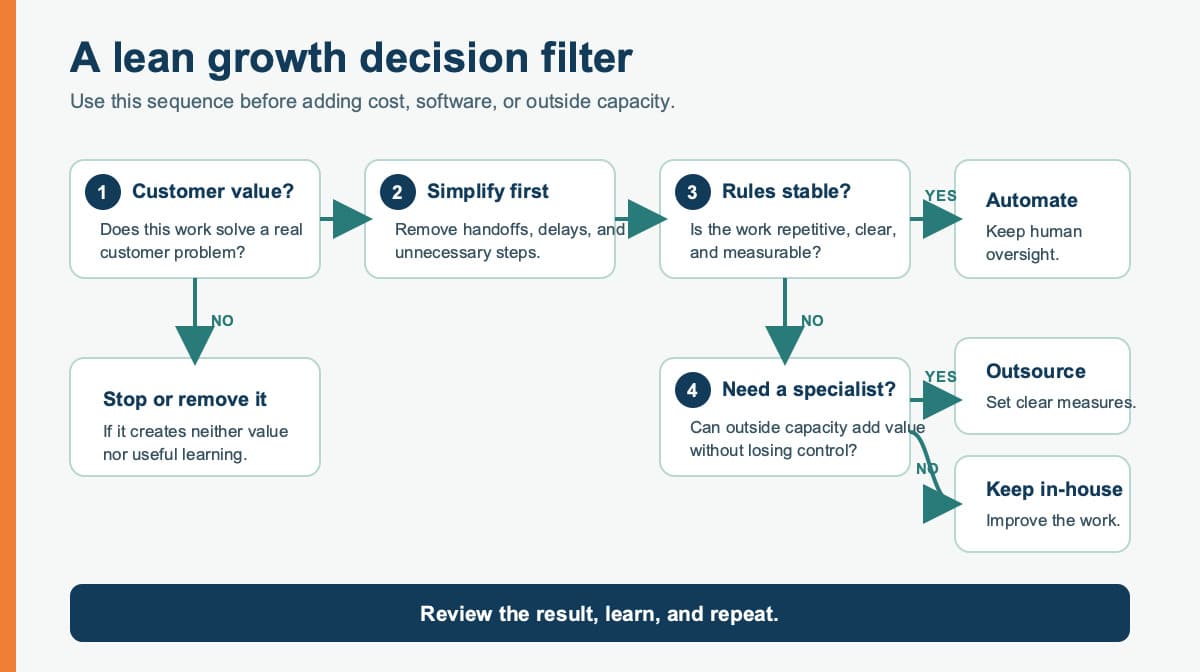
The decision filter is a practical sequence, not a universal rule. Stop work that creates neither customer value nor useful learning. Simplify a necessary process before adding technology or outside capacity. Automate stable, repetitive rules with oversight. Outsource when the process is understood and quality, timing, cost, and accountability can be measured.
How Can You Grow Your Business in a Lean Way?
There are many lean misconceptions. Staying lean does not mean refusing every expense or forcing every team to do more with less. It means making resource decisions deliberately, checking results, and improving the work before scaling it.
Try Before Outsourcing
Outsourcing can provide specialist capacity, but outsourcing a process you do not understand can create costly mistakes, unrealistic expectations, and heavy dependence on third parties. Try the work long enough to learn its inputs, exceptions, quality standard, and connection to the customer. Then use documented outsourcing best practices to define ownership and measures.
Conventional startups are often advised to outsource so they can focus on core business responsibilities and internal resources. Besides saving capacity, a specialist can bring useful experience. However, early offloading can easily lead to dependence on external forces when the business has not learned how to handle various tasks. Keep work in-house when it contains critical customer knowledge, frequent judgment, or an emerging capability your team needs to learn. Consider trying the work before offloading it, then outsource when the outcome is clear, service levels can be monitored, and an external specialist can add capacity without weakening control.
Automate Where Possible, With Oversight
Automation works best after the rules are stable. Look for repetitive, high-volume tasks with predictable inputs and outputs. Email routing, sales-process handoffs, client onboarding reminders, and calendar management can be reasonable candidates when exceptions are easy to identify.
Before you automate business processes, document the current method and choose a useful measure such as cycle time, error rate, completion rate, or staff time. Keep a person responsible for unusual cases. Extensive automation without ownership can make a weak process faster while hiding the cause of failure.
Prioritize Workplace Culture Over Flashy Perks
Free catered meals, office nap pods, music recording studios, and stocked bars can be appealing to job applicants, but they should not take priority over the daily conditions in which people work. A supportive community, opportunity to grow, flexibility, clear expectations, and consistent management practices are operating choices, not decorations.
SHRM guidance on workplace culture explains that culture is shaped through daily behaviors, procedures, leadership reliability, and accountability. A lean business should therefore test whether a proposed perk solves a real employee or business problem before accepting its recurring cash commitment.
Balance Durable Marketing With Measured Acquisition
Organic marketing and paid acquisition solve different problems. Useful content can become a durable owned asset, while paid campaigns can test messages or capture demand quickly. Neither channel is automatically lean. A channel is lean when the target customer, expected outcome, cost, feedback loop, and stopping rule are clear.
Google recommends creating helpful, people-first content for an intended audience rather than content made mainly to attract search visits. That guidance does not guarantee rankings, lead generation, or traffic. Treat each article or campaign as an investment to measure, improve, or stop.
How Do You Decide What to Change First?
Choose one process that is close to customer value and creates visible delay, rework, or frustration. Describe the current steps, identify one source of waste, and run the smallest safe change. The U.S. Small Business Administration explains that market research helps a business find customers and competitive analysis helps it identify an advantage. Use that customer evidence before committing to new capacity, a new location, or a larger marketing budget.
Measure the same indicators before and after the test. Useful indicators include customer response, cycle time, error or rework rate, cash required, and whether important learning remains with your team. If the result improves, document the new method and repeat the cycle. If it does not, reverse the test, record what you learned, and choose the next constraint.
Lean growth does not promise high profitability or seamless scalability. It gives you a disciplined way to meet changing customer needs, reduce unnecessary overhead, and add resources with clearer evidence.
What Do the Basic Principles Look Like in Practice?
For beginners, the basic principles are easier to apply when you focus on one operating problem at a time. An enterprise grows at a healthy pace when it can deliver optimized products and services without directing every resource and all of its energy toward growth alone. Lean business growth often involves shortening product and service development cycles to determine whether a business model is feasible before making a larger commitment. Entrepreneurs can introduce cost-effective measures through the development stages, but each measure should support customer value rather than simple cost cutting.
In an operational startup, lowering expenses and avoiding unnecessary financial activities can help, but those actions do not define the whole lean model. Focus your efforts on improving processes, handling arduous tasks, and building business efficiency through clear standards. Even if you did not start the company with a lean method in mind, you can choose what to automate, how much to automate, and when to automate. A controlled method keeps technical tasks in-house when they carry important knowledge and uses automation tools only after the work is understood.
The same discipline applies to workplace culture. Job applicants may notice free catered meals, office nap pods, music recording studios, and stocked bars, but those features should not replace the intangibles at work. A supportive community, opportunity to grow, and flexibility can be part of a warm culture that draws employees. When someone is deciding whether to remain with the company or accept another job offer, culture, leadership, role design, pay, and benefits can all matter. The lean choice is to learn what your people need instead of assuming that one set of perks creates retention.
Marketing requires the same control. There is no single enough budget or channel for every business, and you should not send 100% of monthly allocations to marketing without a defined target and stopping rule. Content marketing can be a long-term investment, while paid acquisition can supply faster feedback. After a campaign or article runs, review the resulting traffic, lead generation, sales, and customer learning. Continue only when those results justify the next expense.
Frequently Asked Questions
Does lean growth mean cutting every cost?
No. Lean growth directs resources toward customer value and away from waste. A larger expense can still be lean when it improves quality, flow, capacity, or learning and the result is measured.
When should a small business outsource a process?
Outsource after you understand the process, its exceptions, and its quality standard. The outcome, service level, cost, timing, and owner should be clear enough to measure.
Which process should you automate first?
Start with repetitive, rules-based work that has predictable inputs and a measurable result. Document the process first and assign a person to handle exceptions.
How can a business test growth before making a large commitment?
Run a small, reversible experiment with a defined customer or operating measure. Compare the result with the original process before adding permanent staff, software, space, or marketing spend.
What should a lean business measure?
Measure customer response, cycle time, errors or rework, cash required, and learning retained by the team. Select measures that show whether the change created value instead of merely increasing activity.