What’s a Lean ISO Quality System?
What do you think of when you hear “ISO 9001”? If lengthy policies, complicated procedures, miles of forms, and intense audits come to mind, the problem may be the way the quality management system was designed rather than the standard itself.
A Lean ISO quality system combines clear ISO 9001 controls with lean thinking. The goal is an efficient, effective quality management system that reduces waste, keeps useful evidence, and helps people improve the work. In other words, it has “no fat,” but it does not remove controls that protect customers or manage risk.
Lean ISO Quality Management System
Lean does not mean undocumented or uncontrolled. It means removing steps, approvals, handoffs, and records that do not add value while preserving the information people need to operate a process consistently.
When people hear “lean,” they may think “no fat,” as in Jack Sprat. In a QMS, that means efficient and effective process design: easy-to-follow procedures, clear rules and requirements, a minimum number of uncluttered forms, and less time maintaining the system. It does not mean no bureaucracy at all or a mere dozen pages; it means keeping only necessary structure.
ISO 9001 overview material explains that ISO 9001 defines requirements for a quality management system, but it does not prescribe exactly how an organization must operate. The standard can support a lean system because it leaves room to design controls around the organization’s actual processes, customer needs, and risks.
When a QMS creates duplicate approvals, unused forms, or reports nobody reviews, examine the implementation. Ask what decision each document supports, who owns the process, what evidence is necessary, and whether the same information is entered more than once. This is practical lean thinking, not a reason to throw the old system out without control.
Why stick with a system that causes more pain than it removes? Start with lean, review the problem with the process owner, and revise the system through controlled changes. Creating a Lean ISO quality system may be easier than you think when each change has a clear purpose.
Lean ISO 9001
Put the two terms together and Lean ISO 9001 means a QMS with no unnecessary work. It should be easy to follow, proportionate to the business, and capable of showing whether processes achieve their intended results. Done well, it reduces waste within your organization and keeps the QMS in top shape without needless maintenance.
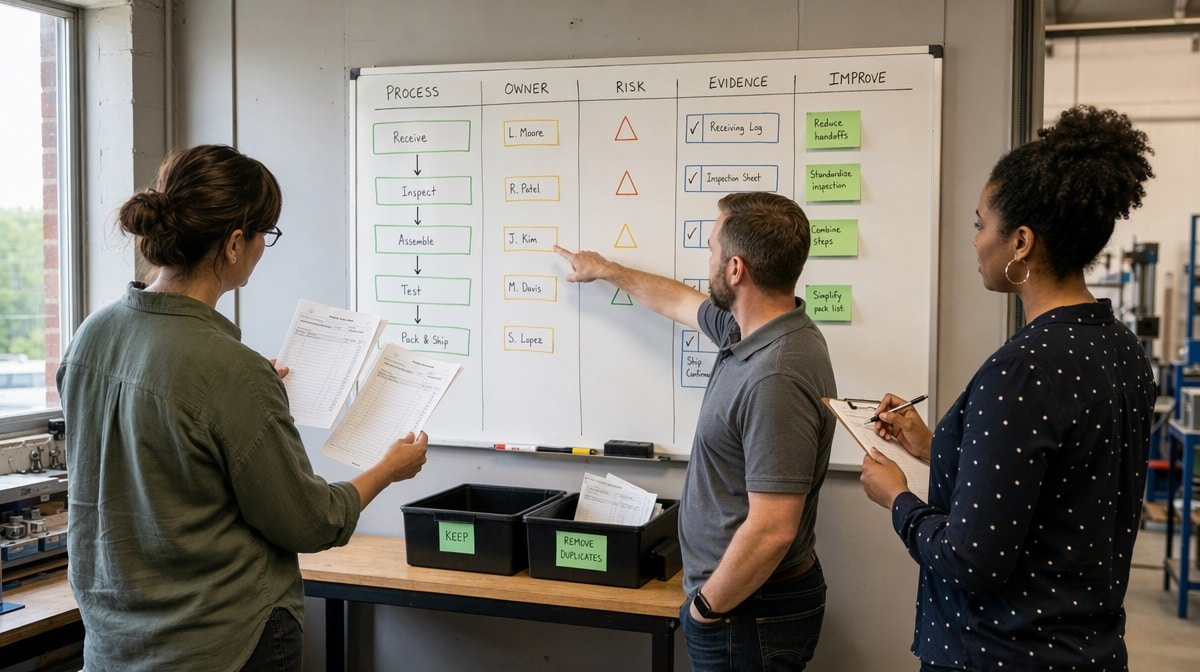
Start by mapping the main processes, owners, inputs, outputs, risks, controls, and measures. Then simplify the flow without weakening the control. If a required approval protects the customer or addresses a real risk, keep it. If two forms capture the same information and nobody uses the duplicate, combine or remove the duplicate through a controlled change.
Lean Quality Management System
A lean quality management system does not need a universal page count. According to ISO documented information guidance, the amount of documented information varies with an organization’s size, process complexity, and employee competence. The right amount is enough to operate and control the process, retain useful evidence, and meet applicable requirements.
That may mean concise ISO 9001 procedures, uncluttered forms, and a visible review method. It can also mean detailed instructions where the work is high risk or difficult to perform consistently. Lean removes non-value-adding work; it does not remove necessary knowledge.
Easily Create a Lean ISO Quality System
“Mix one part ISO with two parts lean” is a useful shorthand, not a compliance formula. Use ISO 9001 to define the outcomes, responsibilities, controls, evidence, and improvement expectations. Use lean methods to make those elements visible and easier to maintain.
- Kaizen improvement: use small, focused changes to correct problems and improve process performance. ISO process approach guidance identifies Kaizen as one way to make small-step continual improvements.
- Lean standard work: document the best current method clearly enough for employees to follow and improve it.
- Value stream mapping: show material and information flow, identify delays and rework, and design a better future state. The ASQ quality tools reference describes this current-state and future-state use.
- Quality dashboard: track a small set of quality objectives and process measures that people actually review.
- Customer focus: connect the quality policy and process measures to requirements and customer outcomes.
Together, these practices make the original idea concrete. Lean standard work can turn procedures into usable routines, value stream maps can define process flow, a lean dashboard can track quality objectives, and a lean quality policy can stay focused on your customer.
Use a Lean ISO QMS Scorecard
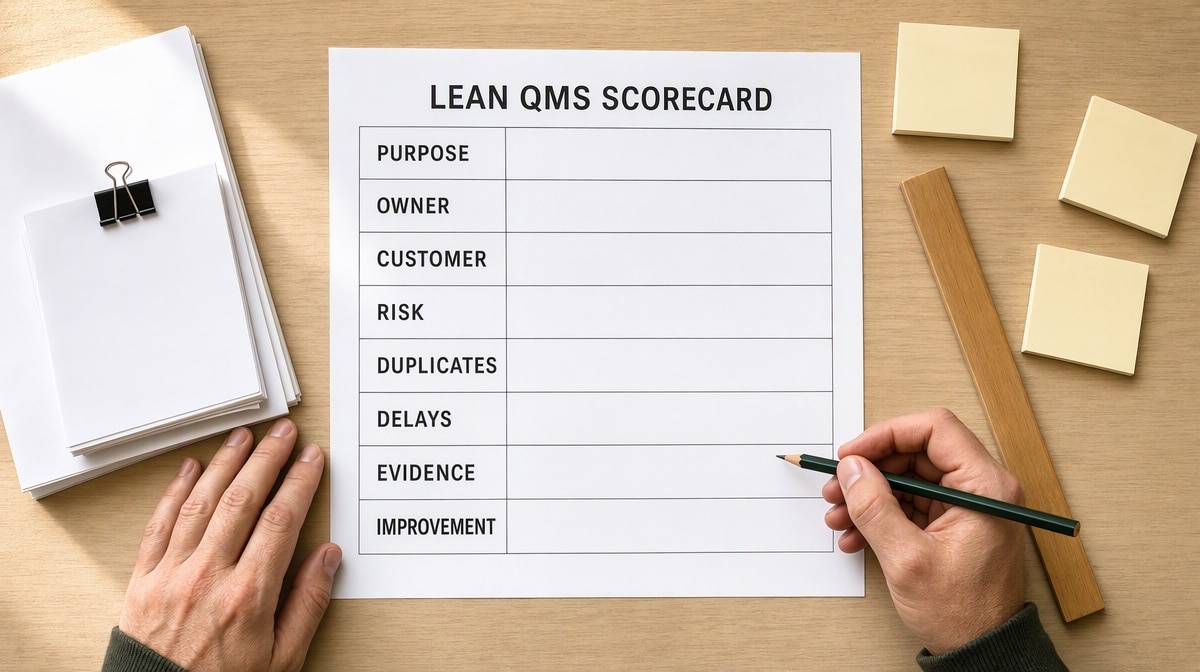
Review one process at a time with the scorecard below. It is a hypothetical working example, not an audit result. A “no” answer does not automatically mean a control should be deleted. It means the team should examine the design and the evidence.
| Scorecard question | What to look for |
|---|---|
| Purpose | The step supports a required outcome or decision. |
| Owner | One role is accountable for keeping the process effective. |
| Customer | The control protects a stated customer or internal requirement. |
| Risk | The control addresses a meaningful failure, compliance, or safety risk. |
| Duplicates | The same information is not captured in multiple places without a reason. |
| Delays | Approvals and handoffs have a clear purpose and reasonable timing. |
| Evidence | Records show that the process operated and achieved its intended result. |
| Improvement | Measures, corrective action, and feedback lead to specific changes. |
Start with Lean
Starting with lean can make an ISO 9001 quality system easier to use because waste and unclear flow become visible early. It does not, by itself, establish conformity with ISO 9001. The organization still needs to determine applicable requirements, implement its QMS, evaluate performance, address nonconformities, and improve.
Lean and Six Sigma are not interchangeable. The ASQ Six Sigma overview explains that lean emphasizes waste, standardization, and flow, while Six Sigma emphasizes variation and process control. Choose the method that fits the problem, or use them together when both flow and variation matter.
Once you get lean, you do not automatically get ISO 9001 as well. Lean, ISO 9001, and Six Sigma have different scopes, although all three can contribute to reliable processes and more satisfied customers.
For corrective and preventive action, use current language and clear practice: correct the nonconformity, find and address causes, use risk-based prevention, and verify that the change worked. A lean kaizen improvement event can help a team complete a focused change. A visible project wall can keep completed corrective action and improvement work in view.

Lean ISO Quality System
A QMS without lean thinking can be like building an airplane from scratch without first agreeing on the design, sequence, and controls. It may eventually work, but unnecessary complexity makes the job harder to understand and maintain.
Start with the process, the customer requirement, and the risk. Keep the controls and evidence that help the organization achieve reliable results. Simplify the rest through controlled change. That is why organizations want a Lean ISO quality system: it makes quality management part of the work instead of a separate layer of paperwork. A structured plan can help you implement a quality management system without losing that focus.
ISO 9001 certification is voluntary, and an independent certification body performs the certification audit, as described in the ISO 9001 overview. If you need help leaning out your ISO 9001 QMS, Contact Bizmanualz.
Frequently Asked Questions
Does ISO 9001 require a large quality manual?
No. ISO 9001 requires documented information needed for an effective quality management system, but the amount depends on the organization’s size, process complexity, competence, risks, and operating needs.
Can a lean system still meet ISO 9001 requirements?
Yes. A lean QMS can meet ISO 9001 requirements when it retains necessary responsibilities, controls, documented information, performance evaluation, corrective action, and improvement practices.
What should you simplify first in an existing QMS?
Begin with duplicate data entry, unused forms, unclear ownership, repeated approvals, delayed handoffs, and measures nobody reviews. Confirm the purpose and risk before changing any control.
Is lean the same as Six Sigma?
No. Lean primarily targets waste and flow, while Six Sigma primarily targets variation and process control. An organization can use either method or combine them based on the problem.
Do you need ISO 9001 certification to use a QMS?
No. An organization can use ISO 9001 requirements to improve its QMS without pursuing certification. When certification is needed, an independent certification body conducts the audit.