How to Reinvent Your Core Business Processes in a Time of Crisis

To “pivot your business” during a crisis, you must change how critical work gets done without destabilizing your workforce or existing customer base. Core business reinvention is not a wholesale rewrite of the company. It is a controlled redesign of the processes that protect customers, cash, product or service delivery, and essential operations.
Start with the smallest viable change that restores a critical outcome, keep the minimum controls that prevent a second problem, and give each temporary process an owner, a success measure, a review date, and a rollback trigger. That approach connects process reinvention to the practical goal of a business continuity plan: sustaining important business processes during and after a significant disruption.
Strategies to Reinvent Your Core Business Processes in a Time of Crisis
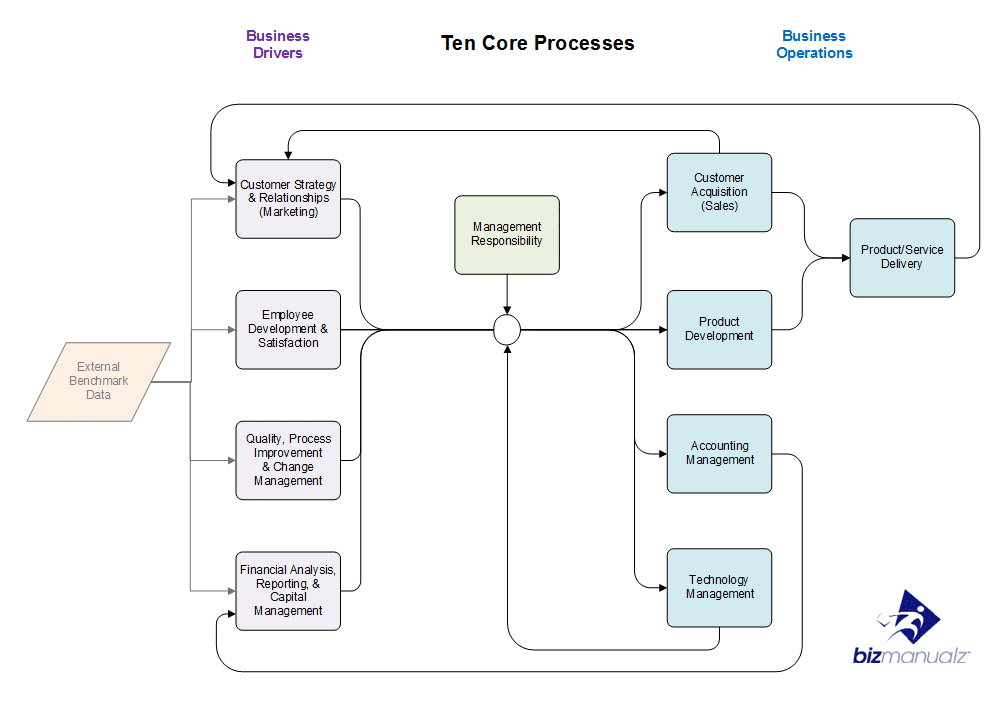
If you are reading this in the middle of a crisis, it can be difficult to navigate the whole host of changes that can put pressure on a business. The consequence may come from a supply interruption, changes in your industry or target market, competitors, a cyber incident, a natural disaster, a financing constraint, or a historical event such as the global Covid pandemic. Whatever the trigger, do not try to redesign every process at once. First identify critical business processes, stabilize the outcomes that customers and employees depend on, and then examine the five functional areas below.
Use this short sequence before changing a workflow:
- Name the failing outcome, such as late shipments, delayed collections, or unanswered customer requests.
- Map the current handoffs, decisions, systems, suppliers, and controls.
- Choose the smallest process change that can relieve the immediate constraint.
- Test the change with a limited scope when the risk allows it.
- Measure the result, review unintended effects, and either standardize, revise, or roll back the change.
Sales & Marketing
Sales and marketing is where your customer base interacts with your brand’s public image. During times of crisis, communications with customers should be clear and consistent. If you are changing delivery times, service channels, product availability, payment terms, or support hours, tell customers what has changed, when it applies, and where they can get help. Ready.gov notes that customers will want to know how they will be affected by an emergency.
The same goes for your brand strategy. Make sure that any changes you make are reflected in your branding and messaging. Keep your core values front and center, but be prepared to change how you communicate those values. Since businesses in crisis need to move quickly, you will need to remain agile as you begin to make progress. Give one person ownership of the message, approve a short set of facts, and update every active channel from the same source. Track customer questions, cancellations, response time, and missed commitments. Those signals show whether the revised communication process is reducing confusion or creating it.
Quality Product / Service Delivery

During times of crisis, the last thing you need is too much red tape holding back your ability to move forward quickly. If you completely ignore the core business processes you have been working on for years, however, you could end up doing more harm than good by removing a control that protects quality, safety, cash, or customer commitments. Find a balance between streamlining processes for faster execution and ensuring that the core values of your company remain in place. Separate required controls from habits. Keep the approvals and checks that prevent serious failure, then shorten queues, combine duplicate reviews, or move decisions closer to the work.
If you have been manufacturing your product in-house, you may need to consider outsourcing, extra capacity, or a new manufacturer when you are experiencing supply chain issues. An established manufacturing team’s expertise may be an advantage, freeing you to focus on other aspects of the business, but do not assume that outsourcing is automatically more profitable. Compare total cost, lead time, quality, switching risk, available capacity, intellectual-property exposure, and the controls you would lose. FEMA preparedness guidance recommends identifying operations critical to survival and identifying additional suppliers in case a primary supplier cannot deliver.
For each delivery process, define the minimum acceptable output, the person who can approve an exception, and the metric that shows whether the temporary workflow works. Useful measures may include defect rate, backlog age, on-time delivery, rework, customer complaints, or time to restore service.
Product Development
If you want to be successful in any business, you need to provide a solution to your customer’s problems. A crisis may change what customers value, what they can afford, or how they use a product or service, so new opportunities may have emerged. That does not mean every new idea is an opportunity. To successfully implement a product development strategy, approach the problem from as many angles as you can, including customer demand, customer experience, technology, and process optimization. Each can play an important role when inventing creative solutions. The U.S. Small Business Administration explains that market research combines consumer behavior and economic trends to confirm and improve a business idea.
Use voice-of-the-customer feedback to identify the problem before committing scarce resources. Test a narrow change with a defined customer group, record the assumption being tested, and decide in advance what result would justify continuing. This keeps product development agile without turning urgency into guesswork.
Accounting & Technology
Many businesses are stuck doing things as they have always been done, unaware of the potential for information technology to automate procedures or make them more reliable. Simple things like online invoicing, payments, and order fulfilment are all business processes that need to be considered. A customer relationship management (CRM) system can also help keep on top of customer interactions across all channels, including social media, email, and phone correspondence. Technology is not the process by itself. It should support a clear owner, accurate inputs, an exception path, access controls, and a way to continue when the system is unavailable.
U.S. Census Bureau reporting on the Annual Business Survey says that improving the quality or reliability of processes or methods was the most common motivation businesses reported for adopting technology. Use that same practical test: choose business process automation only when it improves the outcome, reduces a verified bottleneck, or strengthens visibility without creating a larger operational risk.
Administrative (Management, HR & Finance)
In highly profitable years, businesses tend to expand by hiring more staff; however, inefficiencies tend to creep in. When businesses find themselves in times of crisis, it may be time to reinvent the org chart and get organized around process improvement. Map the work before changing roles. List recurring admin and accounting tasks, decision rights, control responsibilities, peak workloads, service levels, and dependencies. Then decide whether to simplify a handoff, reassign work, cross-train an employee, automate a repeatable step, or outsource selected functions within the business so they run more efficiently. This is more reliable than starting with a headcount target.
If reduced hours, furloughs, or layoffs are being considered, obtain qualified HR and legal advice for the relevant jurisdiction and protect essential segregation of duties. The U.S. Department of Labor advises employers to consider available alternatives that may let employees work shorter hours instead of being laid off. Whatever option you choose, plan knowledge transfer, access changes, payroll and benefit administration, and communication before the change takes effect.
Use a Crisis Process Reinvention Scorecard
Use one row for each process under review. The first row below is a hypothetical worked example, not a claim about a real company. Copy the blank row and complete it with the people who perform and receive the work.
| Process | Crisis trigger | Customer or cash impact | Minimum viable workflow | Operational guardrail | Owner | Seven-day success signal | Rollback trigger |
|---|---|---|---|---|---|---|---|
| Hypothetical: order fulfillment | Primary warehouse unavailable | Orders wait more than two days | Route priority orders through backup location | Second-person check for address and inventory | Operations manager | 90% of priority orders dispatched within one business day | Error rate exceeds the normal process for two consecutive days |
| Your process | What changed? | What outcome is at risk? | What is the smallest workable path? | Which control cannot be removed? | Who decides? | What should improve within seven days? | When will you stop or reverse the change? |
The scorecard forces a temporary process to have a purpose, an owner, a control, and a stopping rule. It also gives leaders a common record for daily review. If the success signal improves without unacceptable side effects, document the new procedure. If it does not, revise the constraint or restore the prior method.
Reinvent Your Core Business Processes
Many businesses have fallen victim to a crisis because leaders react to every symptom at once or preserve a failing process simply because it is familiar. If you are a leader and the business is in crisis, it is your responsibility to create a vision to move forward and get things done while keeping critical controls visible. Some companies choose not to go down the traditional path of business structure. Instead, they opt for an agile management team with employees who are willing and able to adapt quickly when things change. Speed still needs ownership, evidence, and review.
As the nature of business changes, so should aspects of how you approach your core business processes. Whatever you choose to do, your customers are valuable assets, so it is important to keep them updated on what is happening and help the business transition well. Make one controlled process change at a time. A business continuity plan can connect those changes to the broader work of maintaining operations through disruption. Done carefully, a crisis-driven pivot may allow you to make adjustments without having to shut down and could bring the business out the other side in greater shape, without treating the crisis as permission to abandon sound management.