Why Your Company Should Invest in Technology

Your company should invest in technology when a specific tool can remove a verified bottleneck, improve customer service, strengthen control, or help employees complete important work more reliably. The best investment is not always the newest system. It is the one that solves a defined business problem and produces a benefit that exceeds the cost of implementation, training, security, integration, and maintenance.
Using information technology in business can support growth, but each purchase still needs an owner, a measurable outcome, and a review date. Listed here are eight reasons why your company should invest in technology, followed by a practical scorecard for deciding which investment deserves funding.
Eight Reasons Your Company Should Invest in Technology
Technology can improve interactions with customers, shorten response times, and make routine information easier to find. Chatbots, voice assistants, online forms, and self-service tools can provide another service channel, but their value depends on accurate information, clear escalation to a person, and thoughtful implementation. Before adopting a new channel, identify the customer problem it is meant to solve and how you will measure the result.
Among the most noticeable benefits of investing in technology is that it allows better interactions with customers. Chatbots, voice assistants, and other innovative technologies can make customer requests more manageable when they are connected to accurate records and human support. A company can gather information on its clients and create personalized communications based on this data, but it should collect only what it needs and avoid being too pushy or intrusive.
Another benefit of using technology is speed. Automation can reduce manual work when a process is stable and the exceptions are understood. Communication tools can also help employees send and receive information quickly. These benefits are strongest when the company first documents the process, establishes a baseline, and plans the technology upgrades around a real operational need.
Offer Faster Service
In many markets, speed matters. A customer benefits when an order, answer, or service request moves through the business without unnecessary waiting. Your company also benefits when employees can see the status of the work and address delays before they become complaints.
In today’s world, speed matters. The sooner your client receives an order, the better it is for both parties involved: the client receives the desired product faster, and your company can build a better reputation. Speed is directly linked to efficiency when faster delivery comes from a reliable process. Technology can make this happen by automating defined steps and reducing manual labor while keeping human review for exceptions.
Technology can support faster service by routing requests, checking inventory, scheduling work, or sending status updates. A simple online quote form, for example, can collect the information an employee needs before the first conversation. The form does not replace judgment. It removes repeated data entry and helps the employee respond with the right context.
Stay in Touch With Customers
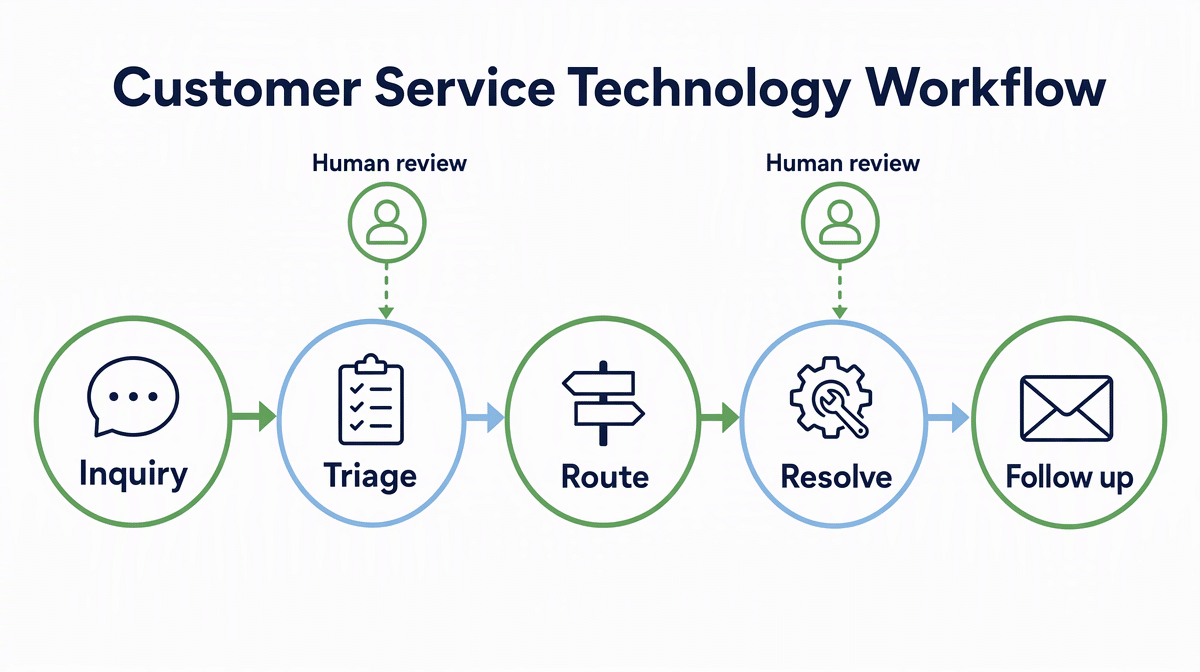
The world of business is competitive, and customers need timely information. Email, text messages, customer portals, and account notifications can help a company explain a delay, announce a product change, confirm an appointment, or communicate a price change. The same discipline that helps you run meetings smoothly also helps customer communication: decide who owns the message, what the recipient needs to know, and when a response is required.
Even though automated messages may not be read by all recipients, they can still reach customers who are interested in receiving such communications. One of the best ways to improve customer loyalty is to keep customers informed about what is going on. Automation should support communication rather than create noise. Give customers appropriate choices, keep contact records accurate, and provide a clear path to a person when the issue does not fit an automated response.
Build a Better Relationship With Clients
Technology helps companies organize customer information and provide consistent follow-up. A CRM system can consolidate contact details, purchase history, open requests, and scheduled actions so an employee does not have to search several files before helping a client.
That information must be collected and used responsibly. Define what data the company needs, who may access it, how long it should be kept, and how customers can correct it. Personalization is useful only when it is relevant, accurate, and respectful of privacy.
Reduce Labor Costs
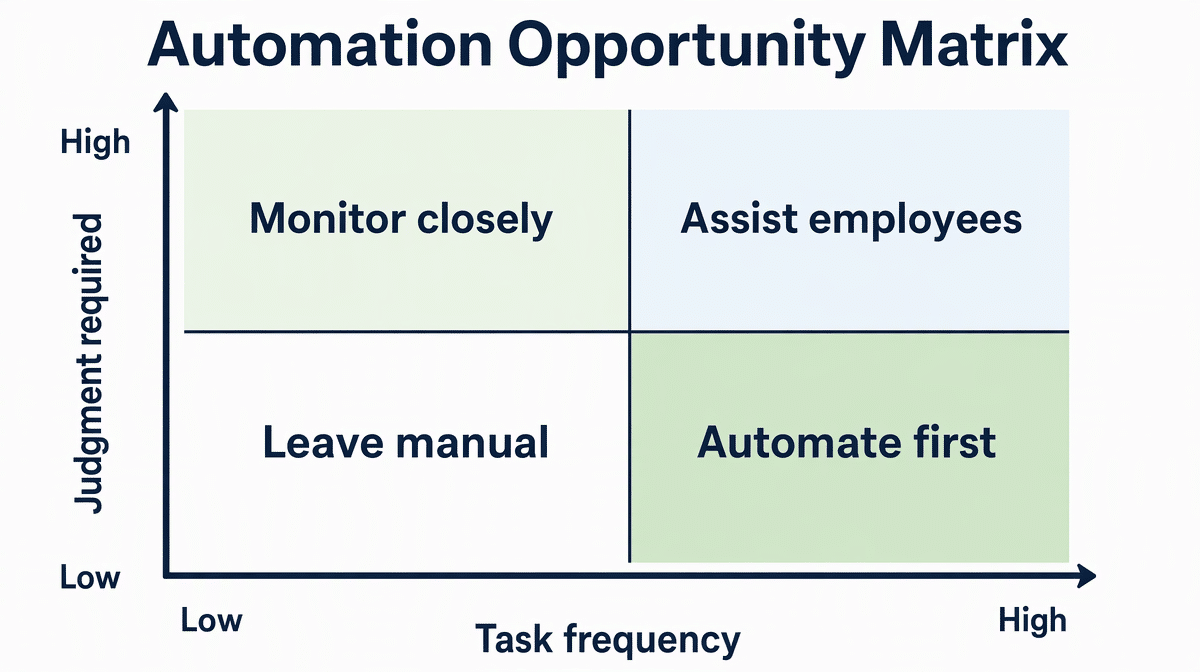
Technology can help a company reduce costs by lowering the time spent on repetitive administration. Retailers, for example, can use software to synchronize listings and orders across eBay, Amazon, and their own store. Employees still need to monitor exceptions, inventory, customer issues, and marketplace rules.
U.S. Census Bureau research found that firms adopting advanced technologies had higher labor productivity, while the study cautions against treating the association as proof that any single purchase caused the result. For your company, the useful question is whether the system reduces the cost of a defined process after subscription fees, setup, integration, support, and employee time are included.
Improve Efficiency
Technology can help operations improve efficiency by making the next step visible and reducing avoidable handoffs. A workflow might assign a request, check required fields, remind an approver, and record the outcome. This is more reliable than asking employees to remember every follow-up.
Efficiency does not come from automation alone. A poorly designed process can become a faster version of the same problem. Document the current process, remove unnecessary steps, define exceptions, and then decide which parts should be automated.
Reach New Markets
Digital tools can help companies reach new markets without opening a physical location in every area. An informative website, online storefront, video demonstration, or remote service channel can show potential customers what the company offers and how to buy it.
Access to a wider audience is another factor that makes technology a necessity for many companies. As a matter of fact, there are various digital tools and apps that can make the process of getting services known easier than ever before. For example, a video app or an informative website can present products to people who had never heard about them before.
Market access is not the same as market demand. Before expanding, confirm that the offer fits the audience, determine how orders and support will be handled, and check any tax, privacy, accessibility, or industry requirements that apply.
Increase Human Performance
Technology can help employees perform by placing reliable information and tools where the work happens. A modern CRM system can surface the latest customer record, prompt a defined follow-up, and reduce duplicate entry. A knowledge base can help an employee find an approved answer without waiting for a colleague.
The company still needs training, access controls, clear procedures, and time for employees to learn. Measure whether the tool improves accuracy, cycle time, service quality, or another relevant outcome. Do not judge the investment only by login counts or the number of features purchased.
Automate Repetitive Tasks
When it comes to productivity and time management, technology can solve some of the most common problems business owners have. Automating repetitive tasks can significantly reduce the amount of time spent on mundane tasks and free up more time for setting higher goals or developing new projects. The benefit comes from a carefully defined process, not from assuming the software will work without human intervention.
Some software solutions can automatically send emails or reminders after a certain period of time has passed. This way, an employee does not have to spend hours looking through customer records or trying to remember where important information was put. Automation still needs oversight. Assign an owner, test normal and unusual cases, record failures, and make sure an employee can correct the result. Whether the task is handled by rules-based software, an AI assistant, or a human virtual assistant, the company remains responsible for the quality and security of the work.
Your Company Should Invest in Technology
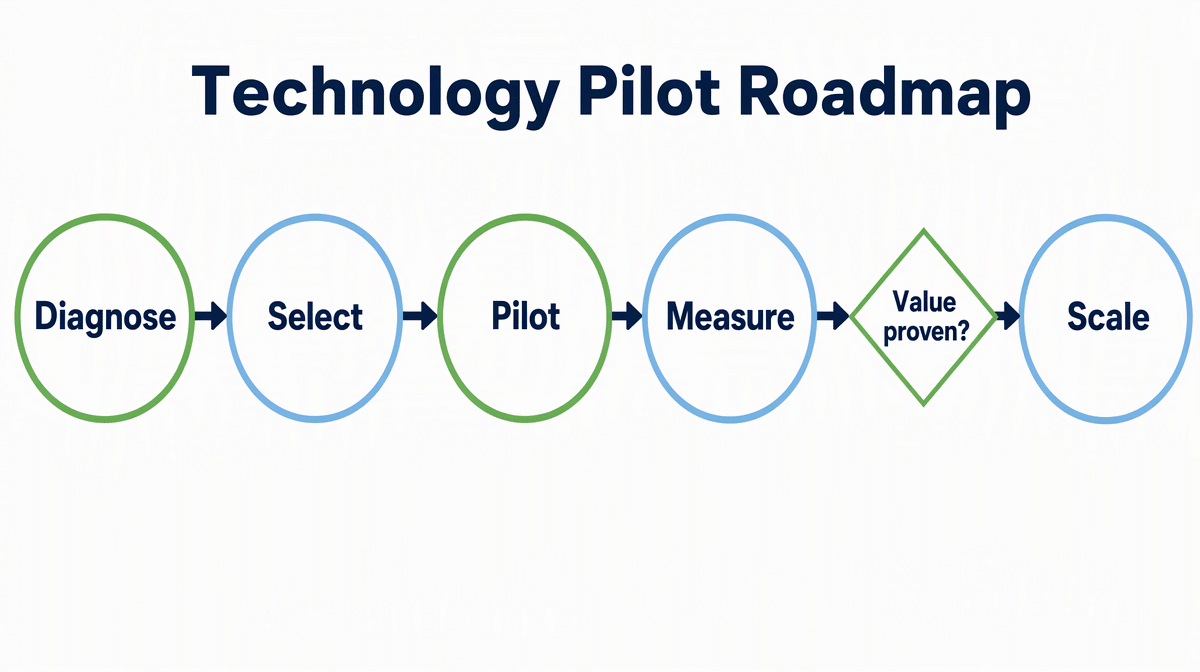
Technology plays an important role in many business operations. No matter what kind of company you are running, you should know how to use technology for your benefit and where a manual process, employee judgment, or direct customer contact still works better.
Technology has revolutionized our lives, but a company should invest in technology for a business reason rather than for novelty. Start with the process or customer problem. Establish the current cost, time, error rate, or service level. Then compare that baseline with a realistic target.
Security and privacy belong in the investment decision. The NIST small-business guide provides considerations for small and medium businesses that are starting or improving a cybersecurity risk management strategy. Apply that discipline before connecting a new tool to customer, employee, financial, or operational data.
Technology Investment Scorecard
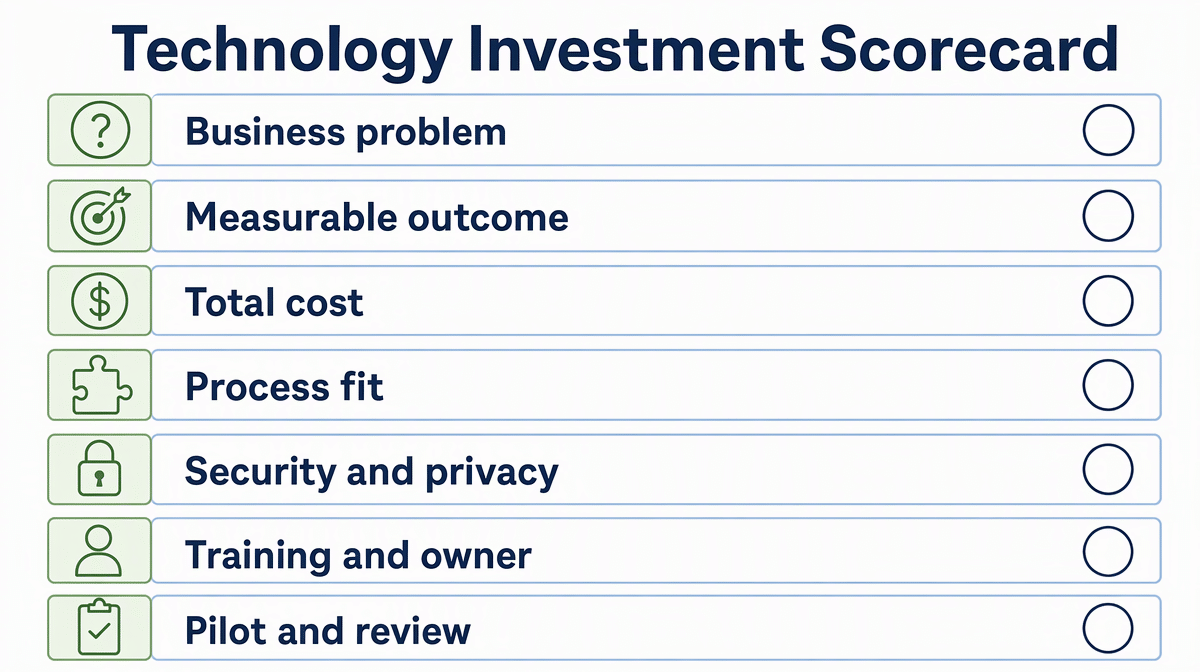
Use this scorecard before approving a purchase. Score each row from 0 to 2, where 0 means no clear answer, 1 means partially defined, and 2 means clearly defined and supported. A low score is a signal to investigate further, not a reason to force the purchase through.
| Decision test | Question to answer | Evidence to collect |
|---|---|---|
| Business bottleneck | What specific delay, error, cost, or customer problem will the tool address? | Current process map and baseline |
| Measurable outcome | What result should improve, and by how much? | Target for time, cost, quality, or service |
| Total cost | What will purchase, setup, integration, training, support, and maintenance cost? | Three-year cost estimate |
| Process fit | Does the tool support the real workflow and its exceptions? | Requirements and pilot observations |
| Security and privacy | What data will the tool access, store, or share? | Risk review, access plan, and vendor terms |
| People and training | Who owns the system, and who needs training? | Named owner and adoption plan |
| Integration and exit | How will data move in, move out, and remain available if the vendor changes? | Integration test and export plan |
| Pilot and review | How will the company test the tool before broader rollout? | Pilot scope, review date, and stop criteria |
For example, a hypothetical service company might test automated appointment reminders for 30 days. It would compare missed appointments, employee follow-up time, customer replies, and message errors with the previous month. The company would also document consent, access, escalation, and the full operating cost. That evidence makes the final decision more useful than a feature list.
Technology can improve the process, help the company reach customers, and reduce repetitive work. Not every new technology is a good investment. Choose a small number of tools that support documented goals, pilot them with real users, and keep only the systems that deliver measurable value without creating unacceptable complexity or risk.
Investing in technology can improve your business when the investment fits the work. Whether you want to reach more customers or reduce costs, there are benefits to be reaped from a tech-centered approach only when the company can implement the system, save money or time, and maintain it without creating a more complicated process.