How Do Digital Nomads Manage a Business from Anywhere?

Travel is the visible part of becoming a digital nomad. The harder part is making sure approvals, information, customer commitments, and decisions do not stop when the owner leaves the office. A laptop and an internet connection are useful, but they are not an operating system.
Digital nomads manage a business from anywhere by documenting work, delegating authority, choosing secure online platforms, coordinating across time zones, and testing whether the team can operate without the owner in the room. The goal is not to recreate the office in every destination. It is to build consistent remote and in-house processes that keep the company moving when your location changes.
How To Run A Business From Anywhere and Become a Digital Nomad
Those working away from the office were once called freelancers or remote workers. A digital nomad is a location-independent worker or business owner who may live and work in different places, sometimes for several months or years. These are people who work outside the office and can do business from anywhere in the world. Digital nomads do not travel exactly like tourists. A short visit may reveal the main sights, while a longer stay exposes the atmosphere and practical conditions that affect work: communication, infrastructure, time zones, privacy, transportation, and ordinary daily life.
Before choosing a destination, talk with other digital nomads who have worked there and compare their advice with information for ordinary business travelers. The reviews of ordinary business travelers should not guide you by themselves because they may ignore poor communication, weak infrastructure, and other nuances that matter during a long stay. Ask about reliable internet, mobile coverage, power interruptions, quiet meeting space, and the hours when your team or customers will be awake. If you want to be a digital nomad, get to know other digital nomads and test the basics before depending on the location.
Test the Business Before You Leave
Before leaving, put the work that must travel online and discuss the specifics of further communication with the team. Then set up a test period. Stay out of the office for a week and work as if you were already abroad so the team can get used to your absence. Your subordinates or team leads should solve most routine work issues without waiting for you. Track every question that still requires your physical presence, a file stored on one computer, an informal explanation, or a signature that only you can provide.
Turn those failures into documented decision rights, procedures, access rules, and escalation paths. Confirm who can approve expenses, communicate with vendors, handle payroll exceptions, respond to a customer problem, and make a time-sensitive operating decision. If banking, signing, or legal authority must be delegated, get qualified advice for the business entity and the relevant jurisdictions instead of assuming one form of power of attorney works everywhere.
The U.S. Small Business Administration says a continuity plan should identify critical functions, organize a continuity team, and evaluate recovery strategies. Your one-week test applies that discipline to the owner’s absence. It shows which business processes are truly portable and which still depend on one person or place.
Use the Remote-Readiness Scorecard
Mark each row as Ready, Needs a Test, or Blocks Travel. A single blocking item is a reason to repair the operating system before committing to a long stay. Repeat the scorecard after the trial week because the test may reveal hidden dependencies.
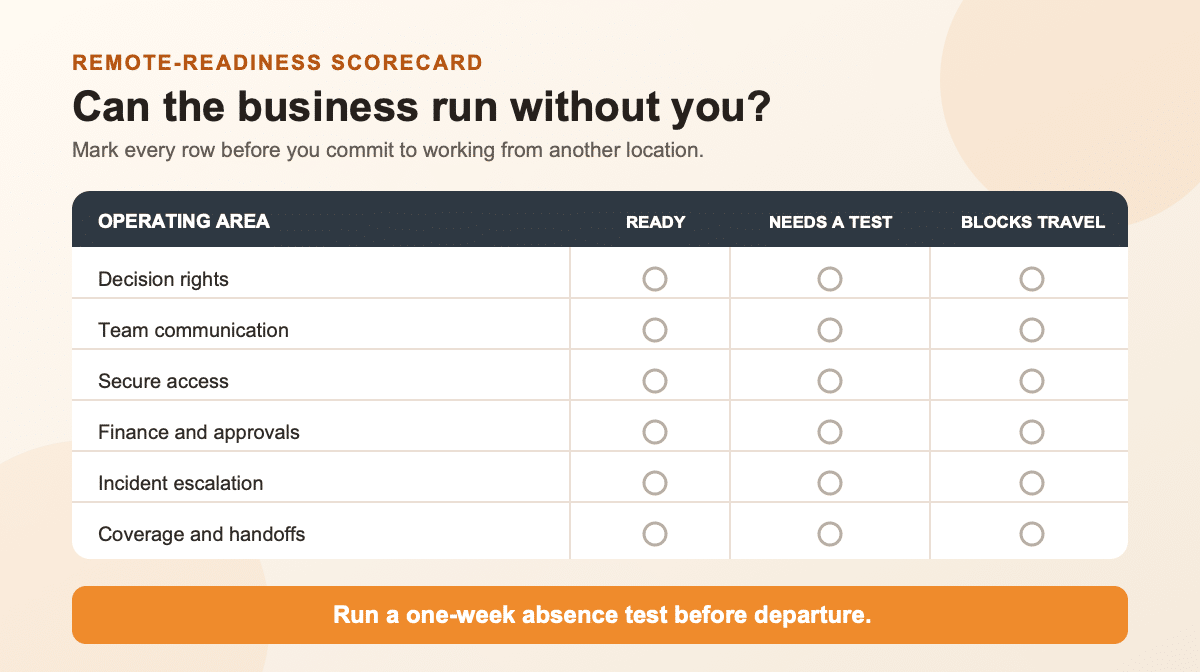
Open the full-size remote-readiness scorecard.
Decision rights and finance usually need the most attention. Write down which choices the team owns, which choices require consultation, and which choices must wait for you. Then define the communication rhythm, secure access, incident escalation, coverage, and handoffs that support those decisions.
Digital Nomads Use Secure Online Platforms
Online business management differs from traditional business management because different formats, tools, and communication methods are used. Instead of choosing programs because they are popular, map each platform to an operating job: assign work and owners, store procedures and records, communicate asynchronously, hold meetings, manage approvals, review cash and performance, and recover when a primary tool or device fails.
The team needs one agreed source of truth for work and procedures. Chat is useful for coordination, but a decision should not disappear inside a message thread. Record the owner, deadline, decision, and next action in the system where the work is managed. Tools are part of business processes, and their assessment helps you understand whether a project can be managed remotely. This also makes it easier to measure the effectiveness of remote working without confusing online activity with useful progress.
NIST recommends that organizations secure telework and remote-access components against expected threats. Define which devices may access company information, how software is updated, how sensitive files are handled, and what happens if a laptop or phone is lost. CISA advises small and medium businesses to enable multifactor authentication for email, file storage, and remote access. Test backup access before travel instead of discovering during an incident that the recovery method depends on a phone number or device you cannot reach.
Build Your Schedule and Follow Your Habits
To be a digital nomad and enjoy it, it is worth sticking to a schedule. Life outside the system can be a beautiful illusion. You are free to choose when to run a business and when to take days off, but the team still needs predictable overlap hours, response expectations, and a handoff process. Determine what part of the day you are doing work, publish those hours in the team’s primary time zone, and state when a matter is urgent enough to interrupt them.
Synchronize your work schedule with the team and strive to achieve consistency in remote and in-house processes. Use a repeatable sequence of actions even when locations or time zones change. For example, review cash, customer commitments, blocked work, and key reports at the same point each day, then reserve a weekly session for risks and decisions.
Repetitive activities help you tune in for productivity. The original routine might include practicing, reading books, or spending 15 minutes on Spanish words. The business version is equally simple: review reports, clear approvals, record decisions, and prepare the next handoff in the same order. A stable routine reduces the number of operating details that must be reconstructed after every move.
Choose a Reliable Place of Work
Cafes, coworking spaces, the terrace of an apartment, or a quiet room can all be places of work, but they are not interchangeable. As a remote project manager, divide locations by task or time interval. A private room may be appropriate for a sensitive customer call, while a cafe may work for planning or routine correspondence.
Test the primary internet connection with a real video call and file upload. Keep a backup connection, know where you will work during a power or network failure, and make sure the setting protects both the device and the conversation. Privacy, noise, power, ergonomics, and travel time matter as much as the view.
You can keep the original rhythm if it works: work at home in the morning, use a cafe at lunchtime to have a snack at the same time, and move outside later with a favorite matcha latte. Minimize the amount of travel stuff you carry, but keep the essential work setup, such as a laptop, a favorite sweatshirt, or a camera when the work requires one. The important point is to assign each place a purpose and keep critical work away from unreliable or exposed environments, even when you are surrounded by the ocean, sun, and palm trees.
Keep the Business Running Without the Office
In-office work provides physical presence. In remote work, you may be alone with your laptop, so you must learn to effectively lead a virtual team. Replace informal observation with clear outcomes, owners, decision rules, and review points. Ask what is blocked, who owns the next action, and when the team will escalate, rather than measuring who appears online.
Keep two communication paths: one for normal updates and one for urgent incidents. Document decisions after meetings, protect overlap time for issues that need live discussion, and let routine work proceed asynchronously. This preserves the flexibility of remote work without forcing the whole team to follow the owner’s travel schedule.
Stay connected with people who have chosen the same lifestyle. Other digital nomads can share local news, reliable work settings, infrastructure problems, and practical ways to maintain habits. Peer support is useful, but it does not replace professional advice. Before working in another country, check immigration, tax, employment, insurance, data-handling, and licensing questions with the relevant authorities and qualified advisers.
For U.S. owners, location does not automatically remove home-country obligations. The IRS says U.S. citizens and resident aliens abroad generally remain subject to U.S. filing rules and tax on worldwide income. Other countries and business structures have different rules, so treat compliance as a destination-specific workstream rather than a generic travel checklist.
Digital nomads can do business from anywhere when the team has documented procedures, clear authority, secure access, dependable communication, and a tested continuity plan. The most useful first step is not buying another tool or booking a longer trip. It is running the company from outside the office for one week, recording every failure, and fixing the system before departure.
Frequently Asked Questions
How can a business owner test whether the company is ready to run remotely?
Work outside the office for one week and record every approval, decision, file, signature, or explanation that still depends on your physical presence. Convert each dependency into a documented owner, procedure, access rule, or escalation path before a longer trip.
How do digital nomads manage teams across time zones?
They publish overlap hours, define normal and urgent response expectations, document decisions, and use clear handoffs so routine work can continue asynchronously. Live meetings are reserved for decisions and problems that genuinely need the team together.
What business functions should be delegated before traveling?
Delegate routine operating decisions, customer and vendor responses, expense approvals, payroll exceptions, incident escalation, and any time-sensitive signing or banking tasks. Document the limits of each person’s authority and obtain jurisdiction-specific advice when formal legal authority is required.
What should a digital nomad check in a place of work?
Check the primary and backup internet connections, power reliability, privacy for calls, noise, device security, ergonomics, time-zone fit, and the nearest backup location. Test the workspace with real tasks before depending on it for customer or team commitments.
What is the most important system for running a business from anywhere?
The most important system is a shared source of truth that connects work, owners, procedures, decisions, deadlines, and escalation rules. Tools support that system, but documented operating agreements are what let the team continue when the owner changes location.