
Bizmanualz blog
Reconciling an account is an important part of financial management. It involves comparing the transactions in a bank statement to the transactions in a company’s accounting records. This article will provide an overview of the process of reconciling an account, including the steps involved, the benefits, and the potential risks. It will also discuss the importance of having a good understanding of the accounting principles and the importance of having a reliable system for tracking and recording transactions. Finally, it will provide tips on how to ensure accuracy and completeness when reconciling an account.
Read more
Financial analysis is an important tool for investors and business owners alike. It can help identify potential risks and opportunities in a company’s financial performance. However, it is important to be aware of red flags that may indicate a company is in financial trouble. This article will discuss the common red flags in financial analysis, such as declining sales, increasing debt, and decreasing profits.
Read more
An audit review and compilation are two different services provided by certified public accountants (CPAs). An audit review is a limited assurance engagement that provides a moderate level of assurance on the financial statements. A compilation is a service that provides no assurance on the financial statements. An audit review is more expensive than a compilation due to the additional procedures performed. Both services are beneficial to the client, but the level of assurance provided by an audit review is higher than that of a compilation.
Read more
Are you looking for an efficient way to record invoices without an invoice number? This article will provide you with a step-by-step guide on how to do just that. We’ll discuss the importance of recording invoices, the different methods you can use to record invoices without an invoice number, and the benefits of using this method.
Read more
A War Exclusion Clause in an Insurance Contract is a clause that excludes coverage for losses caused by war or other military action. This clause is often included in insurance policies to protect the insurer from losses that may be incurred due to war or other military action.
Read more
Are you looking to set up an accounts payable system for your business? Setting up an accounts payable system is an important step in managing your finances and ensuring that your business runs smoothly. This article will provide you with an overview of the process, including the steps you need to take, the tools you need to use, and the benefits of having an accounts payable system in place.
Read more
Writing off outstanding checks is a common accounting practice used to remove checks from the books that have not been cashed or are unlikely to be cashed. This process is used to ensure that the company’s financial statements accurately reflect the current financial position. It is important to understand the process of writing off outstanding checks and the implications it has on the company’s financial statements.
Read more
Recording an advance to an employee is a great way to ensure that they have the funds they need to cover expenses. It is important to understand the process and the implications of recording an advance to an employee. This article will provide an overview of the process, including the steps to take, the implications of recording an advance, and the best practices for managing advances.
Read more
Are you looking for an easy way to keep track of your inventory? Writing down inventory is a great way to stay organized and ensure that you have the right amount of stock on hand. This article will provide you with tips on how to write down inventory, including what information to include, how to organize it, and how to use it to make sure you have the right amount of stock.
Read more
The Securities Exchange Act of 1934 is a federal law that regulates the trading of securities in the United States. It was enacted in response to the stock market crash of 1929 and the Great Depression. The Act requires the registration of all securities exchanges, brokers, and dealers, and sets forth rules and regulations for the trading of securities. The Act is an important part of the U.S. securities regulatory framework, and its provisions are essential for the protection of investors and the integrity of the securities markets.
Read more
Best Manual Deals
-
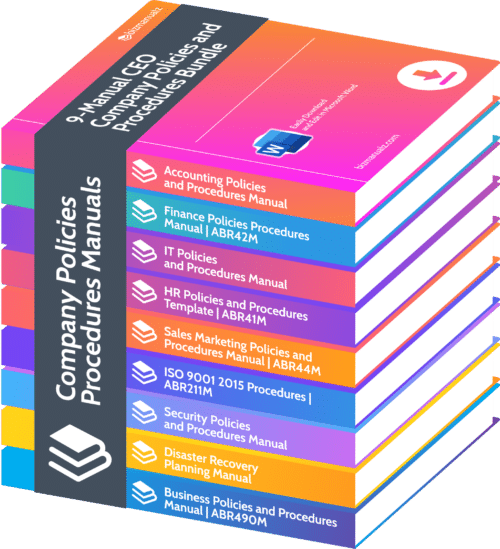 9-Manual CEO Company Policies and Procedures Bundle | Save 45%
$ 2,495.00
-
 ISO 22000 Food Safety Procedures Manual | ABR213M
Original price was: $ 395.00.$ 197.00Current price is: $ 197.00.
-
 ISO 22000 Seguridad de los Alimentos Procedimientos | ABR219M
Original price was: $ 395.00.$ 195.00Current price is: $ 195.00.
-
 ISO 9001 Quality Manual | ABR211MPM
$ 49.99
Business Manuals
-
 Sales Marketing Policies and Procedures Manual | ABR44M
$ 495.00
-
 ISO 9001 2015 Procedures | ABR211M
$ 495.00
-
 Finance Policies Procedures Manual | ABR42M
$ 495.00
-
 Accounting Policies and Procedures Manual | ABR31M
$ 495.00
-
 IT Policies and Procedures Template Manual | ABR34M Information Security Policy Manual
$ 495.00
-
 HR Policies and Procedures | ABR41M Employees Policy Examples
$ 495.00
-
 Security Policies and Procedures Manual | ABR32M
$ 395.00
-
 Disaster Recovery Planning Manual | ABR33M
$ 395.00
-
 AS9100 Quality Procedures Manual Rev D | ABR217M Aerospace QMS
$ 395.00
-
ISO 22000 Food Safety Procedures Manual | ABR213M
Original price was: $ 395.00.$ 197.00Current price is: $ 197.00.
-
9-Manual CEO Company Policies and Procedures Bundle | Save 45%
$ 2,495.00
-
ISO 22000 Food Safety Procedures Manual | ABR213M
Original price was: $ 395.00.$ 197.00Current price is: $ 197.00.
-
ISO 22000 Seguridad de los Alimentos Procedimientos | ABR219M
Original price was: $ 395.00.$ 195.00Current price is: $ 195.00.
-
ISO 9001 Quality Manual | ABR211MPM
$ 49.99
-
 How to Prevent Embezzlement Manual | ABR242DWD
Original price was: $ 49.99.$ 19.99Current price is: $ 19.99.