
Bizmanualz blog
The Quick Ratio is an important tool for financial analysis. It is a measure of a company’s liquidity and its ability to pay short-term obligations. It is calculated by dividing a company’s current assets, excluding inventory, by its current liabilities.
Read more
Assets and liabilities are two of the most important concepts in accounting and finance. They are used to measure the financial health of a business or individual. The difference between assets and liabilities is that assets are items of value owned by a business or individual, while liabilities are obligations or debts owed by a business or individual.
Read more
Is Depreciation a Direct Cost or Indirect Cost? Depreciation is an accounting concept that is used to spread the cost of an asset over its useful life. It is a non-cash expense that is used to reduce the value of an asset on the balance sheet.
Read more
Financial controls are internal controls, practices and procedures organizations use to regulate and manage their finances. They strive to guarantee accuracy, reliability, and integrity of financial information, and protect assets and prevent fraud. What are financial controls?
Read more
Authorized and outstanding shares are two terms used to describe the number of shares a company has issued. Authorized shares refer to the maximum number of shares a company is allowed to issue, while outstanding shares refer to the number of shares that have been issued and are currently held by shareholders. The difference between authorized and outstanding shares is important to understand when evaluating a company’s stock. Authorized shares are determined by the company’s board of directors and can be increased or decreased depending on the company’s needs. Outstanding shares, on the other hand, are the number of shares that have been issued and are currently held by shareholders. This number can be affected by stock splits, stock dividends, and other corporate actions. Knowing the difference between authorized and outstanding shares can help investors make informed decisions when investing in a company’s stock.
Read more
Employee manuals and procedure manuals are two different things – but both are essential in an office. The employee manual explains company policies, benefits, and expectations. It tells employees their rights and responsibilities. Plus, it outlines what’s expected of them while at work. On the other hand, a procedure manual gives detailed instructions on how […]
Read more
Creating and implementing good employee policies and procedures is vital. They outline acceptable behavior, expectations, and the rules for various aspects of employment. They help promote consistency, clarity, and fairness within and organization. Who writes employee policies and procedures for a company?
Read more
Errors in financial statements, inaccurate assets and liabilities, and difficulty monitoring cash flow could arise when transactions aren’t recorded accurately. This also allows businesses to keep and eye on their income and expenses, giving them and accurate reflection of their financial standing.
Read more
Accounting practices vary greatly depending on the business size an type. Small businesses may be asking, “Do I have to follow Generally Accepted Accounting Principles (GAAP) GAAP is the set of standards set by the Financial Accounting Standards Board (FASB). Generally, it’s considered best practice, but small businesses have some flexibility.
Read more
Discover the importance of Management’s Responsibility for Internal Controls and how it helps organizations ensure accurate and reliable financial statements.
Read more
Best Manual Deals
-
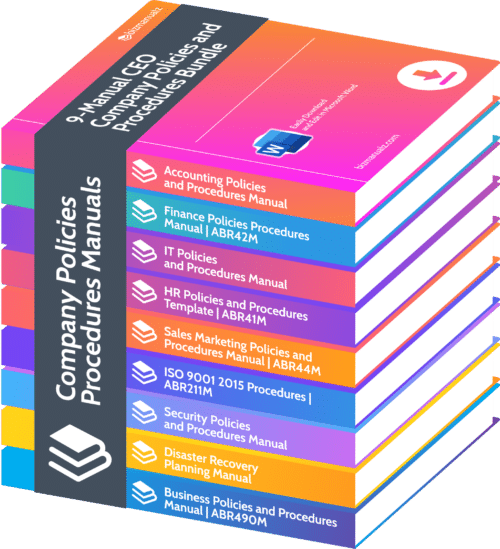 9-Manual CEO Company Policies and Procedures Bundle | Save 45%
$ 2,495.00
-
 ISO 22000 Food Safety Procedures Manual | ABR213M
Original price was: $ 395.00.$ 197.00Current price is: $ 197.00.
-
 ISO 22000 Seguridad de los Alimentos Procedimientos | ABR219M
Original price was: $ 395.00.$ 195.00Current price is: $ 195.00.
-
 ISO 9001 Quality Manual | ABR211MPM
$ 49.99
Business Manuals
-
 Sales Marketing Policies and Procedures Manual | ABR44M
$ 495.00
-
 ISO 9001 2015 Procedures | ABR211M
$ 495.00
-
 Finance Policies Procedures Manual | ABR42M
$ 495.00
-
 Accounting Policies and Procedures Manual | ABR31M
$ 495.00
-
 IT Policies and Procedures Template Manual | ABR34M Information Security Policy Manual
$ 495.00
-
 HR Policies and Procedures | ABR41M Employees Policy Examples
$ 495.00
-
 Security Policies and Procedures Manual | ABR32M
$ 395.00
-
 Disaster Recovery Planning Manual | ABR33M
$ 395.00
-
 AS9100 Quality Procedures Manual Rev D | ABR217M Aerospace QMS
$ 395.00
-
ISO 22000 Food Safety Procedures Manual | ABR213M
Original price was: $ 395.00.$ 197.00Current price is: $ 197.00.
-
9-Manual CEO Company Policies and Procedures Bundle | Save 45%
$ 2,495.00
-
ISO 22000 Food Safety Procedures Manual | ABR213M
Original price was: $ 395.00.$ 197.00Current price is: $ 197.00.
-
ISO 22000 Seguridad de los Alimentos Procedimientos | ABR219M
Original price was: $ 395.00.$ 195.00Current price is: $ 195.00.
-
ISO 9001 Quality Manual | ABR211MPM
$ 49.99
-
 How to Prevent Embezzlement Manual | ABR242DWD
Original price was: $ 49.99.$ 19.99Current price is: $ 19.99.