What Are 10 Leading Indicators for Measuring Organizational Success?

Many metrics can focus an organization on important organizational objectives and help drive the company forward. The controversial part is deciding which measures deserve to be called key. Revenue, profit, and growth are useful, but they are mostly lagging indicators. They tell you what has already happened, not whether your organization is building the conditions that make future success likely.
Revenue can rise because of asset sales, unprofitable discounts, or pulling future revenue into the present. Profit is an accounting number shaped by depreciation, amortization, absorption rules, and tax effects. Growth sounds great, but it can hide failing products or spread the organization too thin. The better question is this: what are the leading indicators for measuring organizational success before the income statement tells you it is too late?
What Are Leading Indicators For Measuring Organizational Success?
Leading indicators are measures that point toward a high probability of future performance. Lagging indicators measure outcomes after the fact. A balanced management system needs both, which is why the balanced scorecard idea became influential in performance management. Harvard Business Review described the balanced scorecard as a way to connect financial measures with customer, internal process, and learning measures in The Balanced Scorecard: Measures That Drive Performance.
For measuring organizational success, leading indicators should show whether customers trust you, employees understand priorities, suppliers support the work, and projects are moving the organization forward. They are not guesses. They are observable signals that help management intervene while there is still time to change the outcome.
The 10 Leading Indicators For Measuring Organizational Success
So what is an organization to do? Produce a balance of leading and lagging indicators for measuring organizational success. The following ten leading indicators preserve the article’s original operating logic: they look at relationships, communication, employee capability, trust, distraction, and execution quality before those forces become visible in revenue or profit.
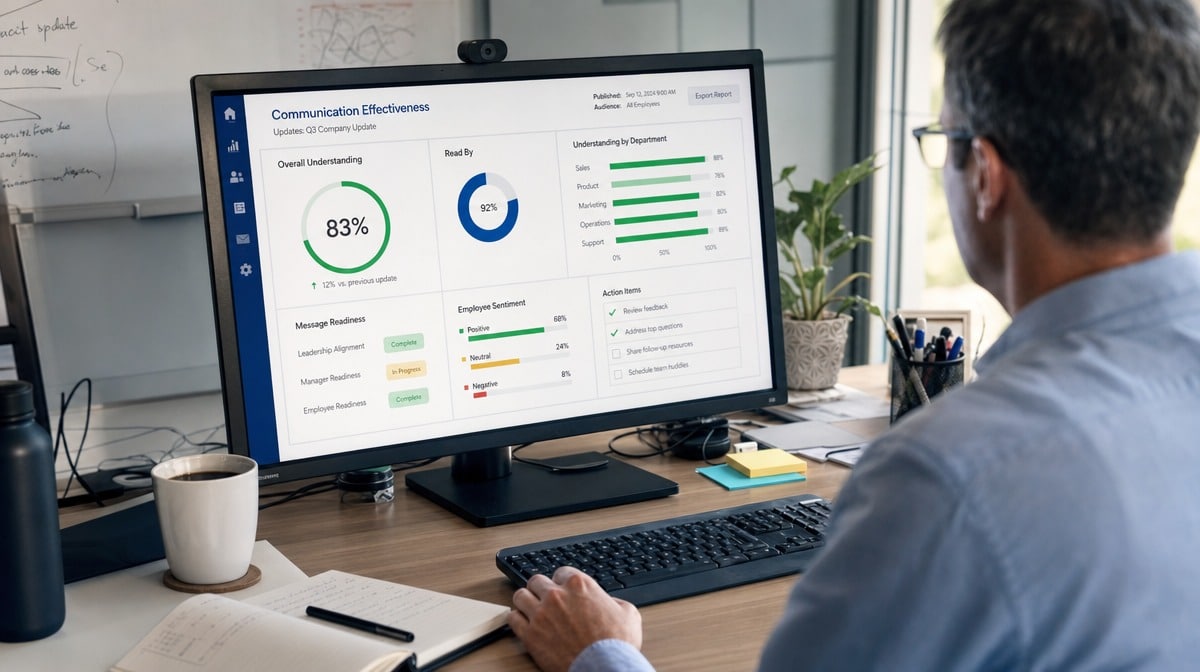
1. Communication Effectiveness
Did your employees understand, not just hear, your latest communication message? You may have said it in a meeting, newsletter, memo, dashboard, or web page, but that does not prove the message was understood. A leading indicator asks whether the communication changed what people know, believe, or do.
Measure this with quick comprehension checks, short quizzes, employee pulse questions, manager confirmation loops, or repeat-back exercises where someone explains the message in different words. If employees cannot describe the priority, decision, or policy change clearly, then the communication has not landed. Strong communication effectiveness supports better interpersonal communication and managerial effectiveness.
2. Customer Relationships
Customer satisfaction matters, but it is not the same thing as customer relationship quality. A customer can be satisfied and still be unprofitable, slow to pay, hard to serve, or unwilling to expand. Relationships are two-way streets. How do you feel about the customer, and how does the customer feel about working with you?
A useful customer relationship index might combine retention risk, payment history, account profitability, referral activity, product fit, support load, and executive access. This goes beyond customer satisfaction and asks whether the relationship is healthy enough to support future sales, competitive advantage, and growth. The customer is always right may be a service principle, but it is not a measurement system. The right customer for your organization is the one you can serve well and profitably.

3. Employee Satisfaction
Happier employees tend to create better customer experiences, but employee satisfaction should be measured with more than an annual survey score. Absenteeism, complaints, voluntary turnover, internal mobility, manager quality, training participation, and employee comments can all reveal whether people are engaged enough to support the next stage of organizational success.
The goal is not to make satisfaction a popularity contest. It is to detect whether employees have the conditions they need to do useful work. If turnover rises, complaints cluster around the same manager, or survey comments show confusion about priorities, the organization is receiving a leading signal. Treat it as a management issue, not an HR footnote. Employee satisfaction also connects directly to productivity at work.
4. Brand Image
Brand image is about more than name recognition. It is a leading indicator of how the market feels about your organization before those feelings turn into sales, referrals, complaints, or churn. A company may have strong awareness and weak trust, or modest awareness and a very strong reputation in a specific niche.
Use market research, customer interviews, win/loss analysis, review trends, search sentiment, and survey data to determine whether your brand image is rising or falling. Track the words people use to describe you. If prospects associate your brand with reliability, competence, and responsiveness, you have a stronger foundation for future sales than if they associate it with confusion, delay, or risk.
5. Distraction
Everybody has a job within your organization, but how much time do they spend doing what they were hired to do? Distraction is a leading indicator because it shows how much organizational energy is being consumed by administrative tasks, quality rework, unnecessary meetings, unclear approvals, and management assignments that are not part of the role.
In lean thinking, this kind of distraction is a form of waste. Measure time spent on rework, internal status reporting, manual handoffs, duplicated approvals, and nonessential requests. If high performers spend too much time navigating internal noise, future performance will suffer even when today’s revenue looks fine.

6. Trust
Do people believe in your organization and its leaders? You could call this the foot-dragging index. When people do not believe management is honest, competent, or consistent, they slow down implementation. They wait for proof, protect themselves, build workarounds, and question whether the next initiative will last.
Trust can be measured through employee survey items, customer promise-keeping, supplier feedback, escalation patterns, transparency in decision-making, and follow-through on commitments. If trust is weak inside the organization, programs move slowly. If trust is weak outside the organization, customers stall, stop buying, or look for a safer vendor.
7. Customer Frustration
Do you want customers to have a consistent and beneficial experience with your organization? Then measure customer frustration, not only customer satisfaction. Frustration appears in phone trees, long hold times, unresolved support tickets, unclear invoices, repeated handoffs, and policies that make sense internally but irritate the customer.
The phone-tree example is familiar because most companies have experienced it: you navigate a system, wait on hold, and finally reach someone who cannot help. Count those aggravations and negative surprises. Track repeat contacts, support reopen rates, complaint themes, abandoned forms, delayed responses, and refund requests. Frustrated customers may remain quiet for a while, but they eventually abandon the organization in search of a more pleasant vendor experience.
8. Supplier Relationships
Just like customer relationships, supplier relationships must be measured too. Suppliers provide inputs that are passed through to your customers in some form, whether that input is material, software, logistics, advice, labor, or information. Garbage in equals garbage out, so supplier relationship quality becomes a leading indicator of customer experience and operational resilience.
Measure supplier responsiveness, quality, delivery performance, issue resolution, pricing stability, collaboration, and ease of doing business. Ask whether the supplier is responsive to your needs and whether their quality is more than sufficient. A healthy supplier relationship supports the broader supply chain as a value chain, not just a purchasing transaction.

9. Project Management
Every organization has projects, either for clients or for internal customers. The better your organization is at delivering on project objectives, the more effective and efficient it will be. Project performance is a leading indicator because missed milestones, uncontrolled scope, weak ownership, and budget drift usually show up before the final financial result does.
Measure budget and cost performance, schedule completion, quality, risk burn-down, decision speed, stakeholder satisfaction, and even innovation. If projects stall repeatedly, then future strategy execution is at risk. A stalled process procedures project is not just one project problem. It may be a signal that governance, resources, ownership, or competence need attention.
10. Employee Competence
Employee competence is more than training hours. It is about whether people learned something useful to their job and can apply it under real operating conditions. Measuring competence is difficult, but ignoring it is worse. A company can spend heavily on training while still leaving skill gaps untouched.
One practical method is a competency matrix that defines required skills against required skill levels. Then measure each employee’s current skill as a percentage of what the role requires. The gaps indicate the training required to move the organization toward higher competence. Competence is a leading indicator because capability today determines what the organization can execute tomorrow.
How Should You Balance Leading And Lagging Indicators?
Producing a balanced set of leading and lagging indicators is critical to measuring organizational success. Leading indicators forecast a high probability of future success. Lagging indicators measure how well you are performing today. A balanced combination gives management a clearer view than either set alone.
Revenue, profit, and growth should remain on the scoreboard, but they should not be the only scoreboard. Pair them with communication effectiveness, relationship health, employee satisfaction, brand image, distraction, trust, customer frustration, supplier performance, project delivery, and competence. That mix gives leaders earlier signals and better options. Download free policies and procedures templates to build a stronger foundation for the continuing success of your organization.
Frequently Asked Questions
What Are Leading Indicators For Organizational Success?
Leading indicators are measures that show whether the organization is building the conditions for future success. They include signals such as communication effectiveness, customer relationship quality, trust, supplier performance, and employee competence.
Why Are Revenue And Profit Lagging Indicators?
Revenue and profit report what has already happened. They are important, but they can hide weak foundations, unprofitable growth, customer frustration, or operational problems that will affect future performance.
How Many Leading Indicators Should A Company Track?
A company should track enough leading indicators to cover customers, employees, operations, suppliers, projects, and capability without creating measurement overload. The ten indicators in this article provide a practical starting point.
How Do You Measure Customer Relationships?
Measure customer relationships with retention risk, payment behavior, profitability, support load, referral activity, responsiveness, and ease of doing business. The goal is to understand whether the relationship can support healthy future growth.
How Do You Measure Employee Competence?
Employee competence can be measured with a competency matrix that compares required skills and skill levels against current employee capability. The gaps show where training, coaching, or hiring is needed.