How to Create Standard Operating Procedures (SOPs) That Your Entire Company Can Use

Standard Operating Procedures (SOPs) entail step-by-step guides or instructions on how certain business activities are performed. They are essential for any growing business that strives for efficient output. A good SOP cuts back on the training resources you spend on every new hire and ensures that you are providing consistent products or services to your end-users, whether the task is performed by the person who designed it or by someone who joined last week.
Writing one is the easy part. The harder part is writing one your entire company will actually use. An SOP that leaves out a crucial piece of information sets up the disaster it was meant to prevent, a manual that grows too large buries the answer your employees are looking for, and a document that lives in a printed copy or an email attachment is lost the first time somebody needs it. The sections below cover who should write your SOPs, what should be included, where they should be stored, how they should be reviewed, and how to confirm your team understands what they are being asked to do.
Creating SOPs That Your Entire Company Can Use
Let’s say you own a small business. At first, you begin performing all the technical tasks yourself. As the business grows, however, you would have to give up these tasks to your new hires so that you have time to take on more managerial roles. In order to perform these tasks correctly and efficiently, your new employees will need a manual or guidebook with instructions. That is what you would call a Standard Operating Procedure (SOP).
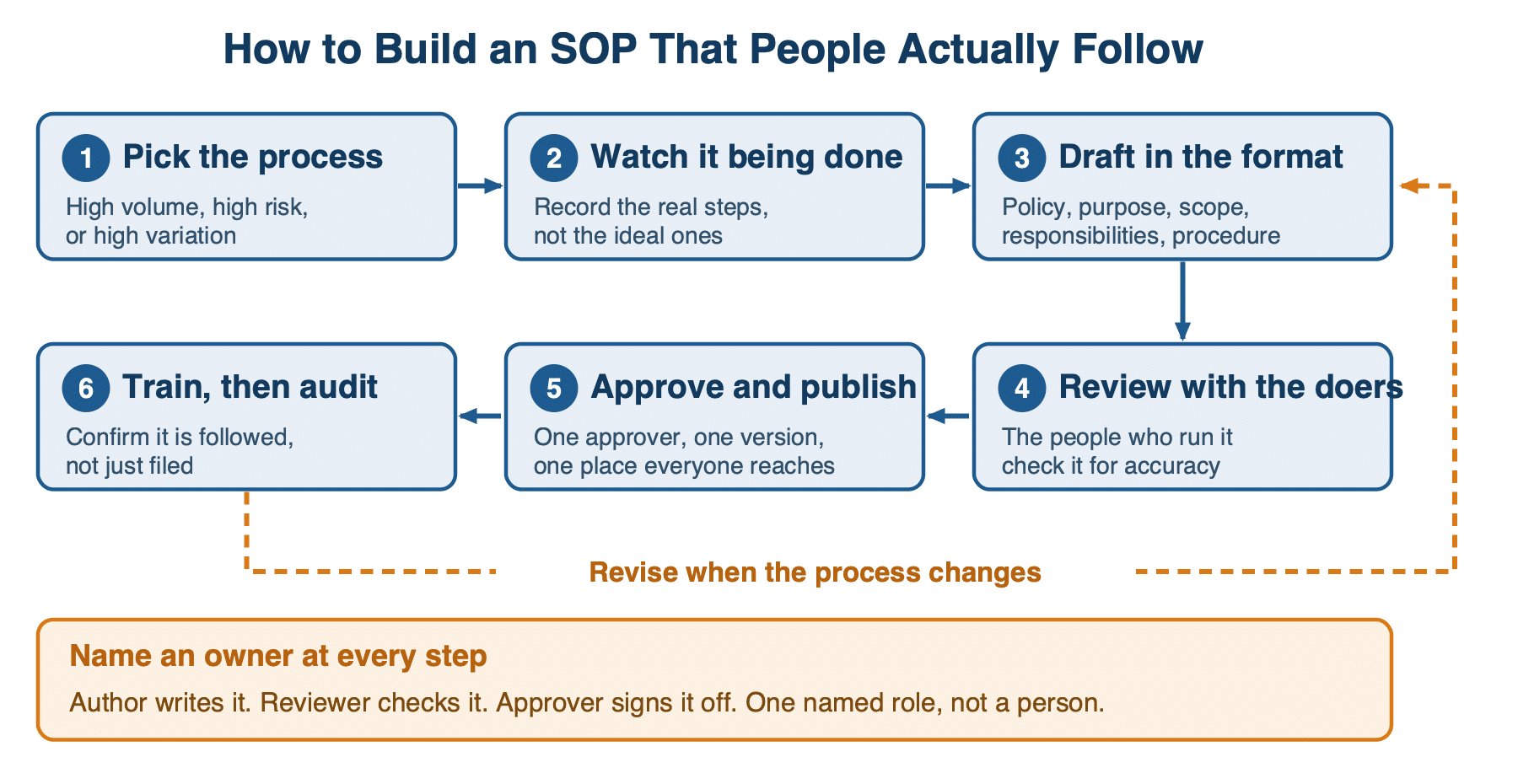
Although this procedure is created to improve your organization and efficiency, sometimes it can get a little messy. The document drifts away from how the work is really done, nobody is quite sure who owns it, and the version people are reading is not the version that was approved. The sequence below keeps those failures out of your step-by-step procedure manual.
Who Should Write the SOP?
The first question that you might ask is who should be in charge of writing the SOPs. There is nothing set in stone for this, but a suggestion is that those who are experts on the task should be the ones writing the SOPs for it.
Usually, however, it is the founder who is in charge of documenting SOPs for their growing company. In this case, they may not have the extensive knowledge on all of the tasks that are being performed. A simple solution for this would be to interview an expert or create the document alongside someone with more knowledge on the document scope.
The United States Environmental Protection Agency publishes guidance on preparing standard operating procedures. That guidance states SOPs should be written by individuals knowledgeable with the activity and the organization’s internal structure, and written in sufficient detail that someone with limited experience of the procedure can successfully reproduce it when unsupervised. That second test is the useful one, because it tells you when your draft is finished.
In practice the split that works separates three roles. The person who performs the task supplies the content, because only they know the workarounds. A single named owner is accountable for keeping the document correct. An approver signs it off before it is published. Naming a role rather than a person matters here, since people change jobs and an SOP owned by someone who left is an SOP nobody maintains. Our guide to SOP reviews covers how to divide those responsibilities.
What Should Be Included?
It is best to take note of all the different sections that should be covered before you even begin writing.
- The first section should include the document details, such as who owns the document (who has full authority), what your company name is, the department to execute the tasks, and the number of times the SOP document has been revised. Record the owner as a role rather than an individual, and pair the revision number with a revision date and a one-line reason for the change, so anyone can see what moved and why.
- The second section should include an introduction to the document, comprising of the purpose, scope, required resources to carry out the task, and definitions of any technical terms included in the document. State the scope both positively and negatively. An explicit line covering what the SOP does not cover prevents most arguments about whose job something is.
- The third section should include the procedure itself, including an explanation of the task, who is assigned to the task, any health and safety concerns, and the step-by-step explanation of the task. Write the steps in the imperative, one action per step, and call out any decision point explicitly rather than burying it in a sentence.

This is just a summary of what is usually included in an SOP, but there are many other details that you may wish to incorporate. Rather than writing everything down on a whim, it helps to see the fields populated. The worked example below shows a short SOP for a common small-business task, using the same three sections described above. The values are illustrative.
| SOP ID and title | SOP-CS-014, Processing a Customer Refund |
| Document owner | Customer Support Manager (role, not an individual) |
| Department | Customer Support |
| Revision | 3, revised 14 March, reason: refund approval threshold changed |
| Approved by | Finance Manager |
| Next review | 12 months from the revision date |
| Purpose | To process an approved customer refund accurately and within two business days. |
| Scope | Covers refunds on completed orders paid by card. Does not cover chargebacks, partial credits, or refunds on wholesale accounts. |
| Required resources | Order management system access, payment gateway refund permission, refund log. |
| Definitions | Approval threshold: the refund value above which a second approver is required. Settlement: the point at which a card payment has cleared. |
| Responsibility | Support Agent performs steps 1 to 6. Finance Manager approves any exception. |
| Procedure | 1. Open the order and confirm the payment has settled. 2. Confirm the return has been received and inspected. 3. Check the refund value against the approval threshold. 4. If the refund exceeds the approval threshold, escalate to the Finance Manager before proceeding. 5. Issue the refund through the payment gateway against the original transaction. 6. Record the refund reference and reason in the refund log, then notify the customer. |
Notice how much of the value sits outside the steps. The scope exclusion, the named approver and the threshold decision point are what stop a new employee from guessing. If you would rather start from a structured format than a blank page, our standard operating procedure template lays the same sections out for you, and it helps to understand policy, process, procedure, and SOP before you decide which one you are writing.
Where Should It Be Stored?
After creating your SOPs, it is best to store them in a single-place that is accessible to all employees. Physical copies are not advised since they are unsustainable and can easily be lost or damaged.
Whatever you choose has to provide five things: one canonical location so there is no second copy competing with it, version control so nobody works from a superseded draft, role-based visibility so people see what applies to them, search that actually finds a procedure by the words an employee would use, and access from wherever the work is performed. A shared drive can satisfy these if it is disciplined. Most are not.
Version control is the one that quietly fails. The National Institute of Standards and Technology recommends keeping a master list of documents for exactly this reason. The master list specifies the current revision and distribution of each document, so personnel can confirm they are using the correct version and obsolete documents are not used by mistake. This is the heart of document control, and it is worth setting up before your manual grows.
This is why online platforms may be your best solution. Waybook, for example, is a centralized, digital platform that can store all of your systems and processes in one place. Specific members can be allocated to certain tasks so that they only see what they are delegated to do, which ultimately improves your company efficiency. Bizmanualz offers policy and procedure management software built around the same control requirements.
How Should It Be Reviewed?
SOPs are constantly reviewed, altered, and updated to ensure a company’s current with the best and most efficient practices. A deadline for SOP reviews should be established by the company, which could be set as an annual or biennial review depending on the tasks and procedures involved. The review should be completed by the SOP owner, while those instructed to perform the tasks should also be consulted.
That cadence matches the federal guidance cited earlier. The EPA recommends SOPs be systematically reviewed on a periodic basis, for example every one to two years, to confirm the procedures remain current and appropriate or to determine whether they are even needed, and that the review date be added to each SOP that has been reviewed. In regulated operations the cadence is not a suggestion at all. Employers covered by the OSHA process safety management standard must certify annually that their written operating procedures are current and accurate.
The calendar is only half of it. Five things should trigger a review before the date falls due: the process changed, the tool or system changed, a regulation or standard changed, the SOP was implicated in an incident or an audit finding, or the people doing the work have started deviating from it consistently. That last trigger is the valuable one. Consistent deviation usually means the document is wrong rather than the operator, and treating it as a discipline problem is how companies end up with procedures nobody trusts.
A review should produce something visible: a new revision number, a review date, a one-line reason for the change, and fresh acknowledgement from the people who perform the task. A review that changes nothing and records nothing is indistinguishable from no review at all.
How Should You Ensure Employee Understanding?
Even if you think you have written the most simple SOP that has ever existed, others may disagree and not follow the procedures that have been created. Being an expert on something can lead you to assume everyone else will grasp concepts you find easy to comprehend in the same way.
This is why it is crucial for you to ensure that your employees understand everything about the SOP, from the purpose of the document to the tasks that they must perform. This could be done by simply asking them if they understand, but you may not always receive the best answers.
The most reliable test costs nothing. Ask somebody who has never performed the task to attempt it using only the document, while the author watches and says nothing. Every pause, every question and every moment the person guesses is a defect in the SOP, and you will find more of them in twenty minutes of this than in any number of read-throughs. Fix what the test exposes before you roll the procedure out.
After that, comprehension tracking has its place. Products like Waybook, the business playbook, provide the opportunity to test your employee’s understanding of the SOP after every section, and you will also be able to monitor their percentage of completion of the entire document. Use it to confirm coverage across a team, not as a substitute for watching one person try the task.
How Long Should an SOP Be?
Long enough that an inexperienced person can complete the task without help, and no longer. Length is rarely the real problem. The usual cause of a bloated manual is that policy, procedure and work instruction have been merged into one document, so a reader who needs three steps has to wade through the reasoning behind the rule to find them.
Split them. Keep the policy short and stable, let the SOP carry the process, and push the keystroke-level detail into a separate work instruction that can change without reopening everything above it. One task per SOP is the other discipline worth holding. When a single document covers four related tasks, all four have to be reviewed whenever one of them changes, which is how reviews start getting skipped.
Create Standard Operating Procedures
Standard Operating Procedures are integral to any business that wants consistent and efficient output. They can make employee onboarding a lot simpler, too. Work through the five decisions above and you have the document: an expert supplies the content and a named role owns it, the three sections carry the details that stop people guessing, one controlled location holds the current version, a review cadence with real triggers keeps it honest, and somebody has proved the procedure works by following it cold.
Although it seems as if writing and implementing an SOP is a complicated process, you do not have to start from a blank page. The Bizmanualz SOP manual guidance and the procedure writing guide give you the formats and the wording to work from.
Frequently Asked Questions
How many SOPs does a small business actually need?
Fewer than most owners assume. Document the tasks that are performed repeatedly, that carry real cost or risk when done wrong, and that somebody other than you will eventually perform. A task done once a year by one person who is not going anywhere is rarely worth an SOP. Start with the handful of processes that would stall the business if the person who owns them were unavailable for two weeks.
What is the difference between an SOP, a policy, and a work instruction?
A policy states what your company requires and why, an SOP describes the process used to meet that requirement, and a work instruction covers the specific keystrokes, settings, or physical steps inside one part of that process. Mixing the three into a single document is the most common reason SOP manuals become too long to use. Keep the policy short and stable, and let the SOP carry the detail that changes more often.
How do you write an SOP for a process nobody has documented before?
Watch the work being done rather than asking someone to describe it from memory. Record each step as it actually happens, including the workarounds, then review the draft with a second person who performs the same task to catch the variations. The gap between how a process is described and how it is performed is where most SOP failures originate, and you will only find it by observing.
Should an SOP be a checklist, a flowchart, or written steps?
Match the format to the work. Sequential tasks with a clear pass or fail at each step suit a checklist, processes with branching decisions are clearer as a flowchart, and anything requiring judgement needs written steps with the reasoning included. Many SOPs are best served by a combination: a short written scope and purpose, followed by a checklist or diagram for the procedure itself.
How do you roll out a new SOP so people actually use it?
Involve the people who perform the task while the SOP is still a draft, because a procedure written at someone is resisted and a procedure written with them is adopted. Announce the change with the reason behind it, confirm each person can find the document without help, and then check adherence within the first few weeks rather than at the annual review. If people are deviating from the SOP early, treat it as feedback on the document before you treat it as a compliance problem.
Author Bio: Mike Bandar is the co-founder of Waybook, which is the onboarding, training and reference tool for growing businesses. It is used by thousands of teams to easily document their knowledge, systems and processes in order to keep their business on the same page.