Performance Marketing: The future of Digital Marketing

Marketing spend is easy to approve when a campaign looks promising. The harder question comes later: which ad, audience, or channel created enough value to justify the cost? Performance marketing changes that bargain by connecting clearly defined measurable objectives to payment, optimization, and decisions about where the next dollar should go.
Cost Per Action (CPA) models and Affiliate Marketing are familiar examples, but the idea is broader than either one. Performance marketing treats a qualified lead, completed signup, sale, or other agreed conversion as evidence that a campaign is working. That discipline is why performance marketing continues to shape the future of digital marketing.
What Is Performance Marketing?
Performance marketing is a digital marketing approach in which spending and optimization are tied to measurable customer actions. Instead of paying a fixed fee upfront without regard to the actual success of the ad campaign, a business defines the action it values, tracks whether that action occurs, and evaluates cost against the result.
The action might be a sale, a request for information, a new subscriber, an app installation, or a qualified opportunity. The selected event must matter to the business. A cheap click that never produces engagement or revenue may look efficient in a dashboard while doing little for the company.
This does not mean every performance-marketing arrangement pays only after a sale. Some companies still buy impressions, clicks, or media placement in advance. What makes the work performance-oriented is the use of defined outcomes, reliable tracking, and regular optimization to improve Return On Investment (ROI).
How Does Performance Marketing Work?
A performance-marketing program starts with an objective, a conversion event, a budget, and a measurement plan. The team launches a campaign, observes how audiences respond, and changes the offer, creative, placement, or targeting based on the data. Tracking, targeting and attribution work together, but none of them can replace a clear business objective.
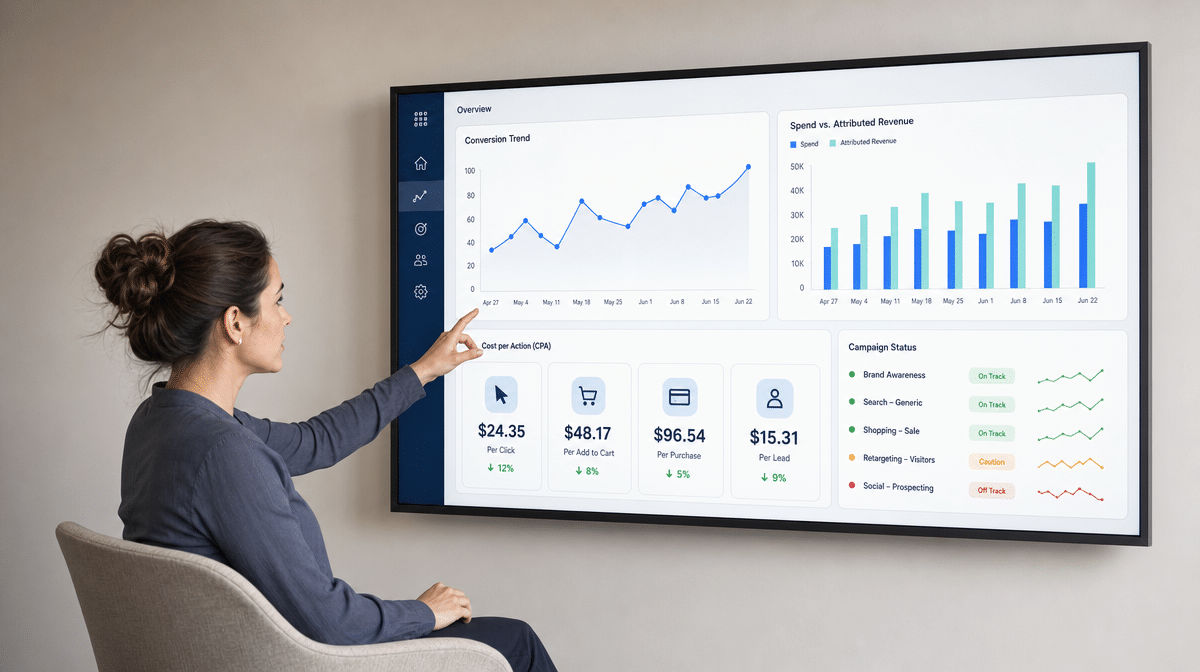
Use Performance Marketing to Retarget Campaigns
In Internet Marketing, many companies face the problem of retargeting customers and converting them in their marketing models. If a potential customer leaves your website without making a purchase, it may be easier to market to that person again because there is already prior knowledge of and engagement with your brand.
You could use that signal to present a relevant reminder, useful comparison, or appropriate incentive. The goal is not to follow every visitor indefinitely. It is to reconnect with a suitable audience, respect applicable consent choices, and measure whether the follow-up produces enough value to justify its cost.
Personalized Advertising
It is possible to reach customers across desktop, mobile web, mobile apps, social media, and email. Performance marketing lets a company tailor a message to a relevant audience and compare how different campaigns perform. Personalization works best when it is based on useful, permitted data rather than an assumption that more targeting is always better.
The measurement should also reflect the customer experience. A highly targeted ad that generates complaints, low-quality leads, or quick cancellations may create short-term conversions while damaging longer-term performance. The most useful program tracks both the immediate action and the quality of the result.
Data Collection
Performance marketing allows marketers to collect specific data on ad performance. It becomes easier to compare each ad, audience, and channel, then respond accordingly. These insights make evaluation easier and increase the potential to deliver the desired results, provided that the underlying conversion events are implemented correctly.

Data collection needs basic governance. Teams should document what each event means, remove duplicate conversions, keep naming consistent, and distinguish leading indicators from business results. An event called “conversion” is only useful when everyone knows whether it represents a page view, a completed form, a qualified lead, or a confirmed sale.
Tools and Technology
The digital world offers a wide range of tools, plugins, and technology for tracking, testing, targeting and attribution. These tools can enhance efficiency and improve the ROI of marketing efforts, but adding more software does not fix an unclear objective or an unreliable conversion event.
Start with the fewest tools needed to connect campaign activity to a meaningful result. Test the path from ad interaction to conversion, confirm that reports use the same definitions, and check that a platform is not counting the same sale twice. Technology should make the decision clearer, not simply produce more charts.
Performance marketing offers several advantages when these basics are in place. A company can tailor specific ads for specific clients, compare performance across multiple devices, and make content relevant to the audience accessing it. Combining useful data with powerful technology can boost ROI, but the greater advantage is a trackable process for deciding what to keep, change, or stop.
How Does Marketing Attribution Support Performance Marketing?
The rise of performance marketing, where compensation or optimization is directly tied to marketing performance, creates an awkward question about marketing attribution: how do you determine which ad led to a particular sale? A customer may view several ads, visit from search, read an email, and return directly before purchasing. Each touchpoint can influence the outcome, but the selected model determines how credit is assigned.
These questions have important implications for correct attribution. A team needs consistent rules for its attribution window, related products, and the treatment of views and clicks. Attribution is an estimate based on observable interactions and a chosen method, not a perfect record of every influence on a purchasing decision.

Attribution Window
The attribution window, also known as the lookback window, defines the length of time between a user seeing or clicking an ad and making a purchase attributed to that interaction. A 30-day click window is common as a platform default, but it is not a universal industry standard. Current Google Ads guidance on conversion windows explains that businesses can select different windows to match the conversion action and buying cycle.
A short promotion may justify a short window. High-value items often require more time because a user may research options, compare models, and involve other decision-makers before buying. The window should be long enough to capture meaningful delayed conversions without claiming credit for activity that is too remote from the campaign.
Windows can differ significantly depending on the product and the way customers make a purchasing decision. In some industries, it can be reasonably expected that several ads and networks influence the outcome. In ambiguous cases, the team still needs a consistent rule so it can fairly attribute marketing performance rather than favor whichever option produces the best-looking report.
An attribution window by itself is not a particularly sophisticated method of marketing attribution. If multiple campaigns overlap, the window can show that an interaction occurred before the sale without proving that the interaction caused it. Teams can combine the window with a consistent attribution model and controlled experiments to make stronger decisions.
Tracking SKUs and Adjacent SKUs
Product SKUs can be tied to online ads, but similar or adjacent SKUs should also be considered. Variations, upselling, and cross-selling may occur because a user clicked an ad for a similar but different product. The relationship is industry-specific, and some advertisers are strict about which SKU relations qualify.
Consider a user who clicks an ad for a 50-inch TV from a particular brand. The user may purchase that television or compare several different models from the same brand and choose another size based on energy efficiency, features, price, or room dimensions. There is still a reasonable argument for tying part of the purchase to the original ad even when the purchased SKU differs from the promoted SKU.
The rules should be documented before results are reviewed. Otherwise, a team may include adjacent products when a campaign looks successful and exclude them when it does not. A consistent SKU-family policy makes performance comparisons fairer across campaigns and time periods.
Views vs. Clicks
One contentious point in performance-marketing attribution is whether views or clicks count toward a conversion. Is it fair to attribute a sale to an ad for that SKU when the deal did not come directly from clicking the ad? A user who views an ad may not make a purchasing decision immediately, yet repeated exposure across multiple channels can influence later recognition and consideration.
Post-click conversions are simpler to connect to a specific interaction, while post-view conversions require more caution. That does not mean clicks always deserve all the credit or that views should be ignored. The company should decide how each signal is treated, apply the same rule across comparable campaigns, and use experiments when it needs to estimate whether exposure produced incremental value.
Post-view conversions can have significant value for remarketing efforts and brand recognition, particularly when ads are spread across several social media sites. Attention should be paid to repeated exposure without assuming that every view caused the purchase. The fair assessment is the one that follows the documented rule and acknowledges what the available data cannot precisely determine.
How Can a Business Switch to Performance Marketing?
Switching does not require abandoning every existing channel or buying method. Programmatic advertising, paid search, affiliates, email, and other tactics can all operate within a performance discipline. The change is managerial: stop chasing new things without a reason, plan for the desired performance, and experiment against a defined measure of success.
Stop Chasing New Things
It is easy to fall prey to trends and fads because competitors appear to be using them. You should test promising tactics, but return to the objectives that guide the business. A new channel is useful only when it reaches the right audience, supports the customer journey, and produces a result worth the cost.
Before launching, write down what would have to happen for the test to succeed. Define the conversion, acceptable cost, minimum data needed, review date, and decision that follows. This prevents a team from extending an unproductive campaign merely because the idea is new or the dashboard looks busy.
Plan for Desired Performance
You need to know how to measure success before you sink cash into a project that may go nowhere. Do you want more user engagement, more conversions, more qualified opportunities, or more people at your booth? Be specific about how the result will be quantified, then set goals and track performance against those figures.
Also define what quality means. More leads may not help if they never fit the target customer or reach the sales process. More purchases may not help if returns, support costs, or cancellations erase the value. The performance plan should connect the marketing event to the outcome the business actually wants.
Experiment with Performance
You need to be confident enough to try new things knowing that some of them will not work. This is what separates disciplined experimentation from random activity. Test one meaningful change at a time when possible, use a controlled budget, and keep the attribution assumptions consistent so the results can be compared.
Great results today may not be maintained for the long haul, while poor immediate results can sometimes precede better loyalty or later purchases. Review both the immediate conversion and the longer-term effect. When claims about performance appear in public advertising, follow the FTC’s advertising and marketing guidance: claims should be truthful, non-deceptive, and supported by evidence.
Why Does Performance Marketing Matter for Digital Marketing?
Performance marketing matters because it forces marketing activity to answer a business question. It can help a company stay relevant to customers by learning which offers, messages, and experiences create useful action. It also gives teams a common language for budget decisions: objective, conversion, cost, attribution, quality, and return.
The discipline is not perfect. Data can be incomplete, attribution models can disagree, and a campaign can optimize for the wrong result. Yet a documented measurement plan is more useful than paying for exposure and hoping it worked. Companies that define meaningful outcomes, test carefully, and review the quality of results can make digital marketing more accountable without pretending every influence is precisely measurable.
Frequently Asked Questions
What Is Performance Marketing?
Performance marketing is a digital marketing approach that connects spending and optimization to measurable customer actions, such as qualified leads, signups, or sales.
How Does Performance Marketing Work?
A business defines an objective and conversion event, launches a campaign, tracks the result, and adjusts targeting, creative, placement, or budget based on the evidence.
How Is Performance Marketing Different From Traditional Advertising?
Traditional advertising may focus on buying exposure for a fixed fee. Performance marketing places greater emphasis on defined actions, measurable outcomes, and continued optimization against the result.
What Is an Attribution Window?
An attribution window, or lookback window, is the period after an ad view or click during which a later conversion may receive credit for that interaction.
How Can a Business Start Using Performance Marketing?
Start with one meaningful objective, define the conversion and acceptable cost, document the attribution rule, run a controlled test, and review both immediate results and longer-term quality.