

ISO22000 FSMS Control of Potentially Unsafe Product Procedure Word
The ISO22000 FSMS Control of Potentially Unsafe Product Procedure Word is a comprehensive document that outlines the steps necessary to control potentially unsafe products in the food industry. This procedure is designed to help food companies comply with ISO22000 standards and ensure the safety of their products.
The procedure includes detailed instructions on how to identify potentially unsafe products, how to investigate and analyze the root cause of the problem, and how to take corrective actions to prevent the issue from happening again. It also includes guidelines on how to communicate with customers and regulatory agencies in the event of a potentially unsafe product incident.
The ISO22000 FSMS Control of Potentially Unsafe Product Procedure Word is easy to customize to fit the specific needs of your company. It comes in a Microsoft Word format, making it easy to edit and update as needed. The document is also fully compliant with ISO22000 standards, ensuring that your company is meeting all necessary requirements.
By implementing the ISO22000 FSMS Control of Potentially Unsafe Product Procedure Word, your company can improve its food safety practices and reduce the risk of potentially unsafe products. This can help to protect your customers, your brand reputation, and your bottom line.
Overall, the ISO22000 FSMS Control of Potentially Unsafe Product Procedure Word is an essential tool for any food company looking to improve its food safety practices and comply with ISO22000 standards. With its comprehensive instructions and customizable format, it is a valuable investment for any food company looking to protect its customers and its business.
FSMS Control of Potentially Unsafe Product Procedure
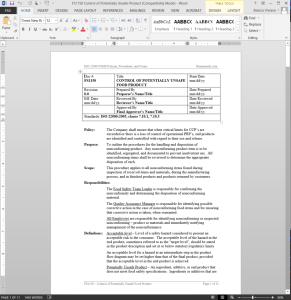
The FSMS Control of Potentially Unsafe Product Procedure outlines the procedures for the handling and disposition of nonconforming product.
The procedure applies to all nonconforming items found during inspection of received items and materials, during the manufacturing process, and in finished products and products returned by customers. (10 pages, 1487 words)
FSMS Control of Potentially Unsafe Product Responsibilities:
The Food Safety Team Leader is responsible for confirming the nonconformity and determining the disposition of nonconforming material.
The Quality Assurance Manager is responsible for identifying possible corrective action in the case of nonconforming food items and for ensuring that corrective action is taken, when warranted.
All Employees are responsible for identifying nonconforming or suspected nonconforming ” product or materials and immediately notifying management of the nonconformance.
FSMS Control of Potentially Unsafe Product Definitions:
Acceptable level – Level of a safety hazard considered to present an acceptable risk to the consumer. The acceptable level of the hazard in the end product, sometimes referred to as the “target level”, should be stated in the product description and set at or below statutory/regulatory limits. An acceptable level for a hazard at an intermediate step in the product flow diagram may be set higher than that of the final product, provided that the acceptable level in the end product is achieved.
Potentially Unsafe Product – An ingredient, additive, or end product that does not meet food safety specifications. Ingredients or additives that are discovered nonconforming in a production operation and can be brought into a conforming condition as a normal part of the same operation are not considered part of this process.
Critical Control Point (CCP) – Step at which control can be applied and is essential to prevent or eliminate a food safety hazard or reduce it to an acceptable level.
Operational PRP – Operational Prerequisite Program; prerequisite program identified during a hazard analysis as essential to controlling the likelihood of introducing food safety hazards to and/or the contamination or proliferation of food safety hazards in the product or processing environment. (See FS1070 ” HAZARD ANALYSIS.)
Recall – Remove a food product from the market because it may cause health problems or possible death. Food manufacturers or distributors typically issue recalls, which may be based on internal or external findings (e.g., consumer complaints).
 FSMS Control of Potentially Unsafe Product Procedure Activities
- General
- Identification and Segregation of Nonconforming Product
- Nonconformance Report
- Evaluation for Release
- Disposition of Potentially Unsafe Products
- Returned Goods
- Control Process Review
FSMS Control of Potentially Unsafe Product Procedure Forms
Control of Potentially Unsafe Products
The Food and Drug Administration (FDA) has been in existence for over 100 years — it actually predates the Pure Food and Drug Act of 1906 — and was begun mainly in response to the proliferation of patent medicines and the often dubious claims people made of them. Food safety was first addressed by the passage of the Meat Inspection Act, which fell under the jurisdiction of the USDA.
Some kind of food safety regulation has been around for more than a century. Yet, while passing various health and food safety legislation for decades, Congress hasn’t actually done much to ensure our protection. They often assign enforcement of food safety laws to the FDA or USDA but the FDA, in particular, has been rendered toothless — ineffective — in recent history as funding for qualified personnel, training, research, and testing have dried up. This typically has the effect of passing the burden (i.e., expense) of ensuring safety on to other parties, such as the consumer. (Don’t believe me? Read the labels on the entrees and side dishes in your freezer.)
Furthermore, food safety standards that are more universal in nature — after all, we’re dealing with a global food supply chain — have been in existence for decades. HACCP (hazard analysis and critical control point) plans — not developed by or for the FDA, incidentally — have been commonplace for nearly forty years because they work!
Food businesses and other organizations (like ISO) have developed a number of easily implemented and universally applicable standards for reducing risks associated with growing, storing, processing, transporting, and consumption of food. ISO 22000 for food safety management systems was released in September, 2005. A complimentary standard, PAS 220 (designed to tighten specifications for food processors’ prerequisite programs, or PRP), was released three years later.





Reviews
There are no reviews yet.