What Is an Accounting Department Organization Chart?

An accounting department organization chart shows who owns finance, accounting, control, and supporting administrative responsibilities, along with who reports to whom. It provides the foundation for coordinating your accounting management system and clarifies how accounting department roles and responsibilities connect to job descriptions, policies, procedures, and financial tasks.
Use the chart to make accountability visible, identify gaps or overlaps, and decide where Finance and Treasury, the Controller, accounting staff, internal auditing, and operations staff belong. The sample below is a starting point, not a universal hierarchy. Your actual Organization Chart should reflect company size, control needs, and the type of activity performed.
Accounting Department Organization Chart
A useful Accounting Department Organization Chart communicates three things: the work the department performs, the role accountable for each area, and the reporting lines used for supervision and escalation. Responsibilities specific to a procedure or task still belong in the related procedure and job description. The chart provides the overview that connects those documents into one accounting management system.
This sample groups the department into three main responsibilities:
- Finance and Treasury: cash management, banking, capital, financing, Treasury investments, fund balances, and long-range financial matters.
- Accounting and Control: books and records, financial statements, Accounts Payable, Accounts Receivable, credit and collections, budgeting, tax coordination, and internal control.
- Operations Support: office management, Human Resources, Information Systems, purchasing, and warehouse activities when the company combines finance and administration.
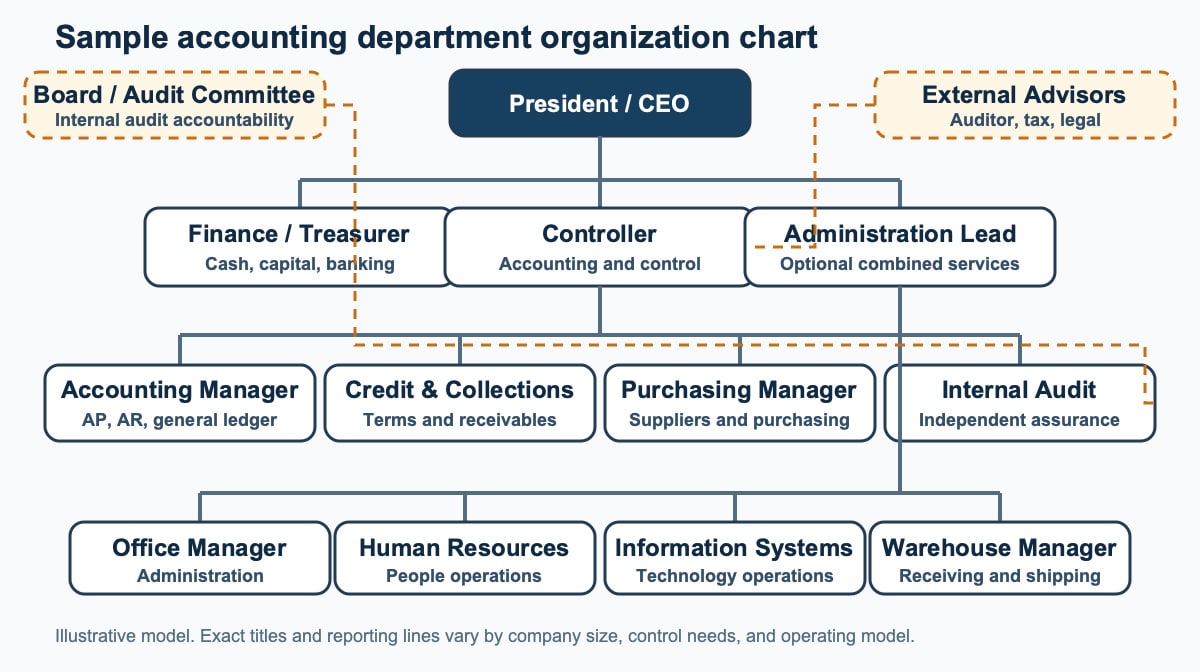
The dashed relationships show activities that need independence or specialist advice. Internal audit may coordinate administratively with finance, but it needs functional accountability to the board or audit committee. External auditors, legal counsel, and outside accountants advise or assess the company without becoming part of the daily accounting staff.
Who Leads the Accounting Department?
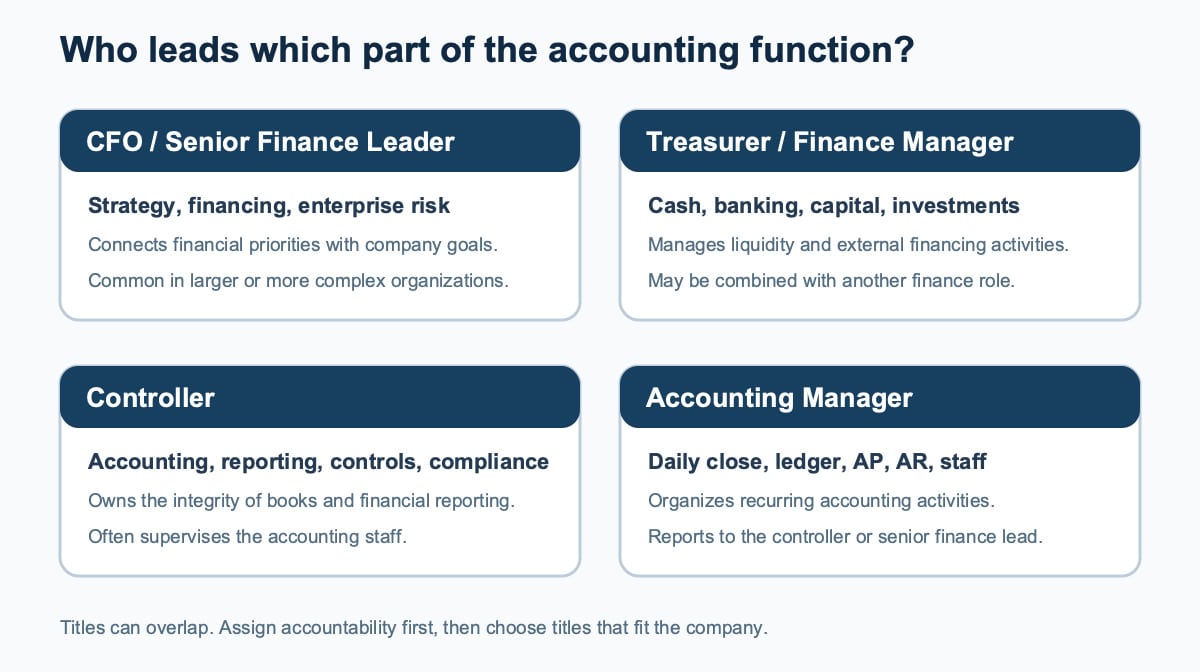
The accounting department may be headed by a Controller, a Chief Financial Officer (CFO), or another senior finance leader. The right title depends on the scope of the job. The U.S. Bureau of Labor Statistics notes that the responsibilities of top executives largely depend on an organization’s size.
BLS distinguishes controllers, treasurers, credit managers, and cash managers as different types of financial managers. In practice, a CFO or senior finance leader usually focuses on financial strategy, financing, enterprise risk, and communication with executive leadership. A Treasurer or finance manager focuses on cash, banking, capital, investments, and fund balances. The Controller directs accounting and control functions, reports the results of operations, and supervises the accounting staff.
In a smaller company, one person may perform several of these roles. In a larger company, the administrative or operations staff may report to a Vice-President of Finance and Administration so the Controller can focus on accounting operations. Titles can overlap, so assign accountability first and select titles second.
What Are Finance and Treasury Responsibilities?
Finance and Treasury responsibilities are focused on raising capital, debt or equity arrangements, cash management, Treasury investments, fund balances, and long-range management activities. The finance leader is responsible to the President or CFO for establishing company-wide financial and administrative objectives, policies, programs, and practices that support a sound financial structure.
The exact boundary between Treasury and the Controller varies. A useful chart separates ownership of cash and financing decisions from ownership of accounting records and reporting, even when the same person fills both roles. The Finance Policies and Procedures Manual provides a broader framework for finance and treasury activities.
What Does the Controller Oversee?
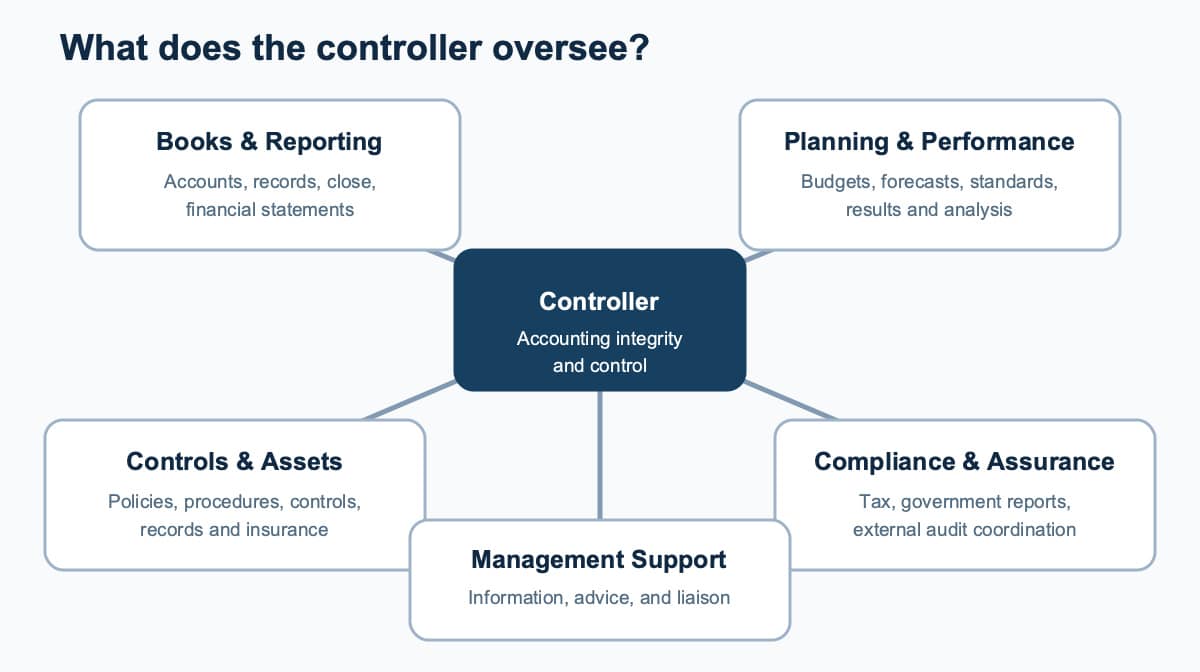
The Controller is accountable to the President, CFO, or senior finance leader and supervises the accounting and control functions. O*NET lists supervising financial reporting, accounting, billing, collections, payroll, and budgeting staff among typical controller tasks. The following responsibilities preserve the practical scope of the original chart while recognizing that assignments vary by organization.
- Develops and implements the Accounting Manuals Template, accounting policies, systems, and procedures.
- Maintains the company’s system of accounts and keeps books and records for company transactions and assets.
- Prepares operating data, special reports, and interim and year-end financial statements.
- Establishes and administers plans for operational control, profit planning, capital investing and financing, sales forecasts, expense budgets, and cost standards.
- Coordinates and reviews budget proposals with the President and finance leadership, including significant proposed changes.
- Compares performance with operating plans and standards, then reports and interprets the results of operations for management.
- Establishes and administers tax policies and procedures and coordinates reports to government agencies.
- Provides managers and departments with the information required to carry out assigned responsibilities.
- Protects business assets through internal controls, record safeguards, insurance coordination, and support for independent assurance.
- Supports product-pricing policy, legal counsel, outside accountants, and the appointment and work of independent public accountants when those duties are assigned.
- Advises the Vice President of Finance, President, and other managers on accounting and control matters.
- Coordinates company-order records and retrieval controls when order administration falls within the finance function.
Which Accounting Staff Roles Belong on the Chart?
Accounting staff responsibilities are focused on accurately documenting the company’s operations, collecting money owed to the company, and responsibly disbursing money owed to vendors. The specific positions depend on transaction volume, complexity, and how work is divided.
Accounting Manager Responsibilities
The accounting manager directs and organizes general accounting activities and accounting staff. This role prepares accounting and financial reports, maintains accurate accounting systems and record keeping, and commonly reports to the Controller. The accounting manager may supervise the Accounts Payable Clerk and Accounts Receivable Clerk and connect their work to documented accounts payable procedures and accounts receivable procedures.
Credit and Collections Manager Responsibilities
The Credit and Collections Manager processes customer credit inquiries, approves credit or financing terms within delegated authority, and coordinates collection of delinquent accounts. The role often reports to the Controller and coordinates with Accounting and Sales.
Purchasing Manager Responsibilities
The purchasing manager buys inventory, supplies, and capital goods; negotiates price, delivery, and credit terms; evaluates vendors; and helps determine inventory and reorder levels. The role may report through finance, operations, manufacturing, or another function. The chart should show the actual line and the required coordination with Accounts Payable and Receiving.
Internal Audit Manager Responsibilities
The internal audit manager evaluates internal control mechanisms, performs audit work on areas such as payroll and billing, and recommends improvements to accounting policies, procedures, and business processes. The IIA says internal audit’s independence from management helps keep its work free from hindrance and bias. Show functional accountability to the board or audit committee, even if day-to-day administration is coordinated with an executive.
When Do Operations Staff Appear on the Chart?
Operations staff responsibilities are focused on supporting operating transactions with administration, training, information, purchasing, receiving, and related services. In some smaller or combined finance-and-administration structures, these positions appear beneath the Controller or finance leader. In other companies they report through Human Resources, Technology, Supply Chain, or Operations. The chart should describe the organization you actually operate.
- Office Manager: performs administrative, office, and clerical functions; supports the President and managers; and may supervise reception.
- Human Resources Manager: develops and updates personnel policies, procedures, and forms; assists managers and employees; and maintains personnel records. The Human Resources Manual can support this branch.
- Information Systems Manager: oversees network and Internet operations, defines technical goals with management, plans hardware and software changes, and determines technology personnel and equipment needs.
- Warehouse Manager: supervises receiving, storage, order pulling, packing, shipping, and freight-carrier coordination.
How Do You Build an Accounting Department Organization Chart?
Start with the work, not the job titles. A small company may combine several functions in one role, but the chart should still make approval, custody, record keeping, and review responsibilities visible.
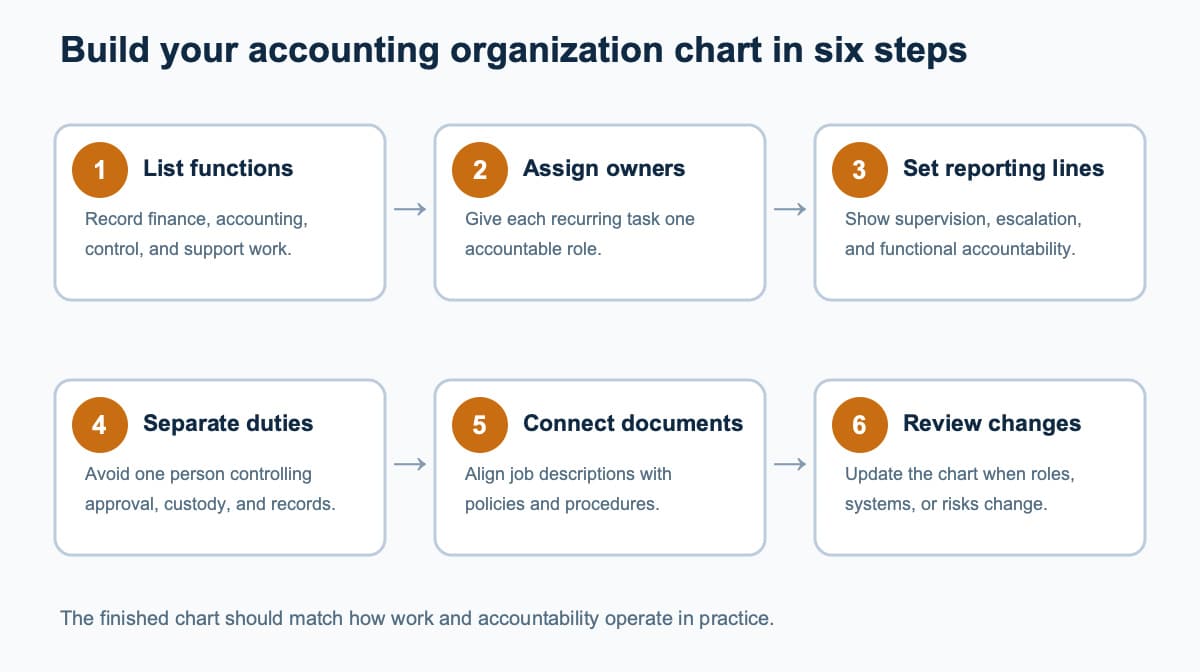
- List required functions. Include finance, Treasury, general accounting, Accounts Payable, Accounts Receivable, payroll, tax, budgeting, reporting, internal control, and any assigned operations support.
- Assign one accountable role. Name the role responsible for each recurring result, even when several people help perform the work.
- Set reporting lines. Show direct supervision, escalation paths, and functional accountability such as the internal audit relationship with the board or audit committee.
- Check separation of duties. Avoid giving one person unchecked control over approval, custody of assets, record keeping, and reconciliation.
- Connect the chart to documents. Align roles with job descriptions, accounting policies, procedures, system access, and approval limits.
- Review changes. Update the chart when staffing, systems, transaction volume, risks, or operating structure change.
Your Accounting Department Organization Chart is the basis for a clear accounting management system. It communicates accounting department roles and responsibilities while your procedures document the detailed financial tasks. Review the chart with the people who perform and approve the work, then compare it with your current job descriptions and system permissions.
Download Free Sample Accounting Procedures to see how editable Microsoft Word templates can support your accounting organization chart, policies, procedures, and systems.
Frequently Asked Questions
Who should lead an accounting department?
A Controller, CFO, senior finance leader, or owner may lead the department. Choose the role that has enough authority and accounting knowledge to own reporting, controls, staffing, and escalation.
What is the difference between a CFO, Controller, and accounting manager?
A CFO usually leads financial strategy and executive communication, a Controller owns accounting and control, and an accounting manager organizes daily accounting work. Smaller companies may combine these responsibilities.
Which positions belong on a small-business accounting chart?
Show the roles that own cash, billing, collections, Accounts Payable, Accounts Receivable, payroll, record keeping, financial reporting, budgeting, tax coordination, and internal control. One person may fill several roles, but each responsibility should remain visible.
Should HR, IT, purchasing, or warehouse staff report to accounting?
They may report through finance in a combined administration structure, but they often report through separate operating functions. Use the reporting line that matches actual accountability, expertise, and control needs.
How often should the organization chart be updated?
Review the chart whenever roles, systems, transaction volume, approval limits, or risks change. A scheduled annual review can catch smaller changes that accumulated during the year.