How Do You Keep Business and Personal Finances Separate?

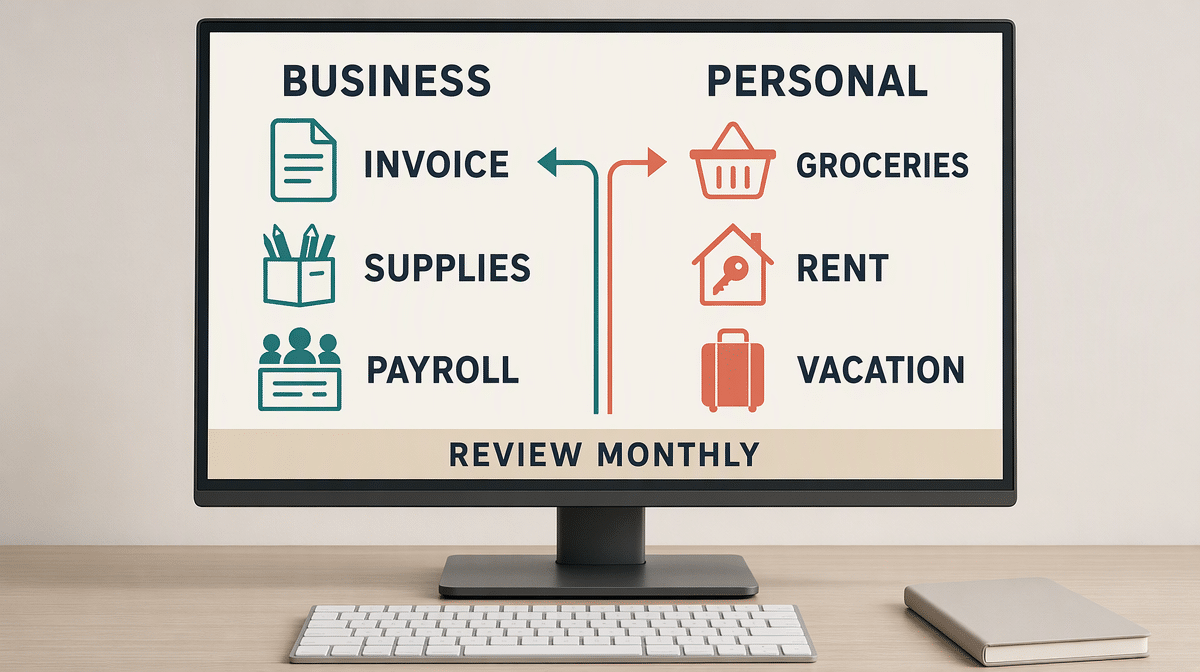
A personal purchase on a business card or a customer payment deposited into a personal account can create hours of avoidable cleanup. The practical answer is to give business money its own path: separate accounts and payment methods, documented owner pay, organized supporting records, and a regular review process.
Keeping business and personal finances separate makes your records easier to understand and helps you explain where money came from and why it was spent. It also gives partners, employees, bookkeepers, and tax professionals a consistent system to follow.
6 Easy Ways to Keep Your Business and Personal Finances Separate
A business can build up legal, tax, and financial obligations, so your operating records should clearly distinguish the business from the people who own it. Use these six controls to keep your business identity and transactions separate from your personal activity.
1. Establish a Separate Business Entity
Start by choosing the business structure that fits your ownership, risk, tax treatment, and state requirements. This applies whether you are launching an eCommerce business or operating something else. A sole proprietorship, partnership, C Corp, S Corp, or LLC can each be appropriate in different circumstances. Which type of legal entity fits depends on the nature of your business. If you are unsure, a legal expert and tax professional can steer you in the right direction. The IRS notes that legal and tax considerations enter into selecting a business structure. Review the IRS business structures guidance for the federal tax context.
Apply for an Employer Identification Number when your situation requires one or when you need it for banking or other business administration. An EIN is a federal tax identification number, not the document that creates a separate state-law entity. Keep formation documents, tax registrations, licenses, and ownership records together so the business identity is easy to verify.
2. Open a Business Bank Account
Open a business checking account and route business receipts and payments through it. Use a dedicated business debit or credit card for purchases instead of switching between personal and business cards. The IRS recommends keeping separate business and personal accounts because doing so makes recordkeeping easier. This clean transaction trail also helps you understand your business cash flow.
You do not want to mix your business and personal expenses together in a checking or credit account. A line of credit is not required for financial separation. If you use business credit, choose it for a documented financing need and establish controls for authorized users, receipts, and repayment. You can also learn how payment history and account reporting affect a business credit score.
3. Give Yourself a Salary or Documented Owner Pay
As your own boss, keeping your personal spending separate is hard to do when you are paying for everything from one account. Do not treat the business account as a personal wallet. Establish a consistent process for transferring money to yourself, record the transaction correctly, and pay personal expenses from your personal account. The procedures for compensating yourself depend on the type of business structure you elect. The IRS owner compensation guidance explains why a sole proprietor, partner, and corporate officer may be paid differently.
For example, an S corporation must pay reasonable compensation to a shareholder-employee for services before making non-wage distributions to that person. See the IRS S corporation compensation guidance. Work with your accountant or payroll professional to define the correct salary, draw, distribution, or reimbursement process, then document it in your payroll policies.
4. Separate and Keep Receipts
Capture supporting records when each business transaction occurs. IRS Publication 583 lists sales slips, paid bills, invoices, receipts, deposit slips, and canceled checks among the documents that can support entries in business books. Review IRS Publication 583 for federal recordkeeping guidance that applies to your situation.
For digital receipts, you can set up folders on your phone or computer by month or expense category and use a consistent filename that identifies the vendor and purpose. To organize your physical receipts, you can use labeled folders or a pair of boxes to keep things separate, then scan fading receipts promptly. Accounting software such as Quicken or QuickBooks can help organize transactions, but the important control is a complete record that connects each purchase to its business purpose. That distinction also improves your accounting and bookkeeping.
5. Understand Personal vs. Business Expenses
Understanding how accounting systems work helps, but every transaction still needs a clear business purpose and the correct account code. If an expense is partly business and partly personal, separate the personal portion from the business portion; the personal portion is generally not deductible. The IRS small business tax guide explains this federal rule.
Mixed-use expenses can include a personal phone used to consult with customers, a personal vehicle driven to business meetings, or a qualifying home office. Keeping daily, weekly, or monthly notes of personal items used for business can help when your accountant asks for the total and the records that back it up. Keep a contemporaneous log or other support for the business portion and ask a tax professional which rules apply. Do not move the full cost into the business records merely because the item was sometimes used for work.
6. Educate Other Business Members
Partners and employees need the same separation rules as the owner. Provide training on approved payment methods, receipt submission, reimbursement, account coding, and what to do after an accidental personal charge. If you are the only one actively separating personal expenses from business expenses, the records will still require cleanup. If everyone is informed and involved, keeping personal expenses separate becomes a shared routine.
Make the rule easy to follow: business purchases use the business account, personal purchases use the personal account, and exceptions are reported promptly. Documenting these accounting procedures gives the team one reference point and makes recurring errors easier to spot.
Use a 30-Day Financial Separation Checklist
Use this worked checklist to turn the six ideas into a repeatable control. Assign one owner for each item and retain the listed proof.
| Control | Owner and Frequency | Proof to Keep |
|---|---|---|
| Route all business income to the business account | Owner or bookkeeper, each receipt | Deposit record and invoice |
| Use only the approved business card for business purchases | All authorized users, each purchase | Card record and supporting document |
| Transfer owner pay using the approved method | Owner or payroll administrator, each pay period | Payroll report, draw record, or distribution record |
| Document mixed-use phone, vehicle, or home-office costs | Owner, at least weekly | Usage log and allocation support |
| Correct accidental mixed transactions | Bookkeeper, within five business days | Correction entry and reimbursement record |
| Reconcile business bank and card accounts | Bookkeeper plus reviewer, monthly | Completed reconciliation and exception notes |
Keeping Business and Personal Finances Separate
Mixing personal and corporate funds can hide cash-flow problems and make reporting harder. The goal is not merely to own two bank accounts. It is to make every receipt, payment, owner transfer, reimbursement, and mixed-use allocation follow a clear route. Capture records weekly, reconcile accounts monthly, and correct mistakes as soon as they are found.
A clean system supports better money management and reduces the confusion created by combining business and personal costs. Review the process with your accountant when the business structure, ownership, payroll, or tax treatment changes.
Frequently Asked Questions
Can a sole proprietor use a personal bank account for business?
A sole proprietor may not have a separate state-law entity, but a dedicated business account still creates a clearer transaction record and makes business activity easier to reconcile.
What should you do after accidentally paying a personal expense from the business account?
Record the transaction promptly, classify it according to your entity and accounting method, reimburse the business when appropriate, and keep a note explaining the correction.
Should every business owner pay themselves a salary?
No. The correct method may be a salary, draw, distribution, guaranteed payment, or another documented method, depending on the business structure and tax treatment.
How should you track an expense that is partly business and partly personal?
Document the business purpose and a reasonable allocation method, record only the business portion in the appropriate expense account, and retain the supporting log or calculation.
How often should business accounts be reconciled?
Reconcile business bank and card accounts at least monthly, and review unusual or mixed transactions sooner so errors do not accumulate.