How to Create Policies and Procedures Strategy

Policies and procedures define your processes, help with deploying your strategy, and identify what is important to the business. ISO standards and the official ISO explanation of a quality management system both point to the same operating idea: policies, processes, procedures, and responsibilities have to work together if improvement is going to be managed. Yet, how often have you contemplated your policies and procedures strategy?
Your policies and procedures should not be an afterthought. Your policies stem from the vision, mission, and values of the organization. Your procedures define the consistency of your business model. Together they represent your strategy and how it is deployed throughout the organization.
What Is a Policies and Procedures Strategy?
A policies and procedures strategy is the deliberate way a company turns strategic intent into repeatable work. It connects the goal, the policy decision, the procedure, the work instruction, the owner, and the measurement that proves the work is happening as intended.
That sounds simple, but many companies treat policies and procedures as paperwork instead of as part of the business model. Strategy says what the business is trying to accomplish. Policies say what the organization believes, requires, allows, and prohibits. Procedures explain how employees carry out those decisions in a consistent way.
When those layers are aligned, employees can see the path from a boardroom decision to the task in front of them. When they are disconnected, the company may have a polished strategy document and still operate through old habits, outdated approvals, unclear handoffs, and competing interpretations of what management actually wants.
Does Your Policies and Procedures Strategy Lack Results?
Your policies and procedures strategy may not be delivering results because it lacks alignment with your tactics. If you want to enter new markets, double sales, or launch a new product, then you need a defined course of action to get there. You cannot wish that it happens.
Employees need clear milestones, action plans, and concrete steps they can take to achieve your strategy. The SBA describes a business plan as a roadmap for how the company will structure, run, and grow the business in its business planning guidance. Policies and procedures are how that roadmap becomes daily operating behavior.
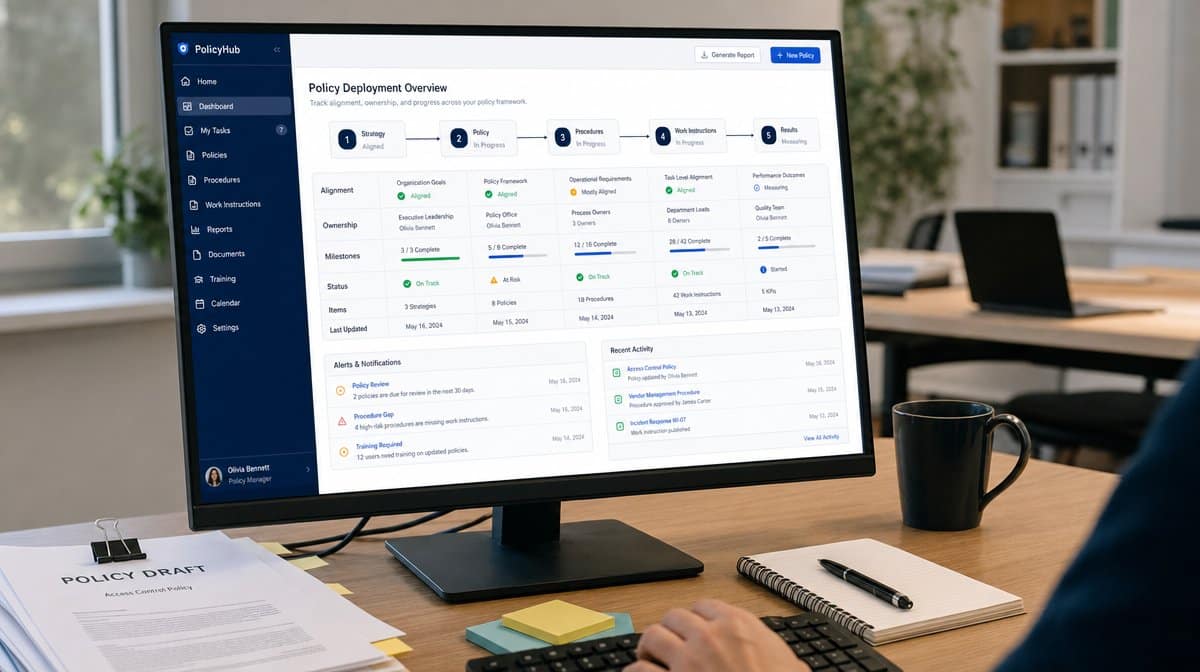
Business policy deployment includes your strategy, policies, procedures, and work instructions. The chain matters because every strategic goal creates work that someone has to own. If ownership is unclear, the goal moves slowly. If the procedure does not match the goal, people may work hard while still producing the wrong result.
A strategy also fails when the company updates the goal but leaves the operating system untouched. The sales team may hear that growth is the priority, but the approval procedure still delays new proposals. The product team may hear that innovation is urgent, but the development procedure still routes every small decision through a committee. The hiring team may hear that speed matters, but the recruiting process still assumes a slow replacement cycle.
How Do Policies and Procedures Deploy Strategy?
Policies and procedures represent your strategic intent. A specific policy and procedure can propel you forward just as much as it can hold you back from achieving your objectives. Not having any policies and procedures in place can create confusion. Employees may not understand what you literally want them to do.
Existing policies may need to change. Old priorities may shift and new procedures may be required to achieve your goal. If a company decides customer retention matters more than new-logo volume, then the sales procedure, customer handoff procedure, renewal approval process, support escalation rules, and reporting cadence all need to reflect that shift.
This is where many organizations struggle. They announce a new objective, hold meetings about why it matters, and then leave employees to interpret how their work should change. A better approach is to write policies and procedures that translate the objective into standards, steps, roles, approvals, records, and measurements.

Policies Set Direction
A policy states the rule or operating principle. It may define who can approve a purchase, what quality standard must be met, how customer complaints are handled, or what level of documentation is required before a process changes. The policy should be stable enough to guide decisions, but current enough to reflect the business strategy.
Procedures Create Consistency
A procedure turns the policy into repeatable work. It identifies the sequence, the responsible roles, the inputs, the outputs, the records, and the exceptions. Good policies and procedures documentation removes guesswork from routine decisions, which is one reason procedures are central to strategy deployment.
Work Instructions Clarify the Task
Work instructions sit closer to the employee doing the task. They explain details that do not belong in a policy, such as how to complete a form, enter information into a system, check a record, or prepare a package for review. The more complex the strategy, the more important it becomes to connect the high-level policy to specific work instructions.
How Should You Make Tactical Adjustments?
Let’s take a simple strategy to doubling sales as your strategic goal. When you set this as the future state for your company, are you saying you plan to double every salesperson’s quota or do you plan to double the number of salespeople? Each would require a different change to your sales and marketing process.
Doubling quota may mean doubling new product introductions, doubling territory sizes, changing lead qualification rules, or retraining salespeople to be more effective in closing sales. Those changes might affect pricing approvals, proposal reviews, forecasting, CRM data requirements, discount authority, customer handoffs, and sales training records.
The alternative may be to double salespeople. This in turn would require doubling leads, entering new markets, and training new salespeople on selling your products. That tactic affects recruiting, onboarding, compensation, territory assignment, product training, marketing campaigns, lead routing, and management review.
The strategic goal is the same in both cases. The policies and procedures strategy is different. That is why tactics cannot be separated from procedures. The choice of tactic tells you which procedures to create, which procedures to revise, which approval points to remove, and which work instructions must be rewritten before employees can execute.
How Do You Turn Strategy Into Procedure Changes?
You can see a lot of interaction with other departments like marketing, new product development, and training. An effective strategy requires that you think through the deployment steps and tactics so you can define the adjustments needed to your policy and procedure system.

Identify the Strategic Goal
Start with the specific result the business wants. “Grow” is not enough. Entering two new markets, reducing order errors by 30 percent, shortening onboarding time, or launching a new product line are clearer targets. A clear goal lets you decide which processes must change and which policies are unaffected.
Map the Processes That Touch the Goal
Trace the work across departments. Strategy usually crosses boundaries. A sales growth goal may involve marketing, sales, finance, product development, customer service, and training. A quality improvement goal may involve purchasing, production, inspection, corrective action, document control, and management review.
Find the Policy Decisions
Ask what management has to decide before the new strategy can operate. Who has authority? What standard applies? What records are required? What exceptions are allowed? What risk level is acceptable? These questions become policy decisions, and those policy decisions shape the procedures that follow.
Revise the Procedure and Owner
A procedure without an owner quickly becomes shelfware. For each procedure change, identify the owner, the affected roles, the forms or systems involved, and the training requirement. If the change affects multiple teams, document the handoff points clearly so each team knows when its part starts and ends.
Measure Whether the Procedure Works
A strategy is not deployed just because a procedure was edited. Define the measurement that proves the procedure is working. That may be cycle time, error rate, lead conversion, quote turnaround, audit findings, customer complaints, training completion, or another operating metric that tells management whether the new behavior is taking hold.
Why Is Effective Strategy Linked to Effective Policies and Procedures?
A lot of time and money is spent developing strategy, defining the action steps, and then communicating it to all of the employees. Yet how much time are you spending looking into the policies and procedures strategy? Your policies and procedures are your strategy. If you do not have time to adjust your policies and procedures for the new strategy, then how do you expect to achieve your new strategy with outdated policies and procedures?
Policies and procedures make strategy visible. They show employees what has changed, what has not changed, who owns the work, and how results will be checked. They also make it easier to train new employees, audit performance, correct breakdowns, and improve the system over time.
The point is not to create more documentation for its own sake. The point is to make the business model repeatable. When your procedures match your strategy, employees have a clearer path from intention to action. When they do not match, the organization keeps running the old strategy even while management talks about the new one.
Frequently Asked Questions
What Is a Policies and Procedures Strategy?
A policies and procedures strategy is the method a company uses to connect business goals to policies, procedures, work instructions, owners, and measurements. It turns strategic intent into repeatable work.
Why Should Policies and Procedures Be Linked to Strategy?
Policies and procedures should be linked to strategy because employees need clear operating rules and steps to execute management’s goals. Without that link, a company may announce a strategy while daily work continues under old assumptions.
How Do Procedures Help Deploy Business Strategy?
Procedures help deploy business strategy by defining who does the work, what sequence they follow, which records are required, and how results are measured. They turn broad direction into consistent execution.
When Should Policies and Procedures Be Updated?
Policies and procedures should be updated when strategy changes, roles change, regulations change, audit findings reveal gaps, or employees cannot execute the current process consistently. A strategy review should include a procedure review.
What Happens If Policies and Procedures Are Outdated?
Outdated policies and procedures create confusion, slow execution, and make employees follow old priorities. They can also weaken training, quality control, compliance, and management’s ability to measure whether the strategy is working.