The Complete Guide To Current State Process Maps

A team may agree that an order takes too long, yet each person describes a different process. Customer service remembers the clean orders, the warehouse remembers stock exceptions, and accounting notices only the adjustments. Improvement begins when those separate views become one observable record of what happens.
A current state process map is a visual record of how work actually moves now, including its steps, decisions, roles, handoffs, systems, delays, and exception paths. This guide shows how to scope, observe, build, verify, and analyze that map before designing a future state. It also includes a reusable observation worksheet and a worked order-fulfillment example.
What Is a Current State Process Map?
A current state process map, also called an as-is process map, describes the process that operates today. It begins with a defined trigger and follows the work to a defined output. The map records the normal path, important decisions, less common exceptions, and the people or systems responsible for each activity.
The word current matters. The map is not the written procedure, the manager’s preferred method, or the workflow the software was configured to support. It is the best evidence-backed account of the work people perform, including workarounds and delays that formal documentation may omit.
Current-state mapping is one application of business process mapping. A flowchart is a common type of process map that shows process steps in sequence with symbols and arrows. A swimlane map adds roles or departments, while a value-stream map adds information about flow, time, inventory, and waste.
The map is a model, not a perfect copy of reality. Its value comes from selecting the detail needed for a decision, verifying that detail with the people who perform the work, and preserving evidence that helps the team distinguish observation from assumption.
Why Map the Current State Before the Future State?
A future state map describes how the process should work after improvement. Creating that to-be process too early encourages the team to solve a simplified version of the problem. The design may remove a visible step while ignoring the exception, approval, dependency, or data problem that created it.
- Establish a shared baseline. People can discuss one map instead of competing memories.
- Reveal hidden work. Follow-up messages, spreadsheets, manual checks, and exception handling become visible.
- Separate work time from waiting. A task may take five minutes while sitting in a queue for two days.
- Locate ownership gaps. The map shows where nobody clearly owns a decision, handoff, or record.
- Protect necessary controls. The team can distinguish a required verification from avoidable delay.
- Create measurable before-and-after evidence. Cycle time, rework, handoffs, and error points can be compared after a change.
ISO’s quality management principles provide a structured approach for defining objectives, establishing processes, and developing systems to manage quality. A current-state map supports that discipline by connecting the objective to the work that produces it. The map does not prove compliance with a standard, but it gives process owners a practical basis for defining, managing, and improving the work.
How Should You Scope a Current State Map?
Start with a business question, not a blank diagram. A useful question might be, “Why do complete orders miss the same-day shipping cutoff?” That question identifies a customer outcome, suggests a start and finish, and keeps the workshop from expanding into every activity related to sales, inventory, purchasing, and delivery.
Write a one-sentence scope statement before observing the work. Include the trigger, final output, customer, process owner, included locations or channels, and the conditions that are outside the current study.
| Scope element | Question to answer | Order-fulfillment example |
|---|---|---|
| Trigger | What starts the process? | A paid online order enters the order queue |
| Output | What proves the process is complete? | The package ships and the customer receives confirmation |
| Customer | Who receives or depends on the output? | The buyer and the service team handling questions |
| Included path | Which products, channels, sites, and exceptions matter? | Stocked products shipped from the main warehouse |
| Excluded path | What will be mapped separately? | Backorders, custom products, and international shipping |
Choose the map level that answers the question. The guide to process map levels helps distinguish an end-to-end view from a task-level procedure. If the first draft contains dozens of tiny actions, return to a higher level and expand only the step that needs analysis.
Current-State Observation Worksheet
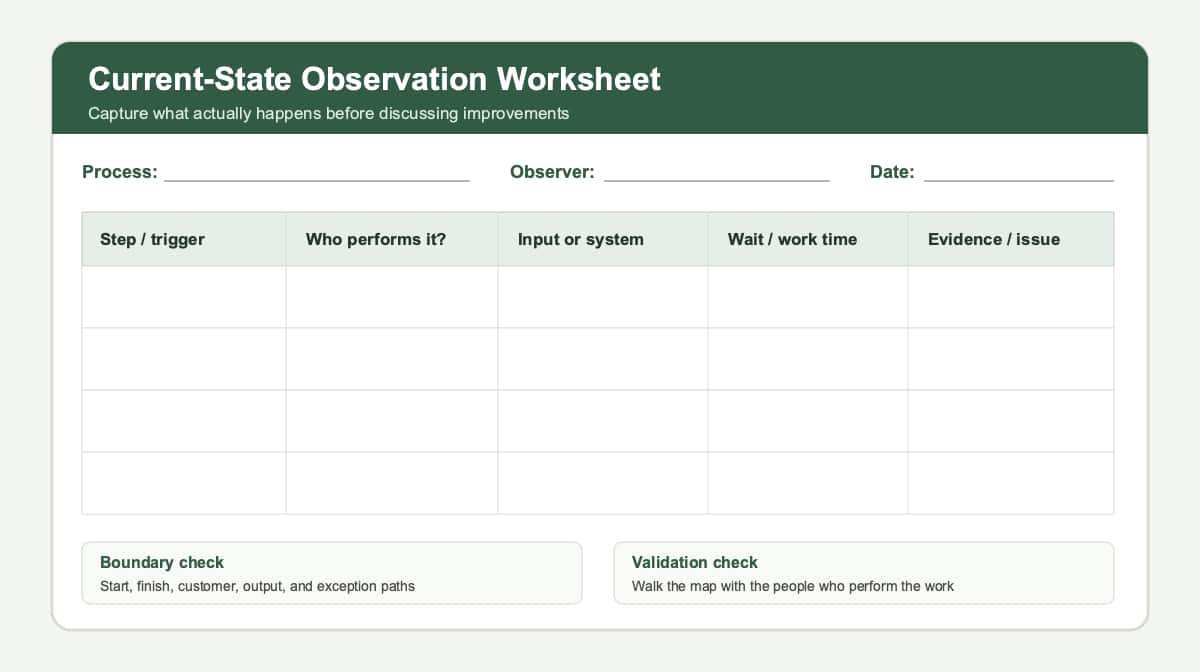
Use the worksheet during interviews, job shadowing, document review, or a mapping workshop. Record one observed step per row. Keep facts in the observation fields and save improvement ideas for a separate parking list so suggestions do not quietly rewrite the as-is process.
| Field | What to capture | Evidence example |
|---|---|---|
| Step or trigger | An action stated with a verb and object | Print pick ticket |
| Performer | Role that does or decides the work | Warehouse coordinator |
| Input or system | Information, material, document, or application used | Paid-order queue |
| Time | Active work time and waiting time, recorded separately | 3 minutes work, 45 minutes average wait |
| Evidence or issue | Record, observation, variation, error, rework, or unanswered question | Ticket print time and three observed reprints |
ASQ recommends that the people who perform the work draw the current-state map and then walk through it to verify accuracy. Include experienced employees and at least one person who handles exceptions. A manager can explain the intended process, but performers can show where the actual process branches, waits, and relies on informal knowledge.
What Detail and Symbols Should You Use?
Use the simplest notation the audience can read. Standard symbols help, but a technically perfect diagram that employees cannot verify is not useful. The purpose of a process map should determine whether you need a basic flowchart, swimlanes, a SIPOC view, a document map, or a more detailed analysis model.
- Rounded rectangle: start or end point.
- Rectangle: activity performed by a person or system.
- Diamond: decision with labeled paths.
- Arrow: direction of work, information, or material flow.
- Swimlane: role, team, department, system, or outside party responsible for the step.
- Annotation: timing, evidence, issue, system, control, or exception detail that matters to the study.
Name activities with a verb and object, such as “review order” or “create shipping label.” Label decision paths, such as yes, no, approved, rejected, complete, or incomplete. When several branches return to the same point, draw the return path instead of pretending the exception disappears.
How Do You Build a Current State Process Map?
- Define the improvement question. State the customer, outcome, and concern that make the map necessary.
- Set the boundaries. Record the trigger, output, owner, included paths, and exclusions.
- Select participants. Include the people who perform the normal work, handle exceptions, supply inputs, receive outputs, and manage the supporting systems.
- Gather existing evidence. Review procedures, forms, system timestamps, queue reports, error records, messages, and prior audit findings. Treat documents as evidence of the intended process until observation confirms actual practice.
- Observe and interview. Follow real items through the process where practical. Ask what happens next, what can go wrong, what the performer waits for, and how completion is proven.
- Draft the normal path. Place the start, major activities, decisions, handoffs, and finish in sequence. Add swimlanes when responsibility matters.
- Add exception paths. Include missing information, rejected approvals, unavailable inventory, system failure, rework, cancellation, and escalation paths that materially affect the result.
- Add analysis data. Record work time, wait time, frequency, volume, errors, systems, evidence, and control points only where the data helps answer the question.
- Walk the map. Trace several real cases with the people who perform the work. Correct steps, labels, sequence, roles, and missing branches.
- Freeze the baseline. Add the scope, date, version, owner, evidence sources, and unresolved questions. Save improvement ideas separately before designing the future state.
Do not force agreement by voting on facts. When participants describe different paths, determine whether the process varies by product, location, customer, employee, or exception. The accurate map may show two current paths and record the conditions that select each one.
A facilitator should guide the sequence without deciding what the process must be. Ask one participant to describe a recent case, let the next performer explain what arrived and what happened, then compare the account with available records. When a statement is uncertain, mark it as a question and assign an evidence check instead of allowing the group to debate from memory.
Use a simple validation sample. Select several routine cases, at least one exception, and one case from a different day, shift, location, or employee when variation is possible. Trace each case from the trigger to the output. Note where the record follows the map, where it branches, and where the evidence is missing. This is not a statistical study, but it is stronger than accepting the first workshop draft.
Finish the baseline with a short sign-off record. List the participants, cases reviewed, systems or documents checked, known exclusions, open questions, process owner, and next review date. Sign-off does not mean that the process is good. It means the map is an agreed and appropriately qualified representation of the current state for the stated analysis purpose.
Worked Example: Order Fulfillment Current State Map
The following hypothetical example maps a paid online order from receipt through shipment confirmation. It uses swimlanes to expose handoffs between customer service, the warehouse, shipping, and follow-up work.
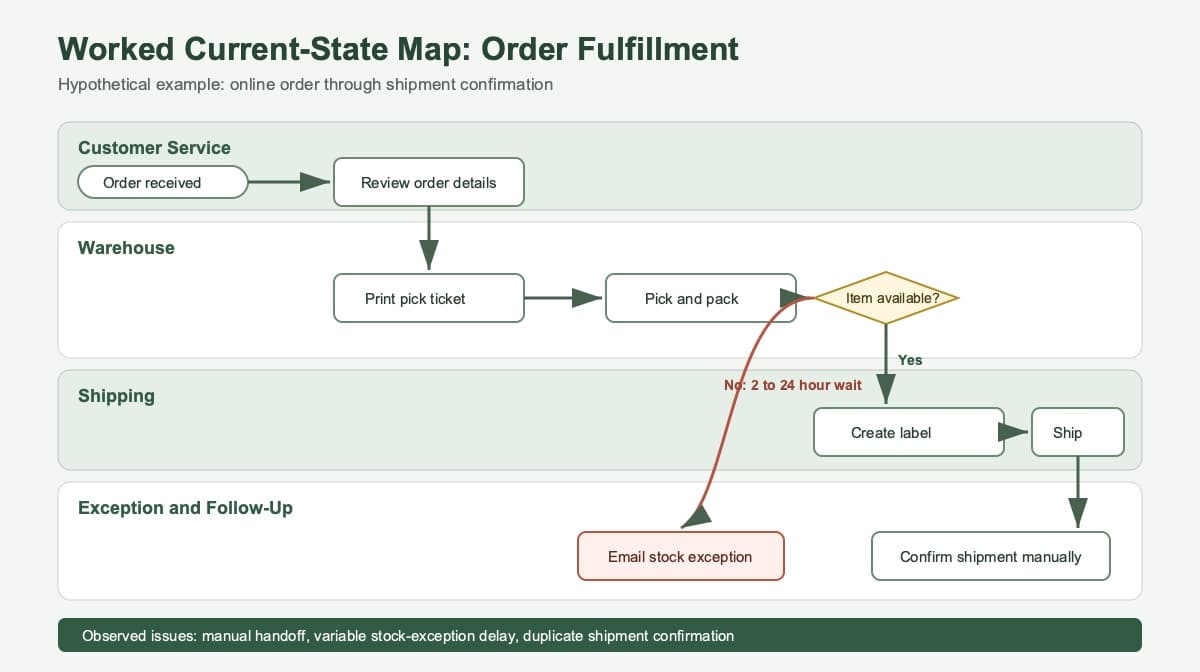
The normal path appears simple: receive the order, review it, print the pick ticket, pick and pack, create the label, ship, and confirm shipment. The exception path changes the analysis. An unavailable item triggers an email, creates a variable wait, and may require a manual confirmation after shipping.
The map alone does not prove the size of the problem. The team should examine order timestamps, exception volume, message records, and a sample of shipments. If the evidence confirms the delay and duplicate confirmation, the future-state design can address the cause instead of merely redrawing the normal path.
How Do You Analyze the Current State?
Analysis begins after the map is accurate enough for the decision. Once the current state is visible, the team can examine bottlenecks, delays, rework, authority gaps, duplication, excessive handoffs, cycle time, and unnecessary steps. Use evidence to distinguish a frequent failure from a memorable exception.
| Analysis lens | Question | Evidence to inspect |
|---|---|---|
| Customer value | Which steps create the required output, and which exist because of internal failure or uncertainty? | Customer requirements, complaints, returns, service records |
| Flow | Where does work queue, stop, loop, or travel backward? | Timestamps, queue age, work-in-process, handoff records |
| Quality | Where are errors created, detected, corrected, or passed downstream? | Defect, rework, adjustment, and return records |
| Responsibility | Is each decision and record clearly owned? | Role descriptions, approvals, escalation records |
| Control | Which checks prevent meaningful risk, and which duplicate another check? | Policies, exceptions, audit findings, error prevention evidence |
| Systems and data | Where is information re-entered, reconciled, missing, or unavailable? | System logs, spreadsheets, forms, integration failures |
Mark findings on a copy of the verified map, not on the baseline itself. For each finding, record the observed condition, supporting evidence, effect, likely cause, owner, and unanswered question. This discipline prevents a workshop opinion from becoming an untested fact.
How Do You Move From As-Is to To-Be?
Keep the current-state and future-state maps separate. The as-is map preserves the baseline. The to-be process shows the proposed design. A third record should explain each proposed change, the evidence behind it, the expected benefit, the owner, and the measure used to determine whether the change worked.
- Prioritize the problem. Select findings with meaningful customer, cost, quality, risk, or capacity impact.
- Identify the cause. Test why the condition occurs instead of redesigning around the symptom.
- Define design principles. Examples include one accountable owner, one source of data, earlier error prevention, fewer handoffs, or explicit exception routing.
- Draw the future state. Show the intended steps, responsibilities, decisions, systems, controls, and exception paths.
- Test the design. Walk representative normal and exception cases through the proposal before changing procedures or systems.
- Plan implementation. Assign actions for procedure updates, configuration, training, data, controls, communication, and measurement.
- Measure the result. Compare the new process with the frozen baseline and update the map after the change stabilizes.
When the map exposes several connected problems, treat them as a managed improvement initiative rather than a collection of isolated fixes. A clear set of process improvement aspirations can connect the future-state design with ownership, resources, procedure changes, and review.
What Current-State Mapping Mistakes Should You Avoid?
- Mapping the procedure instead of the work. Use documents as inputs, then observe and verify actual practice.
- Designing improvements during observation. Keep a parking list so ideas do not rewrite the baseline.
- Excluding the people who do the work. Managers and analysts rarely see every handoff, workaround, and exception.
- Ignoring exceptions. The normal path may be fast while exceptions create most delay, cost, and customer contact.
- Mixing levels of detail. Do not place an end-to-end phase beside dozens of keystrokes. Expand a step in a separate lower-level map.
- Using unlabeled decisions. Every branch should state the condition that sends work down that path.
- Confusing work time with cycle time. Record active effort and waiting separately.
- Adding data without a question. Measurements should support the analysis, not decorate the map.
- Treating every variation as noncompliance. Determine whether the variation reflects customer need, local context, weak training, missing control, or an obsolete procedure.
- Stopping after the workshop. Validate the draft with real cases and retain the evidence, scope, owner, and version.
The broader list of process mapping mistakes can help a facilitator check scope, participation, analysis, and diagram complexity before approving the baseline.
A reliable current-state map does not need to be elaborate. It needs a clear boundary, evidence from real work, visible exception paths, truthful ownership, and validation by the people who perform the process. When those conditions are present, the map becomes a practical baseline for procedure improvement rather than another diagram stored in a folder.
Frequently Asked Questions
What Is the Difference Between a Current State Map and a Future State Map?
A current state map records how the process actually operates now, including delays, workarounds, and exceptions. A future state map describes the intended process after improvement. Keep both maps so the team can explain the change and measure results against the baseline.
Who Should Participate in Current-State Process Mapping?
Include people who perform the normal work, handle exceptions, provide important inputs, receive the output, manage supporting systems, and own the process. The group should be small enough to work through details while representing every material handoff.
How Detailed Should a Current State Process Map Be?
Use only the detail needed to answer the improvement question. Start with major activities, decisions, roles, and exception paths. Expand a step into a separate lower-level map when task detail, system actions, controls, or timing require closer analysis.
How Do You Verify a Current State Process Map?
Walk representative real cases through the map with the people who perform the work. Compare the sequence, roles, decisions, timestamps, records, and exception paths with actual evidence. Record unresolved variations instead of forcing a single path that the evidence does not support.
Bizmanualz Process Mapping Resources