How Do You Build a Brand Identity on Social Media?

When a business changes its colors, tone, and promises from one social profile to another, customers have to work harder to recognize it. You build a brand identity on social media by defining the same core visual cues, voice, values, and response behaviors for every channel, then adapting each post to the audience and format.
This process does not require huge capital inflows. It requires a small, documented system that account owners can apply repeatedly. The eight steps below help a small or medium business turn scattered activity into a recognizable brand presence.
What Is a Social Media Brand Identity?
A social media brand identity is the recognizable combination of your logo, color and image treatment, vocabulary, sentence structure, values, content themes, and interaction style. It is how people experience the business when they see a post, open a profile, read a reply, or move from one channel to another.
Marketing and advertising have changed as more businesses adopt social media marketing tools for publishing, listening, and measurement. Those tools can help a smaller company raise brand awareness, but the identity still comes from the company’s decisions about what it represents and how it behaves.
Consistency does not mean publishing identical posts everywhere. The main message and brand promise should remain coherent, while the grammar, length, example, visual format, and call to action can change for different audiences. LinkedIn, for example, supports targeted Page posts based on follower profile information such as industry, function, seniority, geography, and language. LinkedIn explains targeted Page posts in its official help documentation.
How Do You Build a Brand Identity on Social Media?
Start with a focused social media strategy, then document the choices that make each account look and sound like the same business. Use the following sequence as a practical operating checklist.
Plan Your Expansion
Choose platforms according to the audience you need to reach and the work each channel must do. A business might use LinkedIn for professional education, Instagram for visual examples, Facebook for community updates, and X, formerly Twitter, for timely commentary. X states that the company introduced the X identity in July 2023, which is why older references to Twitter should be updated carefully.
These platforms serve different audiences, so deviation is possible in grammar, language, and style. The important point is to reach different audiences without making the business appear to have a different personality on every account.
Write one sentence that describes the central promise your audience should recognize across all accounts. Then record the purpose, owner, target audience, preferred formats, and publishing capacity for each channel. Expand only when your team can maintain that account without weakening the others.
Design a Creative Logo System
A logo is an important recognition anchor, but it is not the entire brand. Create approved versions for a square avatar, a horizontal profile, and light or dark backgrounds. Define minimum clear space, acceptable colors, and what must never be stretched, recolored, or crowded.
Connect those logo rules to broader brand guidelines for typography, palette, photography, illustrations, and templates. A simple system is easier for several account managers to apply consistently than a collection of one-off designs.
Insert Branded Content
Branded content should help customers associate the business with particular values, problems, and solutions. Do not bombard potential customers with aggressive marketing. Build a repeatable mix of educational posts, examples, customer questions, product or service explanations, and evidence of how the business works.
When new products and services are introduced, connect each announcement to a customer need or creative solution the audience already associates with the brand. This makes branded content part of the relationship rather than a disconnected promotion.
Before publishing, ask whether the post is useful, recognizable, and relevant to the channel. The brand vocabulary and visual system should be clear, even when the format changes. Teams that need more execution guidance can use a documented method to write social media posts without turning every post into a sales pitch.
Make Regular Content Updates
No social media account will remain useful if its published content becomes stale. Select a realistic cadence based on the time required to research, draft, review, design, publish, and respond. A modest schedule that the team can sustain is more useful than a burst of activity followed by silence.
Use a content calendar to assign an owner, topic, channel, format, approval date, and publication date. Reuse strong ideas by adapting them rather than copying identical posts. Brand building does not end when you reach a certain number of followers. It continues through useful, recognizable interactions.
Rotate interesting and informative posts, infographics, visuals, and images according to the general content strategy. Regular content updates should remind followers what the business stands for without repeating the same sales message.
Encourage Active Communication
Let followers ask questions and comment on the quality of products and services. Respond to legitimate criticism with a clear explanation, a correction when appropriate, and a practical next step. Use a published moderation rule for spam, threats, harassment, private information, or prohibited content.
Let people know that their opinion matters, including when the feedback is not what the team wanted to see. Offer possible ways to resolve the conflict and consider how the response will affect other prospective customers who read the exchange.
Do not condition rewards on positive sentiment. FTC guidance says businesses should not suppress or manipulate genuine reviews in ways that distort what consumers think, and material connections behind endorsements may require clear disclosure. Review the FTC guidance on endorsements, influencers, and reviews before running a feedback or creator program.
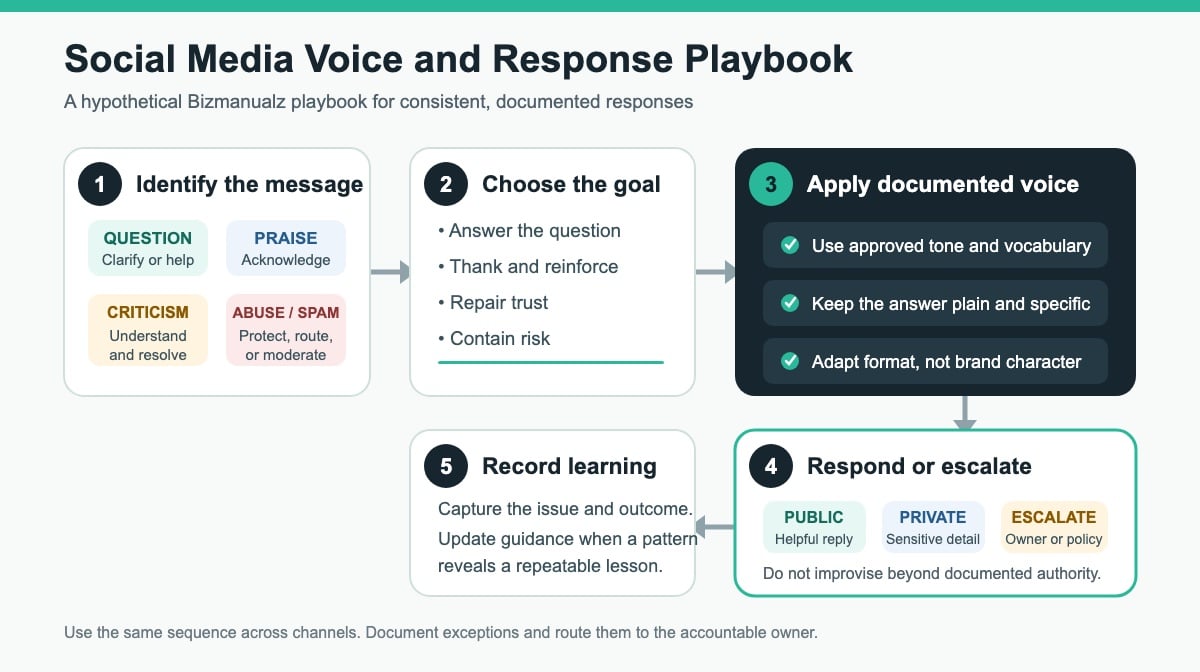
Accessible playbook: Identify whether the message is a question, praise, criticism, or abuse and spam. Choose the response goal, apply the documented brand voice, respond publicly or privately when appropriate, escalate or moderate under the written policy, and record any lesson that should change future content or service.
Work on Your Visual Branding
People should be able to recognize your visual content before they study the account name. Define a restrained palette, two or three repeatable layouts, type rules, image treatment, logo placement, and accessibility requirements. Make sure text remains readable on a phone and that color is not the only way a graphic communicates meaning.
The visual component means more than making a beautiful picture. Written and visual content should work together, fall into the general content strategy, and stay aligned with the logo and brand philosophy.
Align those choices with the logo and the business’s brand identity. Use templates to speed production, but vary the subject and composition enough that the feed does not look mechanical. Simple, consistent choices usually work better than adding more decorative elements.
Establish Brand Tone and Voice
Your brand should have a recognizable vocabulary, sentence structure, point of view, and set of personality traits. Document three to five voice qualities, words the company prefers, words it avoids, sample openings and replies, and the difference between normal, sensitive, and crisis communication.
If several people manage the accounts, a short social media policy can define ownership, approvals, disclosures, moderation, security, and escalation. The goal is not to make every writer sound identical. It is to keep the brand coherent concerning the goals you pursue.
Define How You Measure Success
Any social media management, marketing, and brand identity building activity needs measures of success in order to be evaluated. Start with the business goal, record a baseline, and select a small set of indicators that show whether the activity is moving in the intended direction.
Define criteria that represent the initial goals rather than making the scale comprehensive for its own sake. During each review, note which activities bring the team closer to those goals and which factors contributed to the result.
LinkedIn Page analytics include impressions, members reached, clicks, reactions, comments, reposts, and engagement rate. The official LinkedIn analytics guide defines those measures for its own platform. Other platforms may define similar terms differently, so compare trends within each channel before combining them.
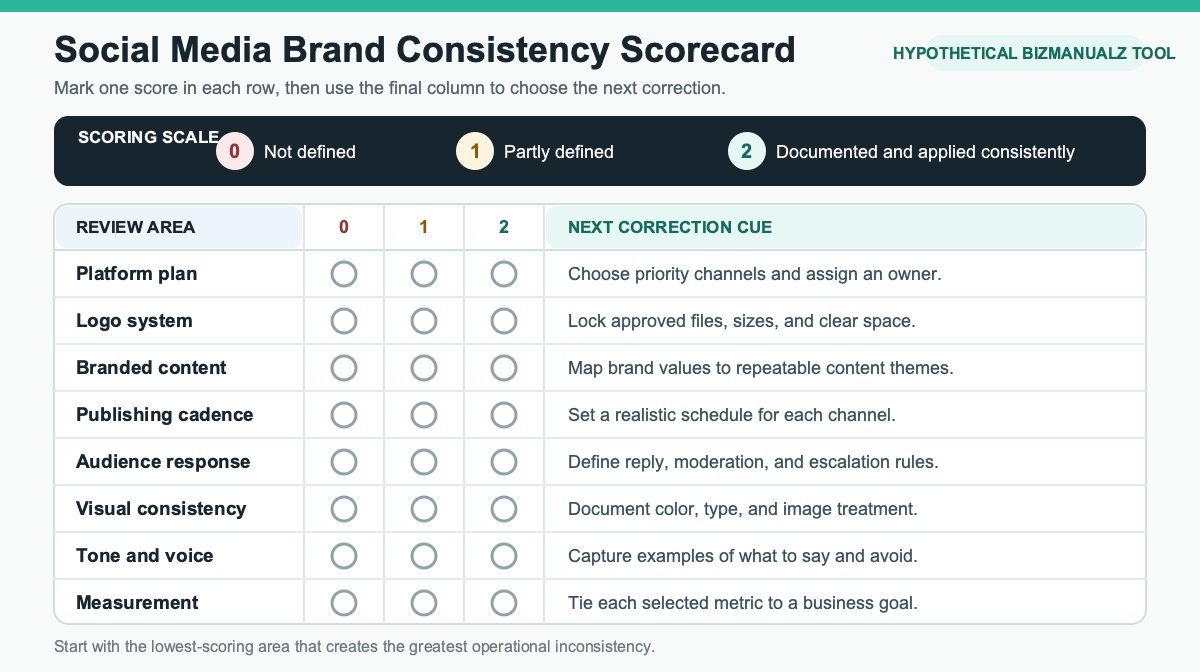
Accessible scorecard: Rate platform plan, logo system, branded content, publishing cadence, audience response, visual consistency, tone and voice, and measurement. Use 0 for not defined, 1 for partly defined, and 2 for documented and applied consistently. Record the next correction for every low-scoring area. The 16-point total is an internal prioritization aid, not an industry benchmark.
Final Thoughts
Building brand identity is important for companies at every size and developmental stage. Customers should encounter the same values and solutions whether they see a profile, post, visual, or reply. The system becomes stronger when the team documents its choices and corrects inconsistencies instead of relying on memory.
Pay attention to social media as one part of building and strengthening the brand. Community growth is useful when the community recognizes the business, understands its values, and remains interested in its posts and blogs.
Audit your active profiles with the scorecard, choose the two lowest-scoring areas, and assign one correction to an owner. Repeat the review after a complete content cycle. Community growth can be useful, but a recognizable and goal-aligned presence is the more durable measure of progress.
Original article by Sandra Larson, whose documented interests include marketing, advertising, entrepreneurship, and independent research.
Frequently Asked Questions
Should a Business Publish the Same Post on Every Social Platform?
No. Keep the core brand promise, facts, and visual identity consistent, but adapt the format, example, length, and call to action to the audience and conventions of each platform.
What Should a Social Media Brand Guide Include?
Include approved logo uses, colors, typography, image treatment, voice qualities, preferred vocabulary, content themes, response examples, moderation rules, approvals, and escalation contacts.
How Often Should a Business Review Its Social Media Brand Identity?
Review it after a complete content cycle, when a new channel or account owner is added, after a business change, or whenever profiles begin to look or sound inconsistent.
How Should a Brand Respond to Negative Comments?
Acknowledge legitimate criticism, explain or correct the issue, offer a practical next step, and move private details to a private channel. Moderate spam, threats, harassment, or prohibited content under a published rule.
Which Metrics Help Measure Brand Identity on Social Media?
Use measures tied to the channel’s job, such as qualified reach, engagement, clicks, response quality, profile actions, or completed conversions. Track a baseline and compare trends within the same platform.