What is the Purpose of an Office Manual?

Do you have a company office manual? Many small businesses delay documenting recurring work until growth, turnover, or repeated mistakes make the gap obvious. A company office manual gives employees the instruction and guidance they need to carry out key business processes consistently.
The purpose of an office manual is practical: it turns company knowledge into clear policies, procedures, responsibilities, controls, and work instructions. Without that common reference, employees can end up re-inventing the wheel, asking the same questions, or learning routine tasks one mistake at a time.
What Is a Company Office Manual?
A company office manual is an organized guide to how administrative and operational work should be performed. It documents important recurring business tasks with policies and procedures, explains who is responsible, identifies the records and tools employees use, and shows what an acceptable result looks like.
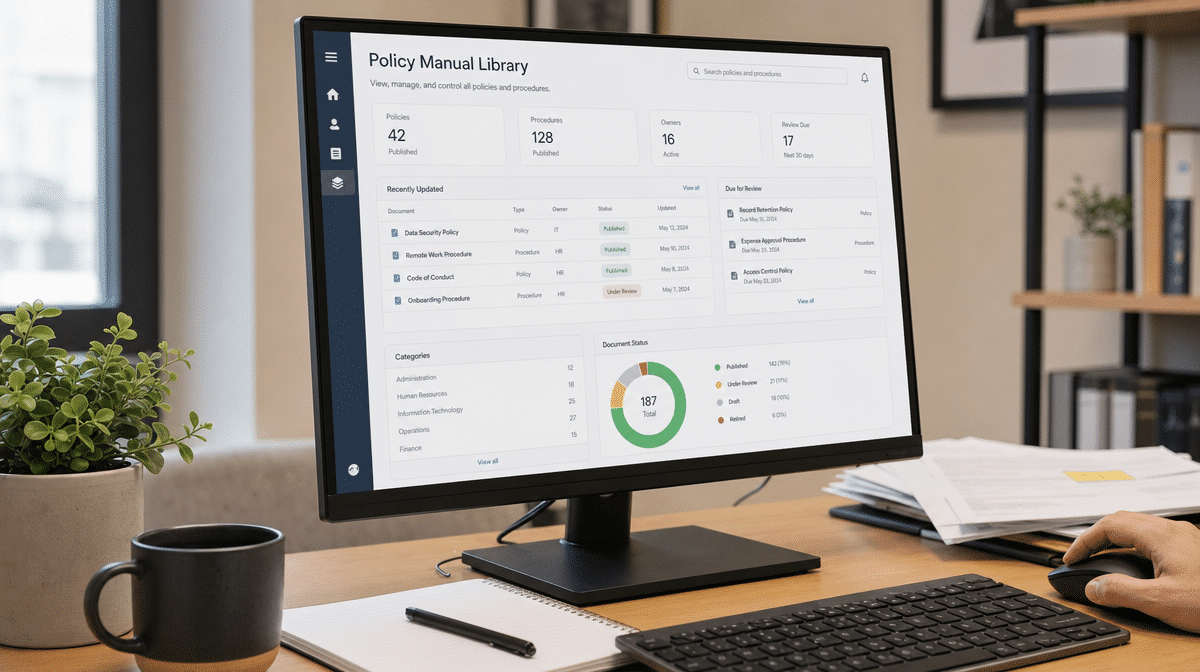
An office manual may be a printed binder, a controlled set of digital documents, an intranet, or an online policy management system. The format matters less than the discipline behind it. Employees should know where the official manual lives, which version is current, who owns each section, and how to raise a question when the documented process no longer matches the work.
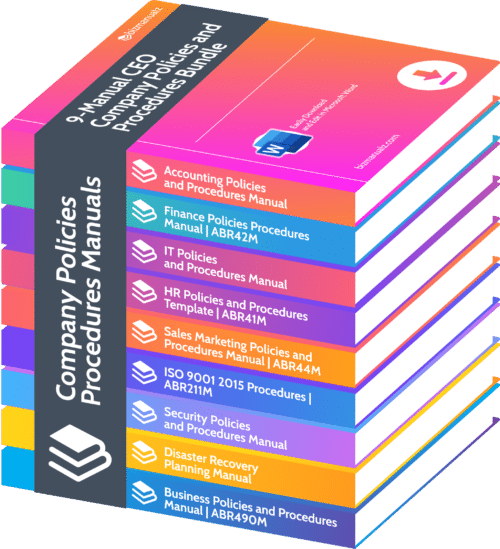
The term is broader than an employee handbook. A handbook usually focuses on employment policies and workplace expectations. A company office manual can also cover purchasing, sales administration, accounting, customer service, document control, facilities, information systems, and other key business processes. A related procedure manual goes deeper into task-level steps.
Over the years, growing companies have learned that recurring work becomes harder to manage when the method exists only in one experienced employee’s memory. The office manual preserves that knowledge. It provides basic internal control, a basis for training, and a useful place to start for process improvement.
When it comes to training, a manual does not replace coaching, demonstration, or supervised practice. It makes those methods repeatable. Managers can teach from the same instruction manual, new employees can revisit the steps after training, and experienced employees can confirm a requirement without waiting for someone else to be available.
Ask yourself which approach your company uses for recurring work: clear instruction supported by coaching, or informal trial and error? The second approach may appear faster at first, but it often creates inconsistent results, avoidable rework, and dependence on individual memory. A company that wants to grow into a large enterprise needs a way to provide the coaching and guidance each employee requires without rebuilding the method for every new hire.
What Should Be Included in an Office Manual?
Your office manual should include the information employees need to complete work, exercise judgment, and recognize when a result is outside the standard. It should connect business policies every company needs with the procedures, forms, records, systems, and responsibilities that put those policies into practice.
A useful starting point is the process itself. Describe how the company makes money and supports customers, then identify the key inputs, process steps, and process outputs. A process map can show the sequence, decisions, handoffs, and feedback loops more clearly than prose alone.

For each important recurring business task, include the following elements:
- Purpose and scope. Explain why the policy or procedure exists, where it applies, and what is outside its boundaries.
- Process map or description. Show the inputs, process steps, decisions, handoffs, and outputs required to complete the work.
- Clear controls or criteria. Define approvals, limits, quality checks, security safeguards, reconciliations, and other controls used to prevent or catch mistakes.
- Clearly identified responsibilities. State who does what, when the work is due, who approves it, and who receives the completed output.
- Standards, laws, and regulations. Reference the requirements that must be followed or satisfied, and identify any records needed to demonstrate compliance.
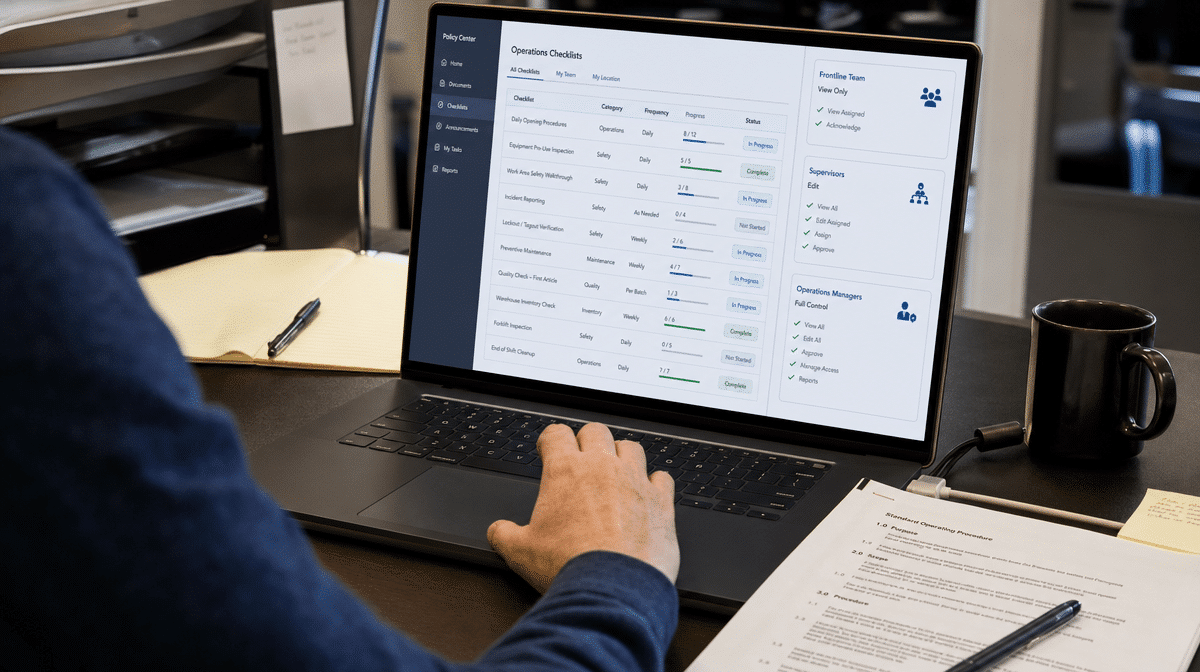
- Forms, tools, software, or reporting systems. Link the employee to the current templates, checklists, systems, and reports required by the procedure.
- Revision and review information. Name the document owner, approval date, current version, review schedule, and method for reporting a needed change.
The requirements section should be specific to the work. For example, the U.S. Department of Labor’s recordkeeping guidance explains records employers must retain under federal wage and hour rules. A manual can point employees to the applicable requirement, define who keeps the record, and explain where the current form or system entry belongs.
Controls and responsibilities also deserve more than a passing mention. OSHA’s recommended practices for safety and health programs emphasize management leadership, worker participation, hazard identification, prevention, training, and program evaluation. The same operating logic applies across an office manual: assign ownership, document the method, train the people doing the work, and review whether the method is effective.
How Is a Company Office Manual Used?
A company office manual is used before, during, and after the work. Before the task, it supports training and preparation. During the task, it provides a work instruction, checklist, decision rule, or reference. After the task, it helps an employee or manager compare the actual result with the expected output and decide whether corrective action is needed.
Use the Office Manual as an Instruction Manual
Consider a kit that needs to be put together. It usually comes with an instruction manual or work instruction that includes an explanation of the parts, the tools needed, an exploded diagram, and a picture of the finished product. The parts are the inputs. The exploded diagram acts like a process map. The final picture represents the output.
The assembler uses the diagram and final picture to confirm that the product is being put together correctly. Employees need the same kind of reference for key business processes. A clear picture of the finished product helps them understand what the output should look like and what criteria it must meet.
Provide Key Business Process Information
Process outputs are not limited to physical products. They may include charted process metrics, measurements, pictures, mated parts, approved records, reconciled accounts, completed service tickets, or anything else that provides instant feedback to the employee. The important point is that the output is observable and can be compared with a defined standard.
That feedback allows employees to catch mistakes and fix them before the problem is passed on to the next person as waste. It also gives managers a factual basis for coaching. Instead of saying that a result simply looks wrong, the manager can point to the expected output, the control that failed, or the step that needs clarification.
The manual also supports continuity when someone is absent, changes roles, or leaves the company. Work should not stop because one person holds the only complete version of the process. Documented responsibilities, forms, systems, inputs, steps, and outputs allow another trained employee to follow the approved method.
How to Write a Company Office Manual
Writing a company office manual does not have to begin with a blank page. Start with the recurring work that creates the most risk, delay, customer impact, or training difficulty. Interview the employees who perform the work, observe the actual process, collect the current forms and tools, and compare practice with the standards, laws, and regulations that apply.
Then document the purpose, scope, responsibilities, inputs, process steps, controls, outputs, records, and revision owner. A consistent policy and procedure manual structure makes each new section easier to write and easier for employees to scan.
Test the procedure with someone who did not write it. If that employee cannot find the tools, follow the steps, or recognize the finished output, revise the manual before treating it as complete. Schedule reviews when responsibilities, systems, requirements, or business processes change. You can also use sample policies and procedures as a guide while adapting the content to your own organization.
Small businesses that want to grow need a company office manual that provides consistent coaching and guidance. Used well, the manual becomes an important training aid, supports basic internal control, guides the worker, strengthens process improvement, and helps reduce mistakes without forcing every employee to start from scratch.
Frequently Asked Questions
What Is a Company Office Manual?
A company office manual is an organized guide to recurring administrative and operational work. It combines policies, procedures, responsibilities, controls, forms, tools, records, and expected outputs in one controlled reference.
What Is the Purpose of an Office Manual?
The purpose of an office manual is to make company knowledge repeatable. It supports training, internal control, consistent decisions, process improvement, and continuity when employees change roles or leave.
What Should Be Included in an Office Manual?
An office manual should include purpose, scope, policies, process maps, inputs, process steps, outputs, controls, responsibilities, requirements, forms, tools, software, records, ownership, and revision information.
How Is a Company Office Manual Used for Employee Training?
Managers use the manual to teach the approved method, while employees use it to revisit steps, find current forms, confirm requirements, and compare completed work with the expected output.
Why Should an Office Manual Include Process Maps, Controls, and Outputs?
Process maps show the sequence and handoffs, controls help prevent or detect mistakes, and defined outputs give employees instant feedback about whether the work meets the standard.