Which Search Engine Marketing Strategies Improve Online Business?

Search engine marketing can put your offer in front of people who are already searching for a solution. It improves an online business only when search intent, ad copy, the landing page, budget controls, and conversion measurement work together.
These 6 Search Engine Marketing Strategies to Improve Online Business form a practical campaign sequence: define your target audience and conversion, research keywords, create original messages, align the ad and landing page, control Pay Per Click (PPC) spending, and complete a final quality check before launch.
6 Search Engine Marketing Strategies to Improve Online Business
Search engine marketing works best as part of a broader digital marketing plan. Paid search can create visibility while a campaign is active, but it does not make traditional marketing, organic search, or customer referrals obsolete. The useful question is whether paid search reaches the right audience at an acceptable cost and produces actions that support your business.
What Is Search Engine Marketing and When Is It Useful?
In this article, Search Engine Marketing, or SEM, means paid advertising on search engines. A business chooses campaign settings and keywords, writes ads, sets a budget, and competes for paid placements. This can complement the work you already do to use marketing to increase sales.
Search Engine Optimization (SEO) is different. SEO improves organic visibility by making pages useful, accessible, and relevant to people searching for a topic. Paid search competes for ad placements, while SEO Marketing earns organic visibility over time. Google says Search Network ads may be labeled “Sponsored,” “Ad,” or “Ads.” Google Ads explains where Search Network ads can appear.
How Does Search Engine Marketing Work?
Suppose a prospective customer searches for “bookkeeping policies for a small business.” The search engine may show paid results near organic results. The paid results enter an auction for that search, and the organic results are selected by the search engine’s ranking systems. Google distinguishes ads from organic search results. Visibility and results still depend on demand, targeting, budget, and auction conditions.
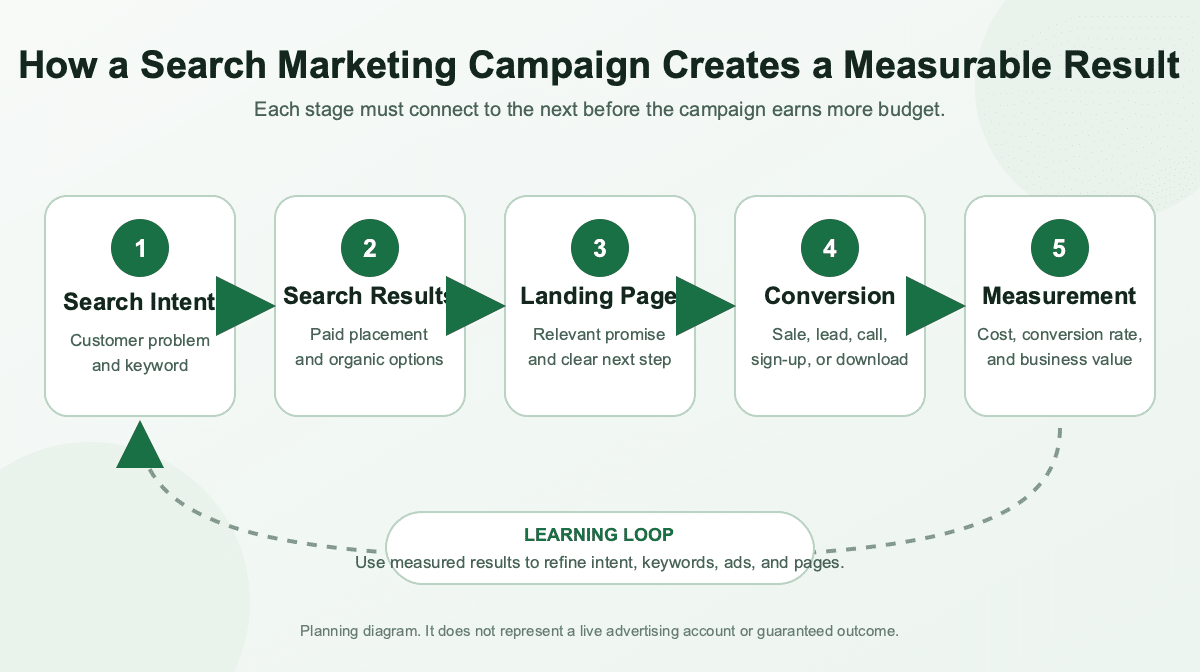
The highest bid does not automatically win the top position every time. Google explains that Ad Rank considers more than the bid, including ad and landing-page quality, thresholds, search context, competition, and the expected impact of assets. Google Ads documents the ad auction. That is why useful ad copy and a relevant landing page matter alongside bidding.
How Can You Build an SEM Campaign in Six Steps?
The following sequence turns the original six strategies into a campaign workflow. Each step gives the next one a clear input, so you do not start buying clicks before you know what a valuable result looks like.
1. Define Your Target Audience and Conversion Goal
Start with the customer problem and the action you want a visitor to take. A useful conversion goal might be a purchase, a qualified lead, a phone call, a sample request, or a download. Write down the customer, the problem, the offer, the location served, and the conversion before choosing keywords.
Demographics can help, but they are only one part of the audience. Search intent, location, device, schedule, and the words people use can be more important for a specific campaign. Review your own sales data before making assumptions. If you use Google Analytics 4, its Audiences report can help you review configured audience groups that engage or convert.
2. Research Keywords Before Creating Content
Keyword research is a significant step for search engine marketing, but the highest search volume should not be your only goal. Group terms by intent, relevance to the offer, likely competition, and the action a searcher appears ready to take. Google’s Keyword Planner can generate keyword ideas and show estimates for searches, competition, and bids. Google Ads explains Keyword Planner.
Ahrefs Keywords Explorer, Google Keyword Planner, and KeywordTool.io remain available examples for keyword searching. Use them to expand ideas, then apply judgment. A specific long-tail keyword may clarify intent, but it does not automatically reduce cost per click or guarantee conversions. Preserve a working list of internet marketing keywords, and separate research terms from purchase-ready terms.
Match types control how closely a search must relate to a keyword. Broad, phrase, and exact match provide different levels of reach and control. Google Ads describes keyword match types. Start with a structure you can monitor rather than placing every keyword in one campaign.
3. Write Original Ads and Landing-Page Content
Create original ad copy and landing-page content that match the searcher’s problem. The ad should make a clear promise, and the landing page should fulfill that promise with useful details, evidence, and one obvious next action. This message continuity helps a visitor understand that the click led to the right place.
You can analyze competitors and learn how they stand out in Ecommerce, but do not copy or mechanically paraphrase their work. Add your own examples, policies, service details, and decision guidance. Google recommends useful, original, people-first content. Google Search explains people-first content.
4. Align Keywords, Ads, and Landing Pages
Optimization connects the keyword, ad, and landing page. Put closely related keywords into focused groups, write ads for each intent, and send visitors to the most relevant page. Google describes landing-page experience in terms of usefulness, relevance, navigation, and consistency with the ad. Google Ads explains landing-page experience.
Use descriptive headings to help readers scan the page, and mention keywords where they make sense. Do not force the same phrase into multiple sentences. Google defines keyword stuffing as unnaturally repeating terms to manipulate rankings. Google Search documents keyword stuffing. A coherent content marketing strategy should serve the reader first.
5. Control Pay Per Click (PPC) Spending
Pay Per Click is a common search engine marketing model. For cost-per-click bidding, you set bid and budget controls and generally pay when someone clicks the ad. Google Ads defines cost-per-click bidding. The practical objective is not to win every auction. It is to earn qualified visits at a cost the business can support.
Set an average daily budget and understand the applicable daily and monthly spending limits before you define the test. Google notes that most campaigns can spend up to twice the average daily budget on a particular day. Google Ads explains spending limits. Choose locations and schedules deliberately, and review the search terms that triggered ads. Add exclusions when the traffic is irrelevant. Negative keywords prevent ads from triggering for specified terms. Google Ads explains negative keywords.
6. Complete a Pre-Launch Quality and Measurement Check
Before launch, check the spelling, originality, destination URL, mobile layout, form or checkout, privacy requirements, conversion action, campaign settings, and negative keywords. A plagiarism checker may flag matching text, but it cannot prove usefulness, originality, or campaign quality.
Conversion tracking can connect ad interactions with actions such as sales, leads, calls, sign-ups, or downloads. Google Ads explains conversion tracking. Test the conversion yourself before launch, then review search terms, cost, conversion rate, and cost per conversion on a regular schedule as part of how you track marketing performance.
SEM Campaign Planning Scorecard
Use this worked scorecard before approving a campaign. The example is hypothetical and shows how each search term should connect to a promise, destination, and measurable result.
On a smaller screen, scroll the scorecard horizontally to view all five columns.
| Search intent | Keyword example | Ad promise | Landing-page action | Conversion measure |
|---|---|---|---|---|
| Research a solution | small business bookkeeping policies | See what a complete policy set covers | Review contents and sample | Sample request |
| Compare an option | bookkeeping policy template | Preview an editable template | Inspect features and format | Qualified download |
| Buy a solution | buy bookkeeping policy manual | Get a ready-to-edit manual | Review product and checkout | Purchase |
Score each row from 0 to 2 for intent clarity, ad relevance, landing-page match, and measurement readiness. Do not launch a row that scores zero on any of those four controls. This simple review prevents a high-volume keyword from receiving budget before the experience is ready.
Add three campaign-level guardrails to the working scorecard: the planned test budget, the maximum cost per conversion the business can support, and a review date. Pause or revise the test when a row attracts irrelevant search terms, the landing-page action does not work, or the measured cost exceeds the approved limit. This turns the scorecard into a repeatable approval record rather than a one-time brainstorming table.
Which Common SEM Mistakes Should You Avoid?
People commonly mix SEO and SEM. Search Engine Optimization uses keyword analysis, on-page SEO, and off-page SEO techniques to improve organic traffic. Unlike SEO, the paid marketing strategy discussed here uses paid promotions, campaign settings, ads, and auctions. The two approaches can support the same website without following the same process.
Search engine marketing requires skills to run business ads online. The amount you spend is not automatically worth the traffic, and expected results should be based on conversions rather than clicks alone. A website owner should never underestimate the power of primary steps such as identifying the target audience, choosing a goal, and checking the destination before launch.
Keyword research including long-tail keywords can help you explore how users search, but do not assume that the most searched keywords are the best fit. High-intent keywords still need a relevant offer, and keyword tools provide estimates rather than certain results. Your marketing campaign should use those estimates as an input, not as a guarantee.
Content writers should create content that depicts the nature of the business and helps buyers decide whether the offer meets their needs. Do not copy a rival’s website, duplicate content, or rely on a paraphrasing tool to maintain uniqueness. Checking plagiarism can detect matching passages, but the final step is to add original analysis, accurate details, and content quality that serves the reader.
A search algorithm provides search results based on the queries users enter, but advertisers do not control the organic results below or around their ads. When competition between websites selling the same products is intense, a relevant page and distinctive offer can matter more than simply trying to surpass competitors’ sites.
Content optimization here means optimizing content for the reader and aligning the ad, headings, titles, and landing-page action. Always mention keywords where they make sense, and add relevant detail instead of adding a single keyword repeatedly. After checking the campaign settings and reading the sections above, you should have enough understanding to run a limited test and learn from the result.
How Should You Decide Whether to Scale SEM?
Search Engine Marketing can improve online business visibility, but growth is not instant and traffic is not automatically valuable. Start with one audience, one conversion goal, a focused keyword group, an original ad, and a relevant landing page. Use measured tests alongside your broader digital marketing strategies, then increase spending only when conversion results support the decision.
Frequently Asked Questions
What Is the Difference Between SEM and SEO?
In this article, SEM means paid search advertising, while SEO means improving organic search visibility. A business can use both because paid placements and organic results serve different roles.
How Should a Small Business Choose SEM Keywords?
Choose keywords by relevance, search intent, likely competition, and conversion potential. Search volume is useful context, but it should not override a weak fit with the offer.
How Can a Business Reduce Wasted PPC Clicks?
Use focused keyword groups, appropriate match types, negative keywords, deliberate locations and schedules, and landing pages that match the ad. Review actual search terms regularly and exclude irrelevant traffic.
How Do You Measure Whether SEM Is Working?
Define a valuable action before launch, verify conversion tracking, and compare cost with qualified results. Useful measures include conversions, conversion rate, cost per conversion, and the business value of those conversions.