How Can You Get Your Website Noticed?

A useful website can still remain invisible when prospects do not know it exists, search with different words, or cannot move easily from a search result to a relevant page. You can get your website noticed by making every important page easy to discover, matching the language and intent of prospective customers, publishing genuinely useful marketing content, earning relevant promotion, and measuring what brings qualified visits and sales leads.
One way business people find goods and services is to search the web. Search engine optimization, or SEO, helps search engines understand your content and helps people find your website. It is part of a broader digital marketing strategy, not a guarantee that every page will land on top.
How Do Website Pages Attract Prospects?
Each of your website pages is an opportunity to attract prospects, but the page must answer a need that a real person is trying to satisfy. What exactly are your prospects searching for? What words and phrases do they use before they know the name or description of your product?
Start with customer questions, sales conversations, support requests, and the query data available in Google Search Console. The Search Console Performance report shows queries, impressions, clicks, click-through rate, and average position. That information can reveal whether people find a page with the language and intent you expected.
Your website also needs strong marketing content that gives visitors a reason to stay, understand the offer, and take the next step. A page should answer its main question early, explain the subject clearly, and connect the reader to relevant evidence, services, products, or related information.
What Is Search Engine Optimization?
Getting noticed on the web takes know-how and work. SEO is the practice of helping search engines discover and understand your pages while improving the experience of the people who visit them. Google Search Essentials recommends helpful, reliable, people-first content and using words people would use to find that content in prominent, descriptive locations.
SEO includes both on-page and off-page work. On-page search engine optimization covers the page itself, including useful copy, descriptive titles, headings, internal links, image alternatives, and a structure that people and search engines can follow. Off-page search engine optimization includes relevant editorial mentions, legitimate business relationships, publicity, and links that help people discover and evaluate the site.
Structuring pages and documents correctly, eliminating common mistakes, and earning links on related sites can all be part of a managed lead-generation program. Search engines assign relevance from many signals, so treat keywords, textual patterns, navigation, links, and page experience as connected inputs rather than a checklist that automatically creates top position.
Do not ask unrelated sites to exchange links or pay for links that pass ranking credit. Google identifies keyword stuffing and manipulative link schemes as spam practices. Earn attention by publishing a useful resource, contributing real expertise, building relationships with organizations related to what you do, and making the destination worth recommending.
Which SEO Elements Help a Website Get Noticed?
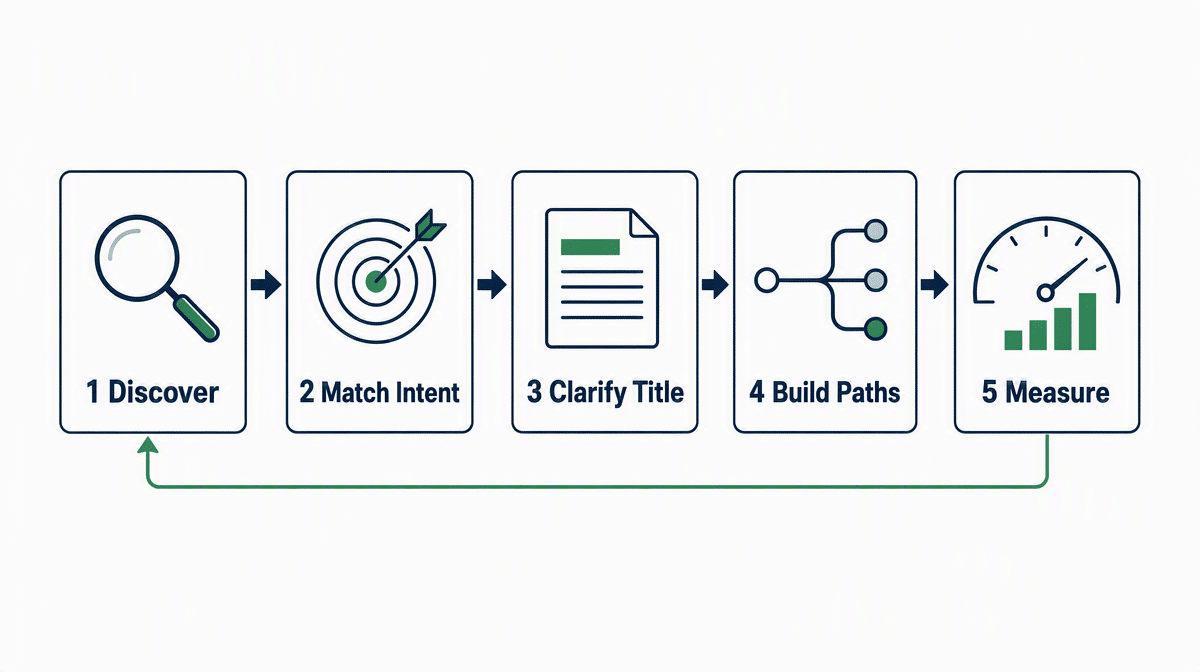
You need successful SEO execution, but there is no simple formula based on keyword frequency, copy length, or one technical setting. Use the following elements as a diagnostic sequence. Fix the first weak point before adding more content or promotion.
| Visibility Check | What to Inspect | What to Do Next |
|---|---|---|
| 1. Discover | Can search engines reach and index the important page? | Check the page URL, internal links, robots directives, and sitemap coverage. |
| 2. Match Intent | Does the page answer what prospects are actually searching for? | Compare the page with customer questions and Search Console queries, then fill the most useful gap. |
| 3. Clarify the Title | Does the page title describe the content accurately and concisely? | Write a distinct title and description that set the right expectation without repetition. |
| 4. Build Paths | Can people and crawlers reach the page through relevant links? | Add descriptive internal links and earn legitimate mentions from related sources. |
| 5. Measure | Are relevant impressions becoming qualified visits and actions? | Review queries, impressions, clicks, engagement, and the intended conversion, then repeat the cycle. |
Keywords and Search Intent
Understanding what people type when they are looking for what you do is still paramount. Keywords and keyword phrases can show the subject and intent, but repeating them liberally does not make a page more useful. Write naturally, cover the question completely, and use the vocabulary prospects recognize. The related guide on keywords and phrases can help organize that research.
If what you do is new, what makes you think prospects are searching for it? They may begin with the problem, desired outcome, job role, industry, or alternative they already understand. Build pages around those starting points instead of assuming people know your internal product language.
Page Titles and Descriptions
Give every important page a clear, concise, and accurate title. Google uses several page signals to generate title links and recommends distinct, descriptive title text without keyword stuffing. A meta description can summarize the page and may help shape a search snippet, but it does not promise a particular result or position.
Older advice often grouped these items under meta tags. Focus on useful metadata instead: an accurate title, a helpful description, a canonical page identity, and robots directives that match your indexing intent. Unsupported meta keywords do not replace meaningful content.
Navigation and Internal Links
Good navigation helps people find the information placed on the site and helps search engines discover related pages. Google recommends crawlable links with descriptive, concise anchor text. Link from relevant pages to the content you care about, and make sure each destination returns the expected information.
Use category pages, menus, breadcrumbs, and contextual links to create understandable paths. The goal is not to add the greatest possible number of links. The goal is to help visitors move from one useful answer to the next and to increase the online presence of pages that serve a real customer task.
Promotion and Credible Mentions
Search is not the only way to attract customers online. Promote useful pages through customer communication, social media, industry relationships, associations, events, and publications where the audience is relevant. A legitimate mention can introduce qualified visitors while also supporting off-page discovery.
Your competitors may already serve some of the same questions. Review what the search results provide, then publish a clearer answer, a better example, or a more practical resource. That can support a competitive advantage, but the advantage comes from usefulness and execution, not from a shortcut.
Measurement and Lead Generation
Measure whether the right people notice the page and whether they can complete the intended next step. Review search queries, impressions, clicks, click-through rate, landing-page engagement, inquiries, downloads, and qualified leads according to the purpose of the page. A ranking without relevant visits or action may not improve the business.
Think you can get people to contact you by writing about a new technology or giving away a free white paper? If prospects are not searching for those terms, connect the offer to the problem they already recognize. Otherwise, your site may become one more dark corner on the Internet.
How Can SEO Support Sales and Marketing?
Effective search engine optimization can improve discoverability and bring relevant visitors into your sales and marketing process. Better visibility supports lead generation when the page matches the visitor’s intent, explains the offer, provides proof, and makes the next action clear.
Use the visibility check as a managed program: diagnose one page, improve the highest-value weakness, promote it through appropriate channels, and measure the result. Over time, the combination of useful pages, clear paths, relevant mentions, and measurement can strengthen your sales and marketing pipeline.
Frequently Asked Questions
What Is the First Step to Getting a Website Noticed?
Start by checking whether the important page can be discovered and indexed, then compare its content with the words and intent of prospective customers. Fix that foundation before adding more promotion.
Should You Repeat Keywords to Rank Higher?
No. Use relevant terms naturally where they help people understand the page. Repeating words or phrases unnaturally can reduce readability and may be treated as keyword stuffing.
How Can You Tell Whether Search Engines Can Find Your Pages?
Check the URL with a search-engine inspection tool, confirm the page is not blocked from indexing, make sure crawlable internal links point to it, and review sitemap and performance data for evidence of discovery.
Can Promotion Help a Website Beyond SEO?
Yes. Customer communication, social media, associations, events, and relevant publications can introduce the page to qualified people. Useful promotion can also lead to legitimate editorial mentions and links.
How Should You Measure Website Visibility?
Track relevant queries, impressions, clicks, click-through rate, landing-page engagement, and the conversion the page is meant to support. Compare trends over consistent periods and investigate whether the visitors match the intended audience.