What Is Project Planning?

A project usually starts to drift before anyone calls it scope creep. The first phase in any project management process is project initiation, where the goal is to uncover the project’s scope, including the boundaries for resources, expectations, results, feasibility, the team, and your requirements, and produce a project charter.
Once the project’s goals and scope are clear, the work moves into project planning. This is where the project charter becomes a set of practical plans that management, the project team, customers, suppliers, and other stakeholders can use to control the work before execution begins.
What Is Project Planning?
Project planning is the second phase of any project management process. It consists of developing the core planning elements that explain what will be done, who will do it, how resources will be used, how risks will be managed, and how the project will be accepted as complete.
The output of project planning is a set of project management documents, or plans. The most important one is the project plan itself, supported by the more detailed plans that explain communication, quality, procurement, user training, testing, deployment, risk, and acceptance.
Good project planning is not paperwork for its own sake. It is a management control system. ISO describes project management guidance in ISO 21502:2020, and the practical point is simple: planning gives the team enough structure to make tradeoffs before time, money, and scope begin moving in different directions.
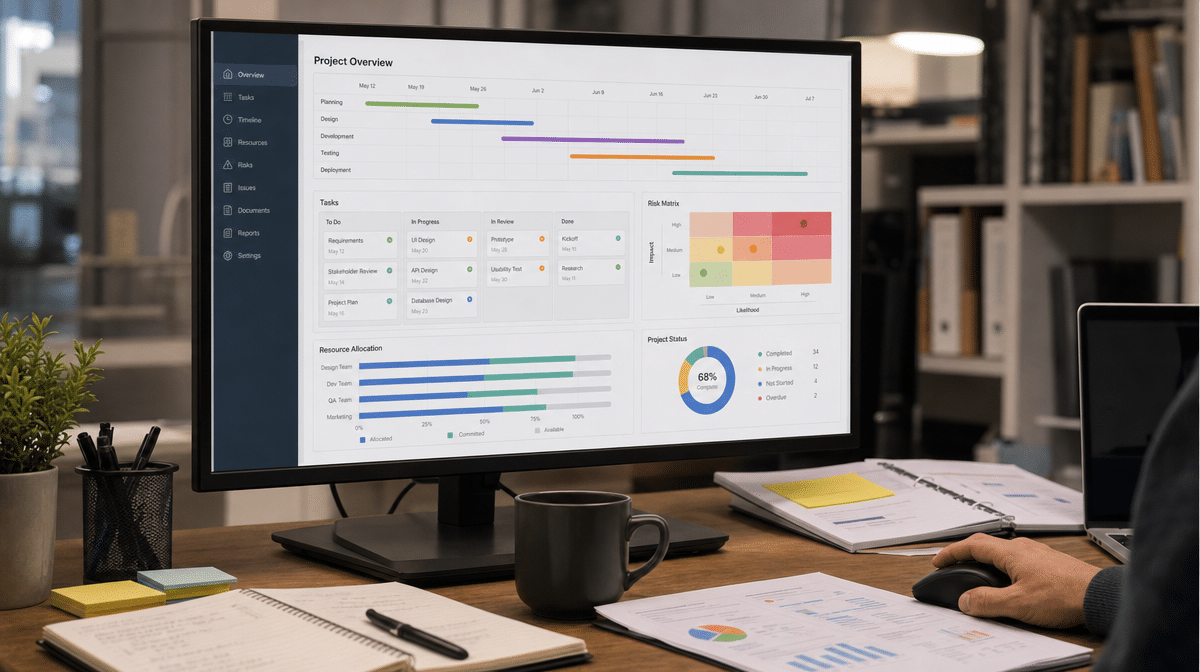
Project planning includes five sections:
- The project overview
- Project organization
- Managerial process plan
- Technical process plan
- Supporting process plans
Project Overview
Project planning starts with the project overview, where you summarize and introduce the project. This is your management abstract. Management may not read much else, so the overview has to make an impact quickly and accurately.
Explain the ROI, user experience changes, and benefits of the project. Do not just list project features, deliverables, schedules, milestones, and costs. Explain the benefits to the user or customer, and connect those benefits to the scope already approved in the project charter.
The project overview should also make the basic boundaries visible. What is included? What is excluded? What result will prove the project was worth doing? If those questions stay vague, later requests will look like harmless additions instead of real changes to scope.
Project Organization
Next, your project organization describes the reporting structure, or organization chart, along with the roles and responsibilities for the various project team members. It should include customers, suppliers, and other stakeholders involved in your project.
Everyone has a role. Customers approve requirements, may participate in testing, and are definitely part of acceptance. Suppliers are involved in procurement. Note the interfaces to all stakeholders so the team knows who makes decisions, who provides input, and who must be informed.
In many projects, various resources may be involved only part of the time. Clarify individual roles and responsibilities and their level of involvement. A 10% resource may become a critical bottleneck because 90% of their time is being used on other projects. Do not just make a superficial list of resources. Note resource issues and your project structure in detail to minimize project risks.
Managerial Process Plan
If management wants to see the details behind the project overview, especially time, money, and risk control, the managerial process plan is where management will find them. This section explains how the customer’s money will be controlled and how schedule, budget, and scope decisions will be managed.
If risk is a big issue, a separate Risk Management plan may be referenced. If hurdles, bottlenecks, dependencies, or handoffs may affect project closing, think through the Project Closeout plan early. Future maintenance, training, and ownership issues are easier to control when they are visible before execution begins.
The managerial process plan is also where change control belongs. Harvard Business Review notes that scope creep is the gradual expansion of project objectives, deliverables, or requirements beyond the initial plan, and project managers need a way to say no or redirect requests without damaging relationships. A clear managerial plan gives that conversation a factual base instead of turning it into a personality contest.
Technical Process Plan
Technical details are covered under the technical process plan. Special test equipment, development hardware, expertise, or facilities are explained so their costs can be justified in the budget. Information from the feasibility study may be referenced or included to explain the design approach, methods, or other design inputs.
It is important to explain what acceptance will mean, so everyone will know when the project is done. The Acceptance plan describes how acceptance will occur, who is responsible for acceptance, and the criteria for acceptance testing.
If the solution will be rolled out to a large or complex group, a Deployment plan may be needed. Deployment planning should cover timing, training, communications, support, and the operational handoff after the project team has delivered the work.
Supporting Process Plans
Other planning details are included in supporting process plans. Here you can include additional project planning documents, such as:
- Communications Plan
- Quality Plan
- Procurement Plan
- User Training Plan
- Test Plan
In a large project, these plans could be separate documents, and probably should be, with ample details. In a small project, you could simply incorporate them into the project plan document. Either way, it is important that you make it clear how you intend to face each planning issue.
Leaving out an important project planning element can cause project scope creep, time overruns, cost overruns, or project failure. Supporting process plans are how you make the hidden work visible before it becomes an emergency.
How Does Project Planning Support Project Management Control?
Let’s say you are working on a set-up reduction process improvement project. Your plan focuses on one work cell at one plant that has three shifts. Management suggests you take the improvements on the road to the other eight plants. Stop and think: is this scope creep? It is if your original plan did not address training a large number of workers across the country.
For the other eight plants, you need to see results from the first one. Only when you are satisfied with those results do you develop a new project charter and a new project plan with a new budget for the other eight. Your new project plan needs a communications plan and a user training plan of its own. Additional training resources will be needed. In other words, despite the similarities, this is a different project.
Project planning produces the most important project management document. The project plan and its supporting plans are your primary management control mechanisms. Your project plan contains the information you use to control the project’s resources and prevent scope creep. Use project planning to explain to management what they are asking for, and stay in control of your project.
Download Free Policies and Procedures to see how easy it is to edit MS Word Templates to build your own policy and procedure management system.
Frequently Asked Questions
What Is Project Planning?
Project planning is the second phase of a project management process. It turns the approved project charter into a practical set of plans for scope, responsibilities, schedule, budget, risk, quality, communication, training, and acceptance.
What Should A Project Plan Include?
A project plan should include a project overview, project organization, managerial process plan, technical process plan, and supporting process plans. Larger projects often split those areas into separate documents for communication, quality, procurement, user training, testing, deployment, and risk management.
Why Is Project Planning Important?
Project planning is important because it gives management and the project team a control mechanism before execution begins. It clarifies deliverables, milestones, costs, responsibilities, bottlenecks, dependencies, acceptance criteria, and the resources needed to complete the work.
How Does Project Planning Prevent Scope Creep?
Project planning prevents scope creep by defining what the project will and will not include before new requests appear. When management asks for a larger rollout, the project plan makes it easier to decide whether that request belongs in the current project or requires a new charter, budget, and plan.
When Should Supporting Process Plans Be Separate Documents?
Supporting process plans should be separate documents when the project is large, risky, cross-functional, regulated, or dependent on many stakeholders. Smaller projects can often include these plans inside the main project plan, as long as responsibilities and controls are still clear.