Direct Labor vs Indirect Labor: What Is the Difference?

Two employees can work the same eight hour shift in the same building, earn the same hourly rate, and still land in completely different places on your financial statements. The machinist cutting parts for a customer order is part of that order’s cost. The technician who spent the morning repairing the machinist’s lathe is not, at least not directly. Getting that split wrong is one of the quietest ways a small manufacturer or contractor misprices work.
The short answer: direct labor is the pay for work performed on a specific product, job or order that you can trace to it from your timesheets, while indirect labor is the pay for production work that supports many jobs at once and has to be allocated through overhead. This article sets out the difference side by side, classifies common roles, and walks one complete pay period from timesheet lines to direct labor and overhead buckets, with an editable worksheet you can download and reuse.
What Is Direct Labor?
Direct labor is the wages and related payroll costs of employees who physically make the product or deliver the billable job, for the hours they spend doing exactly that. A welder assembling a frame for Job 501, a carpenter framing a customer’s addition, and a technician soldering boards for a specific production run are all performing direct labor while they do that work.
The defining test is traceability. If your timesheet or job ticket can tell you, without estimating, that a given hour belongs to a given job, that hour is direct labor. Direct labor is one of the three classic components of product cost in cost accounting, alongside direct materials and manufacturing overhead, and it is usually the cost that managers watch most closely because it responds directly to how efficiently the floor runs.
Direct Labor Examples
- Manufacturing. Machine operators, assemblers, welders and painters working on a specific order or production run.
- Construction and trades. Electricians, plumbers and carpenters whose hours are logged to a customer job.
- Food production. Line cooks and bakers producing a batch that can be traced to a product or catering order.
- Professional services. Engineers, consultants or technicians whose time is recorded against a client project and billed to it.
An example of direct labor cost is the 44 hours a machinist spends cutting parts for one customer order at 30.00 per hour, or 1,320.00 charged to that order. The same employee’s four hours standing idle while a machine is repaired are not direct labor, because they cannot be traced to any job.
What Is Indirect Labor?
Indirect labor is the pay for production work that is necessary but cannot be traced economically to a single product or job. Supervisors, maintenance technicians, material handlers, quality inspectors, production schedulers and warehouse staff all keep the operation running, yet no single order caused their hours. Their pay is pooled into manufacturing overhead and then allocated to jobs through an overhead rate.
Indirect labor also includes the nonproductive time of direct workers: idle time waiting for materials, required safety training, shop meetings and cleanup that is not part of a specific job. For a full treatment of how that pool becomes a rate, see our guide to manufacturing overhead.
Indirect Labor Is Not the Same as Administrative Labor
A common error is to treat every employee who does not touch the product as indirect labor. Indirect labor belongs to the production function. The bookkeeper, the sales team, the receptionist and the owner’s executive assistant are selling, general and administrative costs, usually shortened to SG&A. Those are period costs: they are expensed in the month they are incurred and never become part of inventory or job cost.
Direct vs Indirect Labor: Side by Side
The table below compares the two categories on the points that change how you record, cost and control them.
| Factor | Direct labor | Indirect labor |
|---|---|---|
| What the work does | Makes the product or performs the billable job | Supports production across many jobs |
| Traceability | Traced to a job from timesheets or job tickets | Cannot be traced economically to one job |
| How it reaches product cost | Charged straight to the job or work order | Pooled in overhead, then allocated to jobs with a rate |
| Cost behavior | Mostly variable with output when hours flex with volume | Often fixed or step fixed, such as a salaried supervisor |
| Typical records | Job time tickets, labor distribution by job code | Department payroll, overhead labor accounts |
| Typical formula | Hours on the job multiplied by the hourly rate, plus any payroll burden your policy assigns | Total production payroll minus direct labor, minus any SG&A pay |
| Management question | Did this job take more hours than quoted? | Is support staffing right for the volume we run? |
How Common Roles Are Usually Classified
Classification follows the work, not the person. Most roles fall consistently on one side, but several move depending on what the hour was spent doing. Use this table as a starting point and record your own decisions in a written policy so they are applied the same way every pay period.
| Role | Usually | When it changes |
|---|---|---|
| Machine operator, assembler, welder | Direct labor | Idle time, training and meetings move to indirect labor |
| Field technician or tradesperson on a customer job | Direct labor | Shop time, travel between jobs and callbacks you do not bill are usually indirect |
| Production supervisor or foreman | Indirect labor | Hours personally spent producing a job can be direct if they are logged to it |
| Maintenance technician | Indirect labor | Setup or tooling done for one specific order may be charged to that order |
| Quality inspector | Indirect labor | Inspection a customer contract requires and pays for can be direct |
| Material handler, warehouse, shipping | Indirect labor | Outbound shipping to customers is often treated as a selling cost |
| Production scheduler, plant manager | Indirect labor | Rarely changes |
| Bookkeeper, sales, office staff | SG&A, not production labor | Rarely changes |
Titles alone do not settle the question, which is also why a clear set of accounting job titles and duties helps the person coding payroll. The same caution applies under wage and hour law. The Department of Labor states that job titles do not determine exempt status, and that exempt status depends on salary and duties tests. Keep the two decisions separate: whether a supervisor is exempt from overtime is a legal question, while whether that supervisor’s pay is direct or indirect labor is a cost accounting question.
A Three Question Test for Any Hour of Pay
Classify timesheet lines, not employees. Run each line through three questions in order and you will reach the same answer whoever does the coding.
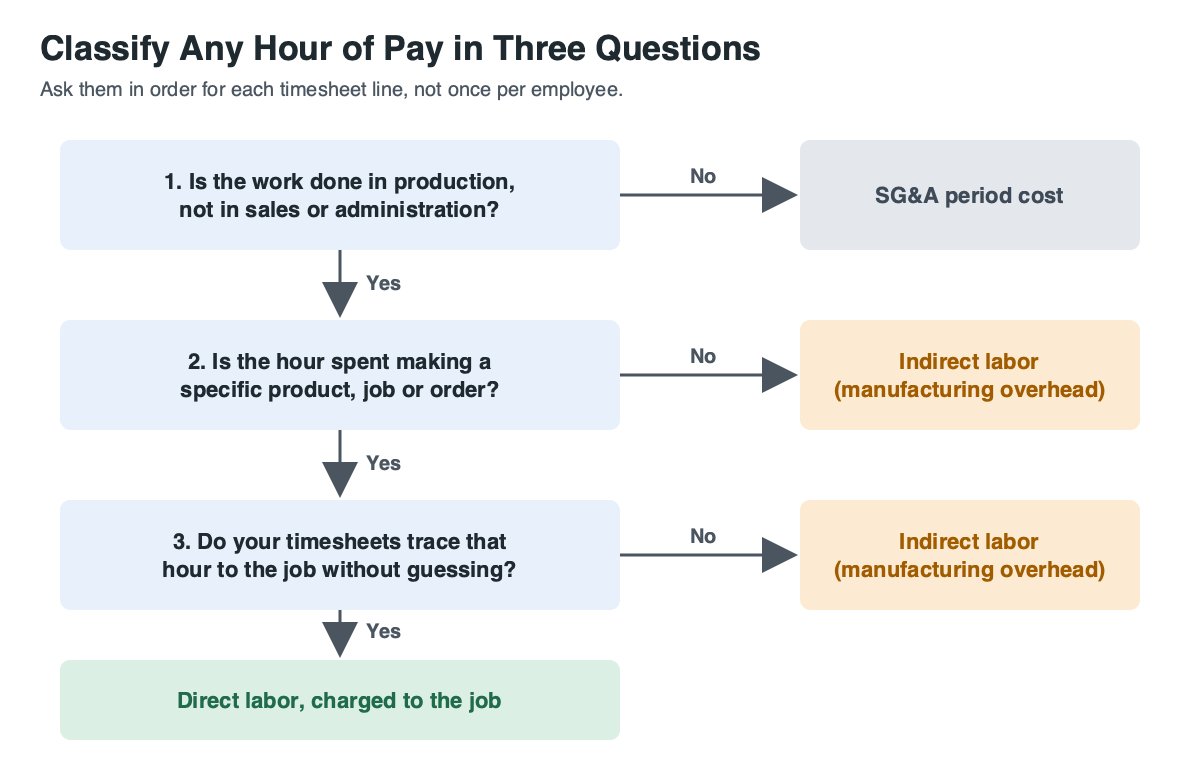
- Is the work done in production, not in sales or administration? If no, the pay is an SG&A period cost and stays out of product cost.
- Is the hour spent making a specific product, job or order? If no, it is indirect labor and belongs in manufacturing overhead.
- Do your timesheets trace that hour to the job without guessing? If yes, it is direct labor. If tracing it would take estimates or more record keeping than the amount is worth, treat it as indirect labor.
Worked Example: Allocating One Pay Period
The worksheet below takes one biweekly pay period at a hypothetical seven person fabrication shop and assigns every timesheet line to one of four buckets: Job 501, Job 502, manufacturing overhead or SG&A. The names and figures are illustrative. The structure is the part to copy.
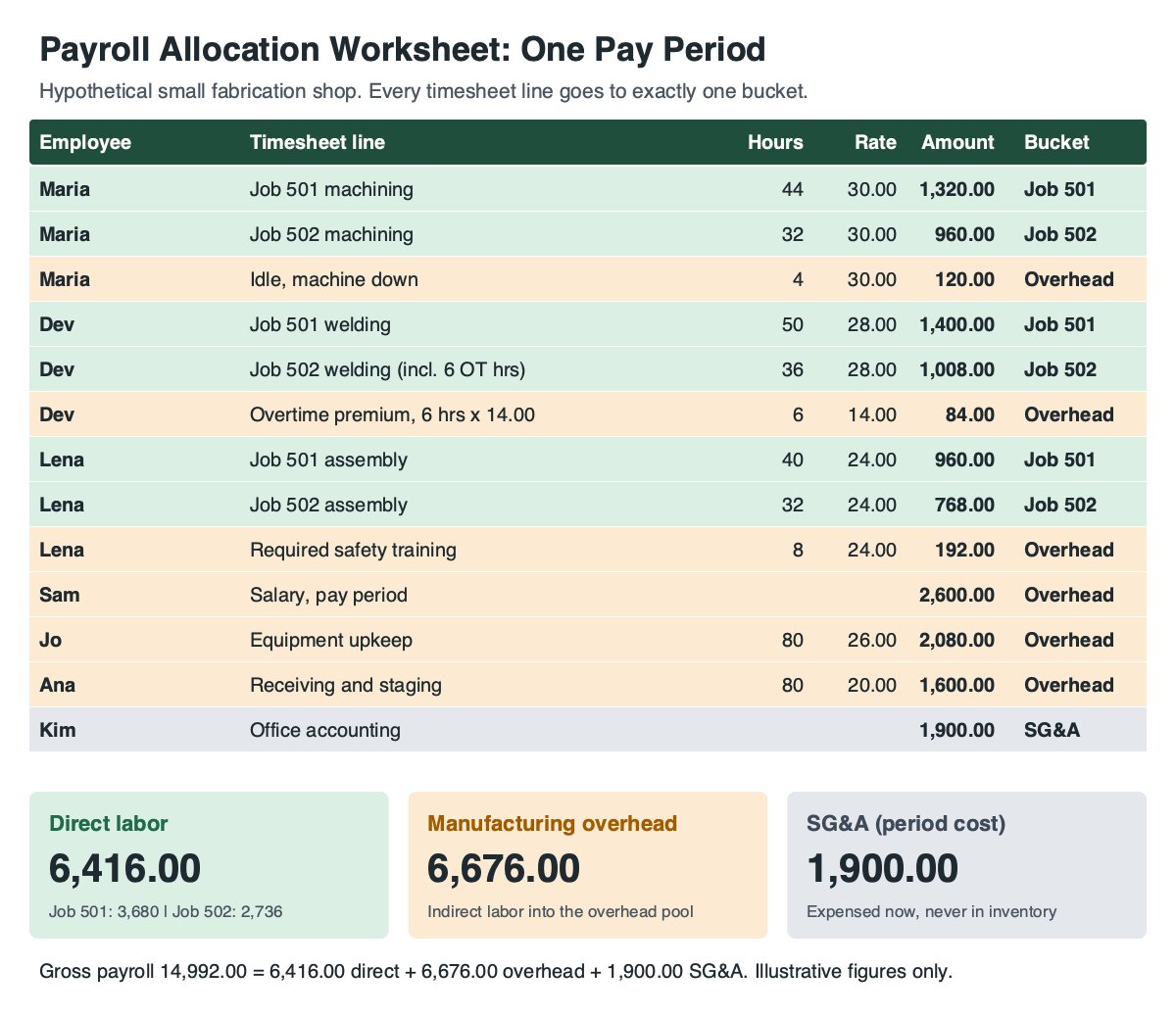
Download the editable payroll allocation worksheet (Excel). Replace the sample lines with your own timesheet data and the bucket totals and reconciliation check update automatically.
Read the worksheet in five steps.
- Start from timesheet lines, not headcount. Maria, a machinist at 30.00 per hour, logged 44 hours to Job 501 and 32 hours to Job 502, which become 1,320.00 and 960.00 of direct labor. Her 4 idle hours while a machine was down, 120.00, go to overhead.
- Split overtime into straight time and premium. Dev, a welder at 28.00 per hour, worked 86 hours, including 6 overtime hours on Job 502. All 86 hours are charged to the jobs at the straight rate: 1,400.00 to Job 501 and 1,008.00 to Job 502. The 6 hour premium at 14.00, or 84.00, goes to overhead because the overtime came from general scheduling rather than a customer request.
- Move nonproductive time of direct workers to overhead. Lena, an assembler at 24.00 per hour, logged 40 hours to Job 501 and 32 hours to Job 502, or 960.00 and 768.00. Her 8 hours of required safety training, 192.00, go to overhead.
- Assign support roles in full. The production supervisor’s 2,600.00 salary, the maintenance technician’s 2,080.00 and the material handler’s 1,600.00 are indirect labor. The bookkeeper’s 1,900.00 is SG&A and never enters product cost.
- Reconcile to gross payroll. Direct labor totals 6,416.00 (Job 501 at 3,680.00 and Job 502 at 2,736.00), indirect labor adds 6,676.00 to overhead, and SG&A takes 1,900.00. Together they equal gross payroll of 14,992.00, so nothing was dropped or counted twice.
Notice the result. Fewer than half of the production payroll dollars in this pay period are direct labor. A quote that prices Job 501 on its 3,680.00 of direct labor and leaves out an overhead rate is missing a cost pool that is larger than the direct labor itself.
What About Payroll Taxes and Benefits?
Gross wages are not the full cost of an hour. Employers also pay their share of payroll taxes, and many pay benefits. According to the IRS, the current tax rate for Social Security is 6.2% for the employer, and the current rate for Medicare is 1.45% for the employer, a combined 7.65% before any additional state or unemployment taxes. On the 6,416.00 of direct labor above, that employer share adds 490.82.
Businesses handle this burden in one of two consistent ways. Some load it onto direct labor with a burden rate, so each direct hour carries its taxes and benefits to the job. Others leave the whole burden in the overhead pool. Either can work. What matters is choosing one method, writing it down and applying it every period, the same consistency principle behind common accounting methods.
Why the Split Matters
Job Costing and Gross Margin
Every job cost and every quote rests on the split. Coding support hours as direct labor overstates the cost of whichever job happened to be on the floor and makes the labor variance meaningless. Leaving direct hours in overhead does the opposite: jobs look cheaper than they were, and the overhead rate inflates and spreads that cost across every other job.
Overtime
Under the Fair Labor Standards Act, nonexempt employees must receive overtime pay at a rate not less than one and one-half times the regular rate of pay after 40 hours of work in a workweek. The legal obligation is the same whatever the cost classification. The accounting choice is where the premium goes. A common practice, shown in the worksheet, charges straight time hours to the job and sends the premium to overhead, unless a customer requested the rush, in which case the premium belongs to that customer’s job.
Inventory Values and Tax Reporting
Direct labor and allocated indirect labor become part of the cost of inventory until the product sells. For tax purposes, the IRS explains that under the uniform capitalization rules you must capitalize the direct costs and part of the indirect costs for production or resale activities rather than deducting them currently. The rules do not apply to a small business taxpayer that meets the gross receipts test under section 448(c) and is not a tax shelter, so confirm your position with your tax adviser.
Corporations and partnerships that deduct cost of goods sold attach Form 1125-A, and the form has a separate line for cost of labor. A documented allocation from timesheet to bucket is what lets you support that number if it is ever questioned.
How To Document Your Labor Classification Policy
A classification method that lives in one person’s head changes every time that person is out. A short written policy keeps job costs comparable from period to period and makes the payroll entry reviewable. It should state:
- Job codes. Which activities get a job or work order code, and which use overhead codes such as idle, training, maintenance and cleanup.
- Edge cases. How you treat overtime premiums, setup time, rework, supervisors who also produce, and travel between jobs.
- Payroll burden. Whether payroll taxes and benefits are loaded to direct labor or kept in overhead.
- Review and approval. Who approves timesheet coding, and how unassigned hours are investigated before payroll closes.
- Reconciliation. A check each period that direct labor, indirect labor and SG&A add back to gross payroll.
Capturing job codes at the time clock rather than reconstructing them at month end removes most coding errors, and it is one of the simpler wins described in our guide to automation in process improvement. When you set pay rates for production roles, a documented salary structure also makes your direct labor rates easier to forecast in quotes.
If you would rather not draft the controls from scratch, the Bizmanualz Accounting Policies and Procedures Manual includes editable procedures for payroll, cost accounting and month end close that you can adapt to your own labor classification rules.
Frequently Asked Questions
Is Indirect Labor a Fixed or Variable Cost?
Indirect labor is often fixed or step fixed. A salaried supervisor or plant manager costs the same whether the shop runs light or full. Some indirect labor, such as material handler overtime in a busy month, rises with volume, so most indirect labor pools are mixed.
Is a Production Supervisor Direct or Indirect Labor?
A production supervisor is normally indirect labor, because supervision supports every job on the floor rather than one job. If the supervisor also works on a specific order and logs those hours to it, those particular hours can be treated as direct labor.
How Do You Calculate Indirect Labor Cost?
Start with total production payroll for the period, subtract the direct labor charged to jobs, and subtract any administrative or sales pay that was coded to production by mistake. What remains, including idle time and training of direct workers, is indirect labor cost for the overhead pool.
Is Direct Labor a Variable Cost?
Direct labor is usually treated as variable because the hours charged to jobs rise and fall with output. In practice it behaves more like a fixed cost when you keep a full crew on salary or guaranteed hours regardless of volume, which is worth knowing before you rely on it in break even analysis.
Do Service Businesses Have Direct Labor?
Yes. Hours that consultants, technicians or crews record against a specific client project are direct labor and belong in the cost of that project. Internal meetings, training and unbilled administrative time are indirect labor or SG&A, depending on whether they support delivery or general administration.