How Prepared is Your Business for an Unpredictable Future?

No business can predict the next disruption, but every business can decide which operations must continue and how its people will adapt. An unpredictable future may bring sudden pandemics, severe weather, cybersecurity threats, supply-chain fluctuations, new payment trends, or a shift in the service economy.
Preparedness turns uncertainty into decisions made before pressure narrows the options. It combines a continuity plan that protects essential activities with an action plan that helps the company respond to change, pursue opportunities, and keep improving.
What Is Business Preparedness for an Unpredictable Future?
Business preparedness is the ability to anticipate plausible disruptions, protect critical operations, respond with clear ownership, and adapt as conditions change. It does not require leaders to forecast every event. It requires them to understand their organization, identify what cannot stop, and prepare people and resources to act.
In ancient times, farmers had no idea how much the next harvest would yield. The Industrial Revolution led to a new period of innovation that came with labor strikes, supply-chain fluctuations, and other worrisome instability. In recent decades, the technological boom has created a churning sense of continual change. Perpetual improvement and modernization have produced an ever-evolving cycle of adaptation.
The operational lesson has remained consistent across those eras. A business may not control the event, but it can control how it evaluates risk, assigns responsibility, communicates, and recovers. Preparedness creates that operating discipline before an emergency, technology failure, market shift, or unexpected opportunity tests it.
That discipline also prevents planning from becoming a catalog of remote dangers. Leaders can begin with a few practical questions: Which products or services generate the most important customer commitments? Which activities depend on a single employee, facility, supplier, or system? How long can each activity remain unavailable? The answers establish a risk-based focus and keep limited preparation time aimed at the circumstances that matter most.
Which Disruptions Should a Business Prepare For?
Traditional disaster management has revolved around fires, floods, and other natural calamities. In the modern world, the definition of disaster has expanded. A continuity plan should consider several broad categories without pretending that every organization faces the same probability or consequence.
Natural and Cataclysmic Events
Wind storms, hurricanes, earthquakes, tornadoes, floods, wildfires, and other natural catastrophes can interrupt facilities, transportation, power, suppliers, and employees. The risk is not theoretical. NOAA’s record of costly U.S. weather and climate disasters shows why leaders should connect regional hazards to practical recovery priorities rather than rely on a generic emergency binder.
Technological Failures
Hardware malfunctions, software outages, telecommunications failures, data loss, and cybersecurity threats can stop work even when the building remains open. Identify the systems that drive customer service, payment, production, payroll, and communication. Then define manual workarounds, backup access, recovery order, and the people authorized to make decisions.
Public Health and Workforce Interruptions
Pandemics showed how quickly illness, quarantines, travel restrictions, and economic turmoil could affect staffing and demand. The broader category includes any event that makes the normal workforce or workplace unavailable. Plans should address remote work, cross-training, minimum staffing, employee communication, and the activities that must continue when capacity falls.
Human-Caused Disruptions
Theft, sabotage, workplace violence, civil disturbance, fraud, and access-control incidents require prevention and response. The plan should define who contacts emergency services, how employees receive instructions, how facilities and information are secured, and who can authorize a temporary closure or relocation.
How Do You Build a Quality Continuity Plan?
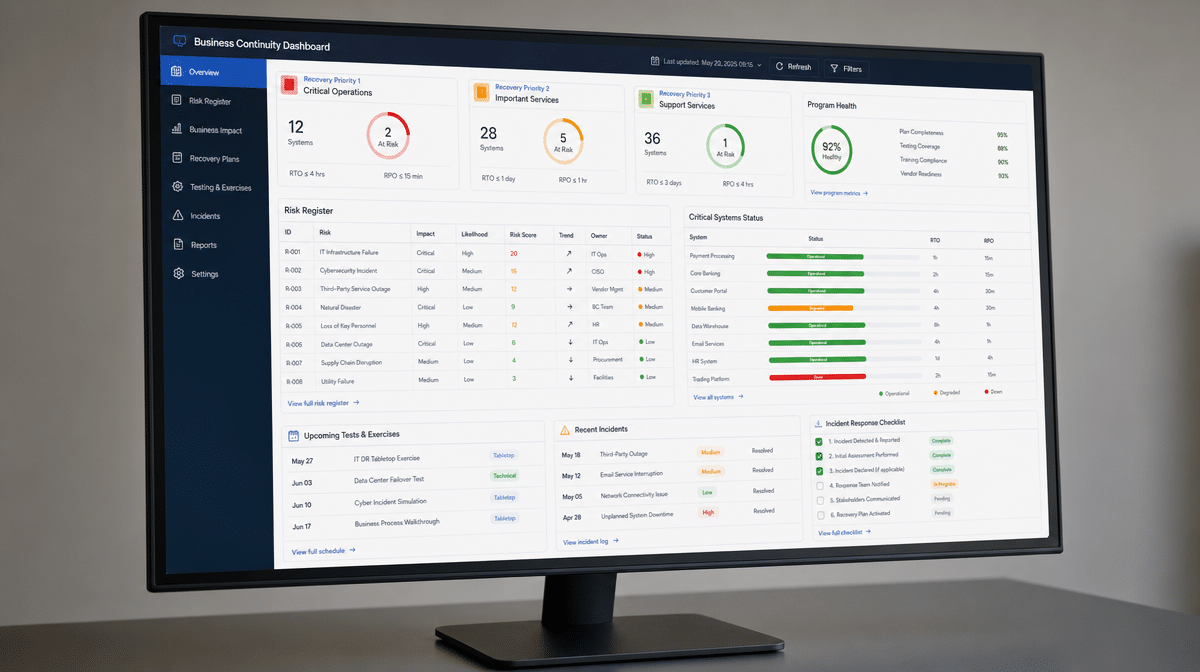
It is difficult to know which potential dangers a business will face, and it is equally challenging to prepare thoroughly for every one. This is why each organization needs a continuity plan based on its unique circumstances, most likely threats, critical dependencies, and ability to respond to an emergency whether it was foreseen or not.
Ready.gov’s business emergency planning guidance connects continuity planning with emergency response, communications, and information technology recovery. A useful plan identifies essential functions and recovery priorities, but it also names the owners, contact paths, resources, and decisions required to keep those functions operating.
Gather an Emergency Preparedness Team
Gather knowledgeable members of staff to create and carry out the plan. A capable disaster recovery team represents operations, technology, facilities, finance, communications, and other functions that understand critical dependencies. Give the team a leader, clear decision rights, and alternates for roles that cannot remain vacant.
Assess Likely Threats and Their Impact
Consider which threats are most likely for the organization, how they could be contained, and what consequences would follow. A short business impact analysis should examine people, facilities, suppliers, data, systems, cash flow, legal obligations, and customer commitments. Probability matters, but a low-probability event may still deserve attention when its impact would be severe.
Identify Key Areas of Business
Identify the key areas that must be maintained even when a catastrophe strikes. Separate essential functions from work that can pause. For each essential function, document its people, information, equipment, vendors, workspace, system access, and upstream or downstream dependencies. This makes recovery priorities explicit instead of leaving every department to argue that it should be first.
Outline the Activities That Must Continue
Outline which activities must continue during an emergency and prepare for each item. State the minimum acceptable service level, recovery sequence, responsible owner, backup owner, manual workaround, communication path, and required resource. A plan becomes executable when employees can see what to do, in what order, and under whose authority.
Review, Test, and Update the Plan Regularly
Create a business continuity plan with quality in mind, then test it. Tabletop exercises, contact-list checks, backup restoration tests, and short simulations expose assumptions while correction is still inexpensive. Review the plan on a set cadence and after major changes to staff, facilities, technology, suppliers, or customer commitments.
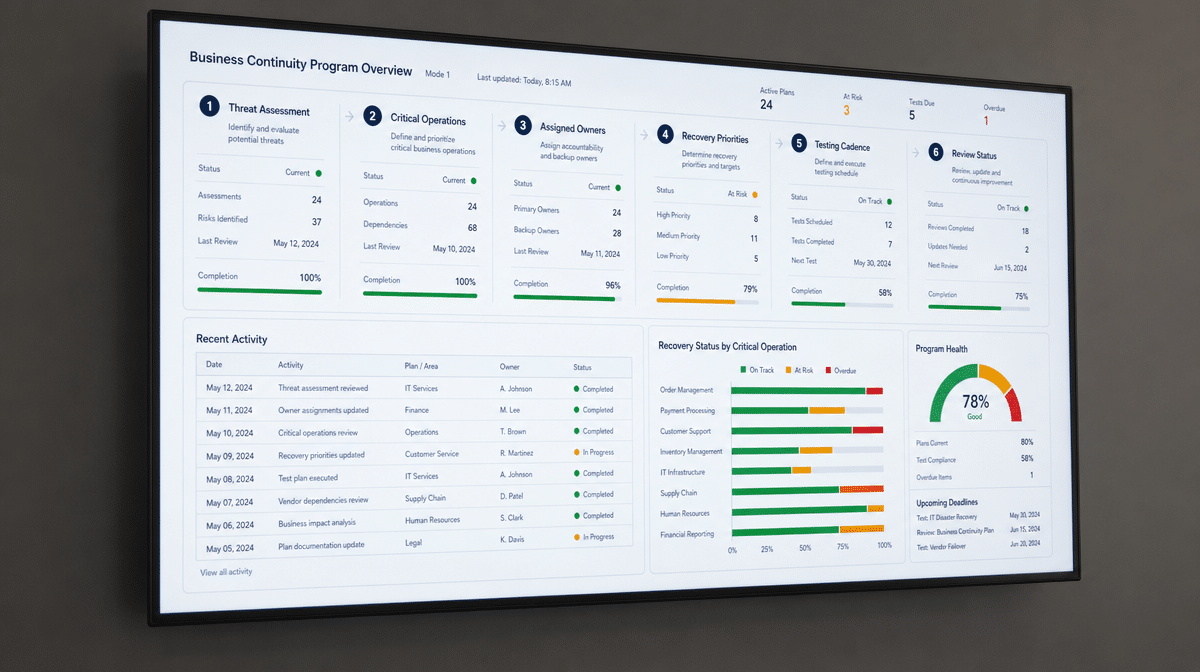
A continuity plan does not eliminate danger. It equips staff mentally and operationally by reducing ambiguity, preserving communication, and establishing a practiced response. The result is a business that can contain disruption and protect its most important activities while leaders evaluate what comes next.
How Does an Action Plan Help a Business Thrive?
Of course, a business should do more than survive the future. It is also wise to create an action plan that helps it thrive. An action plan connects company strategy and vision to specific work. It identifies strengths, weaknesses, opportunities, and threats through a SWOT analysis, then turns those findings into priorities.
Each priority needs an owner, objective, deadline, measure, resource, and next action. The plan should also name assumptions and triggers. If demand falls below a threshold, a supplier misses a commitment, or a new technology changes a process, the trigger tells leaders when to revisit the original choice instead of waiting for a quarterly review.
Good action planning also distinguishes an objective from an activity. “Improve resilience” is an objective, while qualifying a second supplier, documenting a manual workaround, or cross-training two employees are activities. Measures show whether the activities produced the intended result. Without that connection, a plan can look busy while the original weakness remains.
Use Action Plans to Guide Business Process Management
Action plans are a critical part of business process management (BPM), because BPM tends to evolve. It once focused heavily on efficiency and productivity. Modern BPM often balances those outcomes with customer experience, resilience, quality, and adaptability. An updated action plan translates a changing priority into controlled process work instead of an improvised reaction.
For example, traditional supply-chain management has shifted during the rise of e-commerce. Businesses once maintained fairly stable quantities of stock while fielding orders from brick-and-mortar retailers. Online orders created a less predictable flow across channels, locations, and delivery expectations.
Innovative businesses use apps, integrated order systems, and data sharing to track supply and demand and create greater transparency. They also use automation to improve coordination and response speed. A focused plan to manage an e-commerce supply chain can assign the owners, system changes, process measures, and review points needed to turn that capability into daily operations.
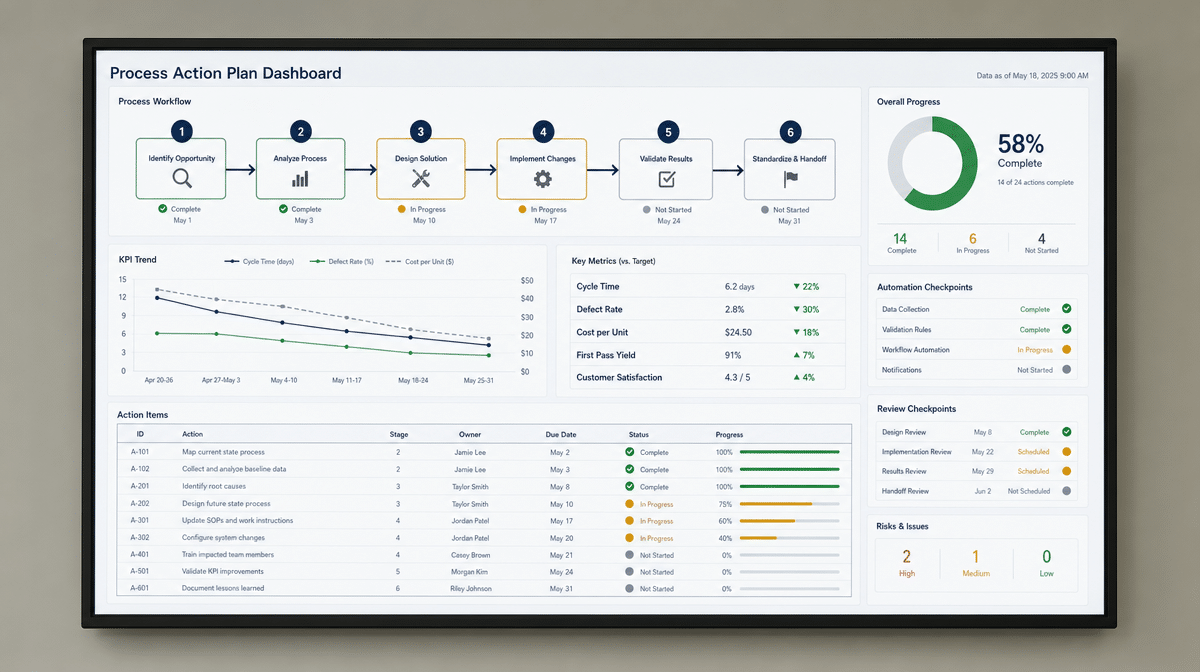
Whether the change affects supply-chain management, marketing, back-office activity, payment trends, customer service, or another part of the organizational structure, the same principle applies. A flexible action plan introduces developing trends and industry evolution into BPM through deliberate objectives, activities, measures, and review. It keeps improvement connected to strategy rather than to the loudest new idea.
Review the action plan alongside operating results. Close completed activities, escalate blocked work, question assumptions, and retire priorities that no longer support the vision. This cadence helps the organization adapt without allowing continual change to become continual distraction.
How Do Continuity Plans and Action Plans Work Together?
An uncertain future gives leaders two critical responsibilities. First, create a thorough continuity plan as protection against future catastrophe. Second, maintain an updated action plan that incorporates developing trends and industry evolution into business process management efforts.
The first is a survival activity focused on preservation and a healthy response to danger. The second is a thriving activity that helps the organization proactively improve. Taking preventive action through both plans creates a practical balance: protect what must continue, then adapt what must change.
The plans should share assumptions, owners, measures, and a review cadence. A continuity exercise may expose a single-source supplier or an undocumented manual process. That finding should become an action-plan priority. An action-plan change may introduce a new platform or partner. That change should flow back into continuity documentation, recovery procedures, and training.
Preparedness is therefore not a one-time project. It is an operating cycle of assessing risk, planning, testing, acting, measuring, and updating. A business that maintains that cycle is better able to remain healthy and whole no matter what the future has to offer.
Frequently Asked Questions
What Is Business Preparedness?
Business preparedness is the ability to anticipate plausible disruptions, protect critical operations, respond with clear ownership, and adapt as conditions change. It combines continuity planning with action planning.
Why Does a Business Continuity Plan Matter?
A continuity plan identifies essential functions, recovery priorities, dependencies, owners, communications, and workarounds before a disruption occurs. It reduces ambiguity and helps employees protect the activities the business cannot afford to lose.
What Threats Should a Continuity Plan Address?
A continuity plan should address the natural, technological, public-health, workforce, and human-caused disruptions that are plausible for the organization. The priority depends on each threat’s probability, impact, and connection to critical operations.
How Often Should a Continuity Plan Be Updated?
Review the plan on a regular schedule and after major changes to people, facilities, systems, suppliers, or customer commitments. Tests and real incidents should also trigger updates when they expose a weak assumption or missing dependency.
How Do Continuity Plans and Action Plans Work Together?
Continuity plans protect essential operations and support survival during disruption. Action plans turn changing conditions, lessons, and opportunities into prioritized work that helps the business adapt and thrive.