What are Examples of Standard Work Instructions?

A work instruction stops being standard when the process changes but the document does not. When accounting software, controls, or responsibilities shift, employees need instructions that still match the work in front of them.
Standard work instructions turn a procedure into clear task-level direction. They can support purchasing, accounts payable (AP), accounts receivable (AR), inventory counting, asset control, and other critical business processes, policies, and procedures. The examples below show how editable Microsoft Word templates and controlled digital documents can be opened, modified, saved, and updated as work changes.
What Are Standard Work Instructions?
Standard work instructions are detailed directions for completing a specific task in a consistent way. A procedure usually describes the broader process, including who is responsible and what outcome is required. A work instruction explains how an employee performs one part of that process, often with numbered steps, system fields, decision points, control checks, and examples.
The distinction matters because employees often need more than a policy statement or a high-level process map. They need to know which screen to open, which information to enter, what evidence to retain, and what to do when a transaction does not follow the normal path. The Bizmanualz guide to the difference between procedures and work instructions explains how these document levels fit together.
What Should a Work Instruction Contain?
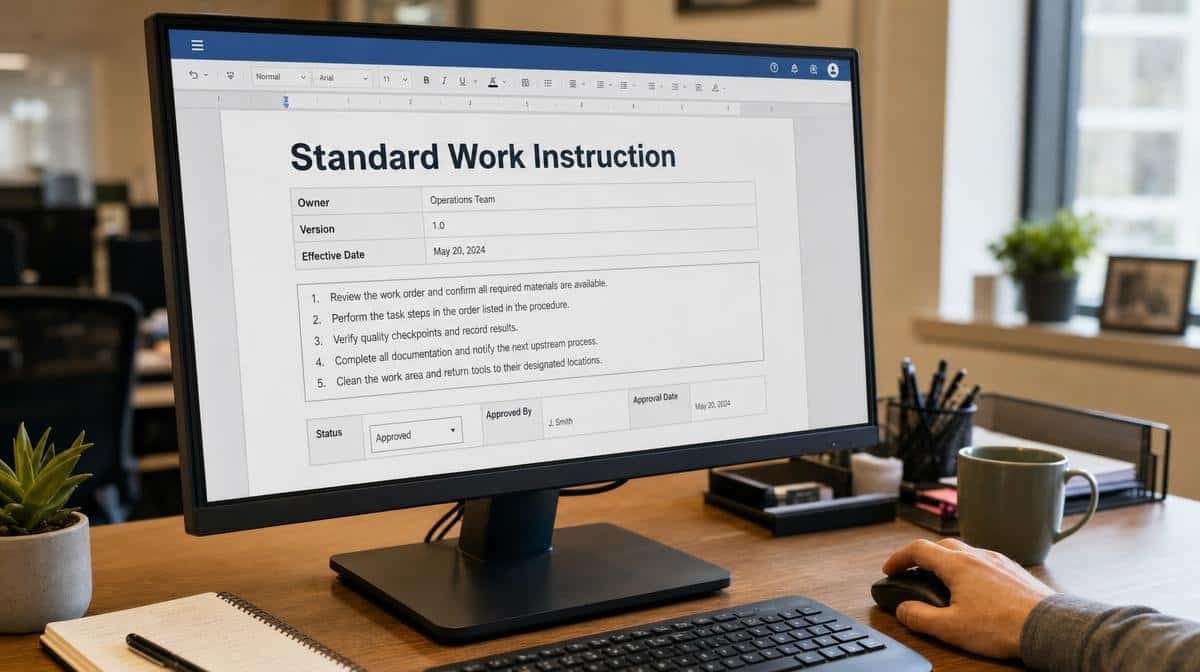
A useful instruction identifies the task, owner, effective date, version, required inputs, and expected output. It then presents the steps in the order employees perform them. Screenshots, form names, transaction codes, quality checks, approvals, and exception paths should appear only when they help the user complete the work correctly.
Each instruction should also state where records are stored and who reviews the document. The EPA’s guidance for preparing standard operating procedures emphasizes consistent format, review, approval, and controlled revision within a quality system. Those disciplines also make everyday business instructions easier to maintain.
Which Business Functions Use Work Instructions?
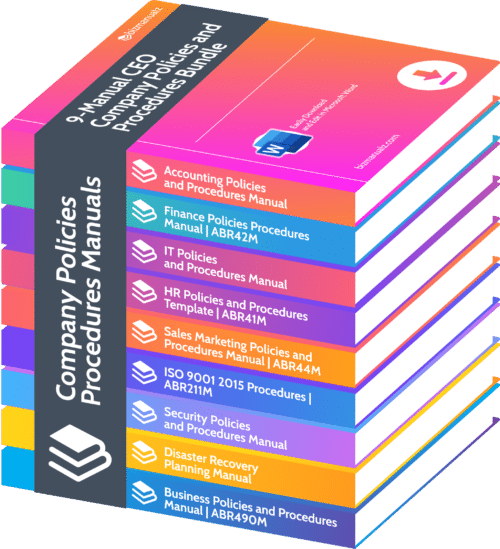
Work instruction examples exist for a wide range of business functions. Common areas include Accounting Controls, Financial Compliance, Computer & IT Security, Sales & Marketing, Business Sampler activities, Human Resources, ISO 9001 quality management, Security Planning, and Disaster Recovery. Each area uses the same basic discipline, but the steps, risks, records, and approvals differ.
What Are Examples of Standard Work Instructions?
Examples of standard work instructions range from a one-page checklist for opening a store to a detailed accounting instruction for posting, approving, and reconciling a transaction. The right level of detail depends on the task’s complexity, the employee’s experience, the system being used, and the consequences of an error.
Accounting Work Instructions
Accounting work instructions support process training and end-user help. They provide a practical place for process notes and transaction notes that answer questions about an accounting system. Instead of telling an employee to “process the invoice,” an instruction can identify the invoice fields to verify, the approval threshold, the account coding rule, the supporting evidence to attach, and the exception route for a mismatch.

Purchasing and Accounts Payable
A purchasing instruction can show how to create a purchase request, select an approved supplier, obtain authorization, and issue a purchase order. The related accounts payable instruction can cover three-way matching, duplicate-invoice checks, payment approval, and record retention. Together, these instructions connect purchasing policy to the exact work performed in the system.
Accounts Receivable and Cash Application
Accounts receivable instructions may explain customer setup, invoice creation, receipt posting, credit-memo approval, and collection follow-up. A cash-application instruction can define how employees match receipts to invoices, handle short payments, record unapplied cash, and escalate disputed balances. Clear steps reduce inconsistent treatment and make process training easier.
Inventory Counting and Asset Control
Inventory counting instructions can specify count sheets, team assignments, cutoff rules, recount thresholds, and variance approvals. Asset-control instructions can cover tagging, location changes, maintenance records, disposal approval, and periodic verification. These examples show why a broad procedure often needs supporting work instructions for the tasks that carry the most operational or financial risk.
Accounting Systems and Controls
Organizations can adapt accounting instructions to SAP Cloud ERP, Microsoft Dynamics 365 Finance, QuickBooks, or another current platform. The document should use the names and fields employees actually see, while separating system navigation from the control objective. This makes future updates easier when the interface changes but the required approval or evidence does not.
Accounting work instructions can support documented controls and consistent financial reporting, but a template does not create compliance by itself. Controls may support US Generally Accepted Accounting Principles (GAAP) or the IFRS Foundation’s issued Accounting Standards where applicable. Covered public companies may also document controls relevant to Sarbanes-Oxley (SOX) Section 404, which addresses management reporting on internal control over financial reporting.
Industry Work Instructions
Work instruction samples also exist for medical offices, construction projects, nonprofit organizations, software projects, and bank procedures. A medical office may need instructions for patient records and billing. A construction business may document site inspections, change orders, and subcontractor approvals. A nonprofit may focus on donation processing and restricted funds, while a bank may require more detailed verification and segregation of duties.
Each downloadable Microsoft Word industry policy and procedure template is a starting point, not a finished operating system. The organization still needs to adapt the instruction to its roles, risks, software, regulatory environment, and records. That local review is what turns boilerplate into usable standard work.
How Do Work Instructions Improve Business Processes?
Standard work instructions improve business processes by making the expected method visible. They simplify process training, provide clear direction to employees, and support compliance requirements by showing how a control is performed. They also create a stable baseline for identifying waste, delays, unclear handoffs, and repeated exceptions.
Create the Instruction Around Real Work
Start with the employee who performs the task and observe the current sequence. Capture the inputs, decisions, systems, approvals, and records that matter. A plan to document processes and procedures helps teams prioritize the work that is frequent, risky, difficult to learn, or dependent on one experienced person.
Review and Approve the Standard
The process owner should verify that the steps match policy, system configuration, and control requirements. A second employee should test the instruction without coaching from the author. If the tester cannot complete the task, the document needs clarification before approval and release.
Train Employees With the Same Document
Using the approved instruction during training connects explanation to execution. New employees can follow the steps, experienced employees can confirm unusual cases, and supervisors can coach against one standard. The document becomes end-user help rather than a file that sits unread in a shared folder.
Update Instructions When the Process Changes
Review work instructions after software releases, control changes, audit findings, role changes, or repeated employee questions. Record the version, effective date, approver, and reason for revision. ISO 9001 connects the process approach, documented information, and continual improvement, which is why controlled updates matter as much as the first draft.
Use the Standard to Simplify the Process
Documentation often exposes duplicated approvals, missing decisions, and system steps that no longer add value. Teams can use that evidence to simplify complex processes, then revise the instruction to match the improved method. The instruction should describe the best current way to work, not preserve unnecessary complexity.
What Is the Difference Between Procedures and Work Instructions?
A procedure coordinates a process across roles and defines its purpose, responsibilities, controls, and outputs. A work instruction supports that procedure with task-level detail. For example, an accounts payable procedure may cover invoice receipt through payment, while separate instructions explain vendor setup, invoice entry, three-way matching, payment-file approval, and exception handling.
A procedure manual organizes policies, procedures, forms, and related work instructions so employees can find the correct level of guidance. Editable Word document templates can speed the first draft, but every instruction must be modified to fit the current environment, reviewed by the people who do the work, saved under document control, and updated as needed.
Well-maintained standard work instructions give employees practical direction without confusing the instruction with the broader procedure. They support consistent execution, faster training, clearer controls, and better process improvement across accounting and other business functions. Organizations that need a starting point can review free policies and procedures and adapt the relevant materials to their own work.
Frequently Asked Questions
What Are Standard Work Instructions?
Standard work instructions are detailed, task-level directions that explain how to perform a specific activity consistently. They often include steps, system fields, control checks, approvals, and required records.
What Is the Difference Between a Procedure and a Work Instruction?
A procedure describes the broader process, responsibilities, controls, and outcomes. A work instruction explains how an employee completes one task within that procedure.
What Should a Standard Work Instruction Include?
It should include the task owner, version, effective date, required inputs, ordered steps, decisions, control checks, approvals, expected output, and record-storage requirements.
When Should Standard Work Instructions Be Updated?
Update them after software releases, control changes, role changes, audit findings, repeated employee questions, or any other change that makes the documented steps inaccurate.
How Do Work Instructions Support Training and Compliance?
They give employees one approved method to follow during training and daily work. They can also show how required controls are performed and what evidence employees must retain, although the document alone does not create compliance.