
How Do You Write a Good Business Policy?

Writing a good company policy is similar to writing a good business procedure, but there are a few differences between a policy and a procedure. A business policy consists of either company rules, typically about ethics or relationships, or process outcomes defining expected results, kind of like a mission statement. So how exactly do you write a good business policy?
Company Employee Handbook

Company rules are found in your Employee Handbook. One example would be sexual harassment. It is illegal in the United States to subject others to unwelcome sexual conduct in a work situation.
If you are going to write a good sexual harassment policy, you would start with the law or regulation issued by the Equal Employment Opportunity Commission (EEOC). The EEOC provides definitions and additional information that will allow us to describe what will be required of a good company policy. Let’s take a look at an example of a good policy for sexual harassment.
Example Sexual Harassment Policy
Every company should have a sexual harassment policy in their company manual that reads something like this:
The Company is committed to providing a workplace free from sexual harassment and as such prohibits the sexual harassment, or gender-based discrimination of any employee.
Notice this is a rule about relationships and ethics. So now that we have written a rule, what do we do with it? We are not done. Before we release this business policy we need to put some context behind it. We could use some basic descriptive information:
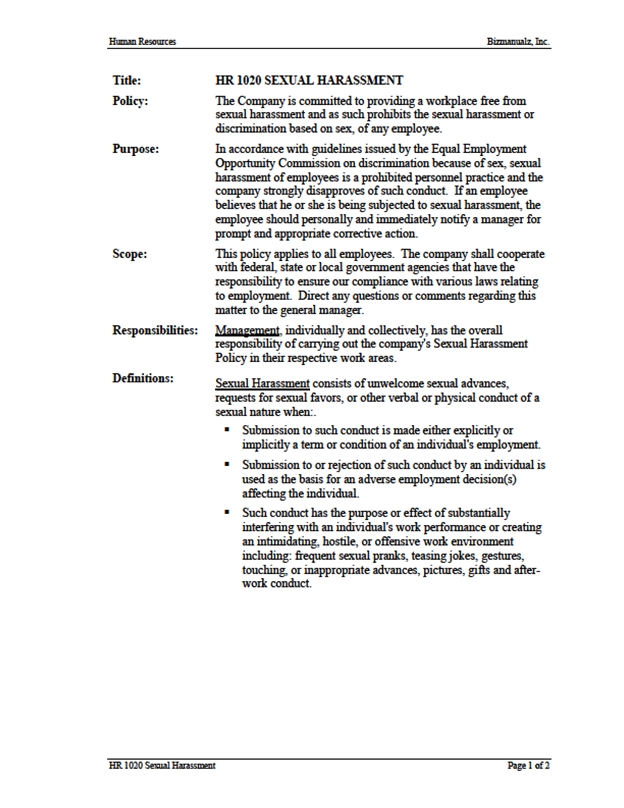
Sexual Harassment Policy
- Title: What is the policy going to be called?
- Policy: What is the text of the policy?
- Purpose: Why do we need a policy for this?
- Scope: Who does this policy apply to?
- Responsibilities : Who is responsible for the policy?
- Definitions: Are all terms in the policy clear?
- References: Does this policy refer to other documents?
Once you have answered all of these questions you are ready to produce a complete business policy document (see figure). But what if you need to write a business policy as part of a business procedure (think an accounting manuals template)? Then you should focus it on the business process results.
A Policy in a Procedure
A business policy in a procedure acts as a mini-mission statement containing the customer of the policy, its purpose, and a Key Performance Indicator (KPI) to communicate how users know the procedure is working. Let’s take a look at an example of a good policy for accounts receivable.
Example Accounts Receivable Policy
This example comes from Bizmanualz Accounting Policies and Procedures Manual. The example policy for an Accounts Receivable Procedure:
Accounts Receivable Personnel are responsible for the timely preparation, distribution, and collection of invoices to optimize cash flow and customer payments while maintaining accurate records for proper internal control.
In the Accounts Receivable policy you see the customer is the Accounts Receivable personnel. The purpose is to optimize cash flow and customer payments while maintaining accurate records for proper internal control and the KPI is optimize, timely and accurate. The procedure needs to define what optimize, timely and accurate means.
Keep Business Policies Short
I would try to keep business policies short, to a single paragraph. A longer business policy is more complex and is harder to follow. Here we have three KPIs to follow (optimize, timely and accurate.)
You could just as easily shorten the policy to:
Accounts Receivable personnel shall ensure that all outstanding customer invoices are paid in a timely manner.
A shorter business policy is more focused on a single KPI and much easier to follow. What do we do with the questions we need to answer for Title, Policy, Purpose, Scope and Responsibilities? Answer them, but in this case we are writing a procedure policy so the answers are in the context of the procedure, not just the policy. Otherwise it is pretty much the same as writing a policy rule for use in an employee handbook.

That Is How You Write a Good Business Policy
It is easier than you think. But you don’t want to write a business policy from scratch over and over again. It is very easy to start with Bizmanualz free policies and procedures. Just image the time you will save writing standard operating policies and procedures for your business. Try out Bizmanualz today.






Leave a Reply