Why is Process Mapping an Important Tool for Improving Processes?
Did you know that it is a “best practice” to create a process map for every procedure or system of procedures that you develop or improve? And did you know that, like a table of contents, process mapping will create stronger communication and better understanding in your organization? Why is process mapping an important tool for improving processes?
Process Mapping is an Important Tool for Improving Processes
Process maps are not required by the ISO 9001 standard. They are one way to satisfy requirements to determine the process needed, the sequence and interaction, and documents to ensure effective planning and control, and they are helpful in communicating responsibilities, internal communication, product realization planning, and monitoring and measuring.
Process mapping is not required, but it is considered a “best practice” and is used by all advanced quality systems. How do you use a process map? It’s important to identify your business’ core processes. Let’s take a further look at how to create a process map and see how it creates knowledge to benefit you and your organization.
Process Mapping as a Communication Tool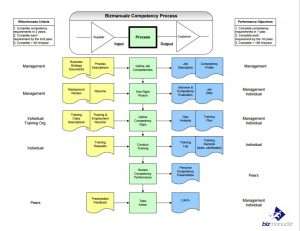
A process map is a flow diagram of the primary processes within an organization. It very specifically shows you both who and what is involved in a process, as well as the requirements for that process to be effective. The primary goal is to use the process map as a communication tool.
It is to show the sequence of interactions of the elements involved in the process. And so process maps are drawn and used by organizations to achieve several benefits:
- Increase process understanding
- Clarify process boundaries, ownership, and effectiveness measures
- Identify process sequences
- Isolate core processes, bottlenecks, and opportunities for improvement
- Clarify the interaction of Customer, Supplier, Management, and Operations processes
- Provide a tool for training and discussion
In other words, a process map details what happens first, second, and third in a process. It shows what happens in each step along the way, and it’s drawn in graphical form for easier communication and understanding.
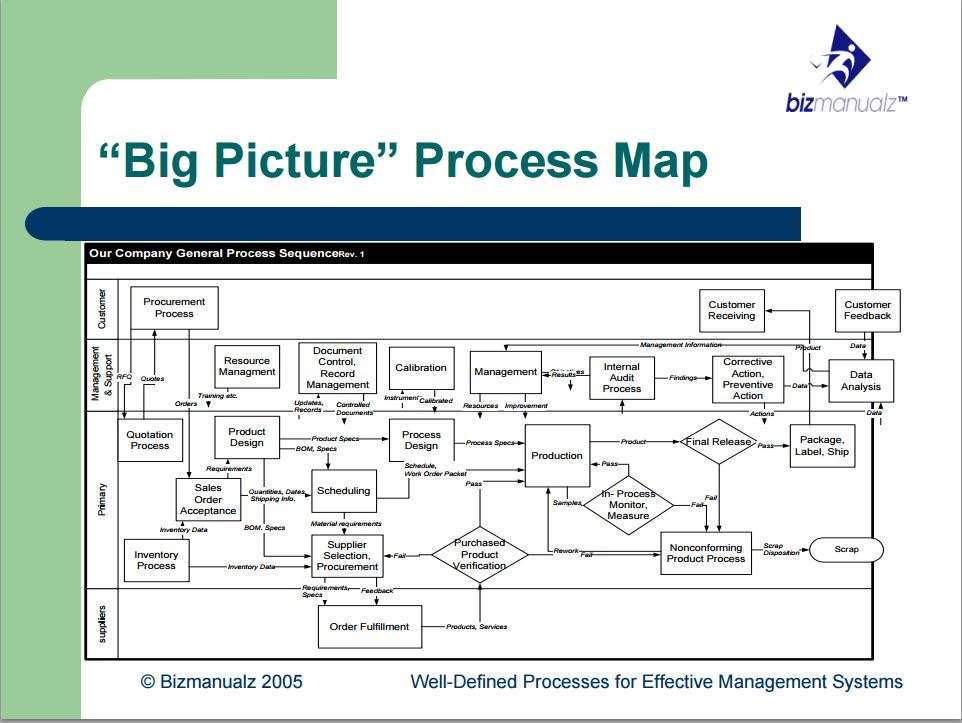
Let’s take a look at a “big picture” process map, taken from Bizmanualz How to Create Well-Defined Processes class.
This type of map shows the “big picture” of ten to twenty core processes within the organization. The map also shows the critical elements within each section and its importance within the whole management system. And these sections, or bands, are what relate the processes to each other AND to the outside suppliers and customers.
Process Maps Link Suppliers and Customers
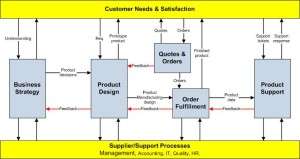
Figure 3: An Example of Organization Processes
Although there are several ways to draw a process map, the basic diagram is typically constructed in four bands. And these four bands link together Customers, Primary Processes, Secondary Processes, and Suppliers.
You improve effectiveness by showing the specifics of a process. And sometimes we’ve learned the hard way that the development phase of a project or a process is far more expensive than the planning phase.
Thinking through and perfecting your processes beforehand, you decrease waste in development time. With a detailed process map, you identify and decrease such waste wherever it occurs in the process.
Here are a few key points to keep in mind while mapping a process:
- Identify core processes to support the company mission and goals
- Determine how to create value for the customer throughout the process
- Map ownership and performance metrics along with the process
- Engage your people in process mapping to define problems and solutions
Now, let’s break down the process map even further.
Define the Steps of the Process Before Improvement
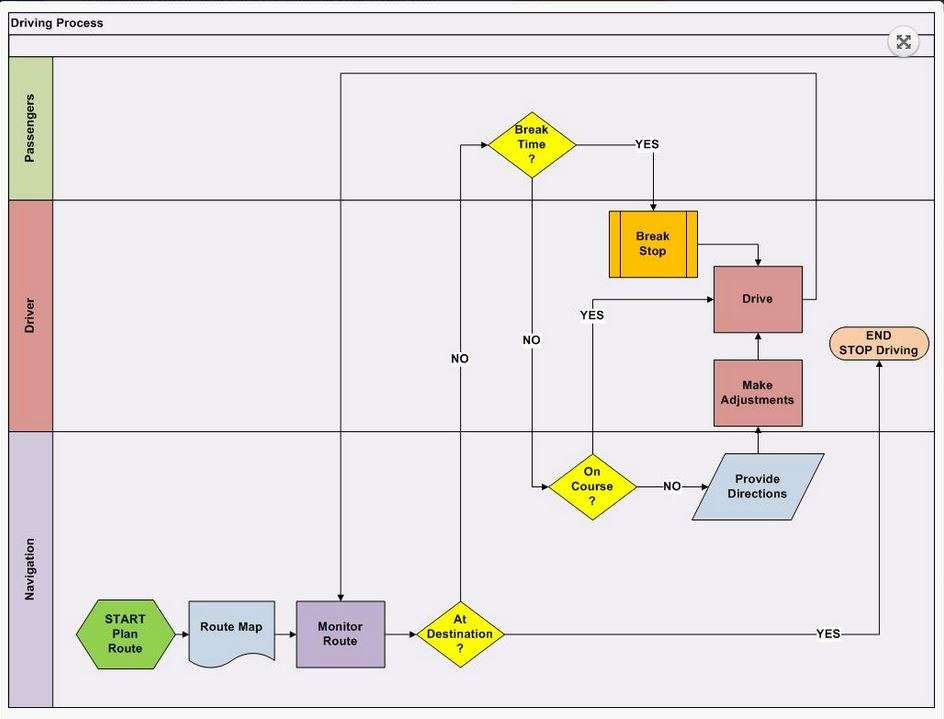
We’ve just defined the big picture process map as a sequence of interactions of multiple processes. These multiple processes consist of multiple steps.
As we’ve discussed, the benefits are better communication and understanding and a decrease in waste. And this offers a great “big picture” view of your organization’s processes. But…
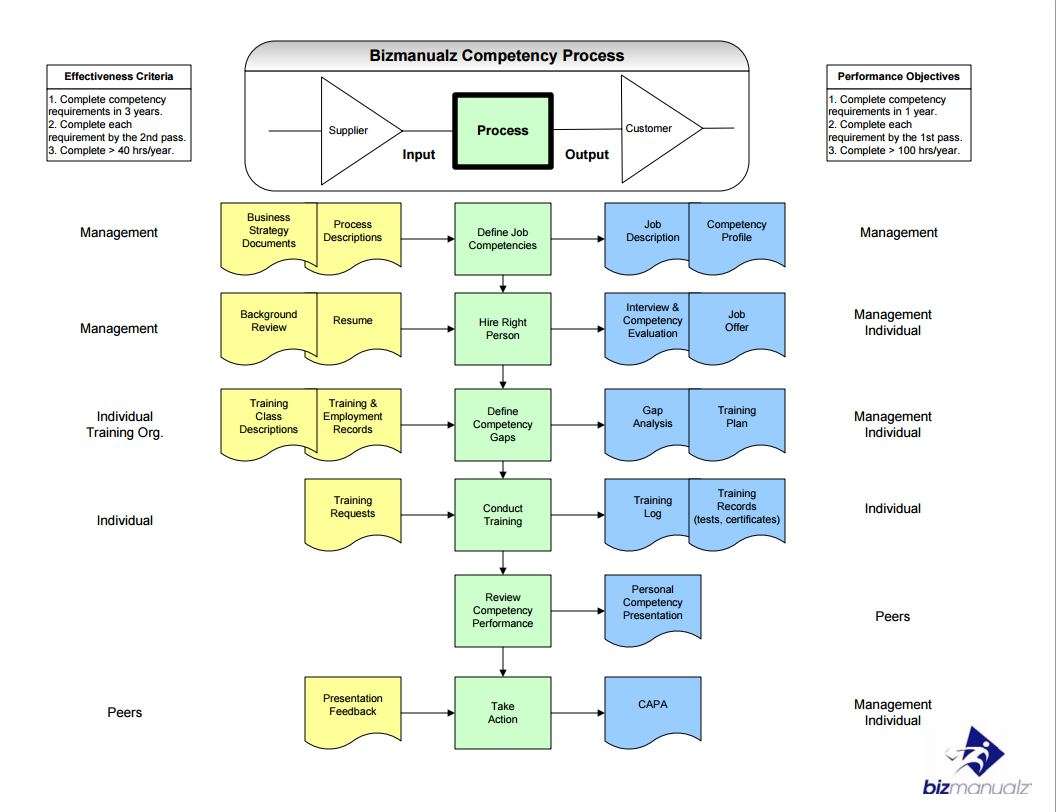
When you go to write your organization’s procedures, you need more detail. You’ll need a method to define the sequence of interactions of each step. And you do this with a procedure map. To the right, there is an example of a typical procedure map.
With this refined procedure map, you can see the steps that go into an organization’s competency process, including the suppliers and customers for each of those steps. This is also called the SIPOC method. Using this method identifies the Suppliers of the specific data used as an Input for the Process to create Outputs for the Customer.
The map also gives you both effectiveness and performance criteria for this process’ owner(s). With such measurement criteria, you set the mark for continuous improvement of the process.
And so by creating a procedure map, you will further increase communication and understanding within your organization. Procedure maps become a strong tool in training, either to familiarize new employees to their jobs or to increase efficiency and performance with current employees.
An Important Tool for Improving Processes is Process Mapping
Both process and procedure maps are crucial in an organization. And so as a rule of thumb, never develop a procedure or start process improvement without first creating a process and procedure map.
Acting like a table of contents, a process map helps organize the chapters of a complex book in a way that this knowledge can easily be communicated, understood and applied. Process maps are critical to understanding a process, communicating the process, and improving the process.