Bizmanualz Policies and Procedures Blog

Bizmanualz has been at the forefront of deploying business best practices since 1995 delivering Policies, Procedures and Forms; quality systems implementation; and strategic business process improvement to help business owners achieve the growth and expansion they envision.

Premium Quality Policies, Procedures & Forms

Posted by Chris Anderson on June 2nd, 2011

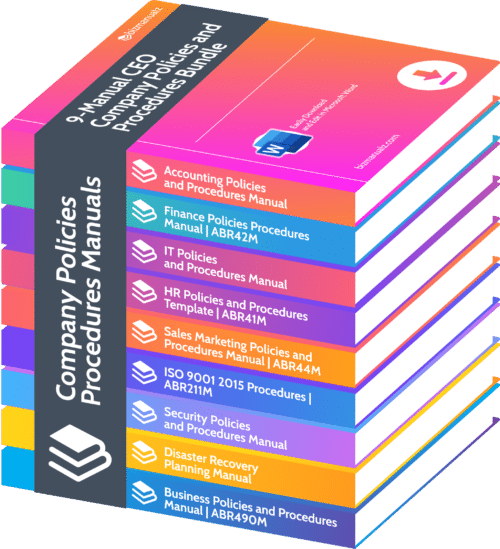
Bizmanualz is the Internet’s Premier online source for premium quality policies and procedures manuals of all types such as accounting, human resources, ISO quality, security, disaster recovery, and more. Bizmanualz is your direct connection to a variety of prewritten MS-WORD procedure templates for industries ranging from manufacturing, non-profit, construction, software development, banking, and medical office to employee handbooks, job descriptions, business forms, and other standard operating procedures.

If you’ve been struggling with writing your own procedures or searching the Internet for samples of policies and procedures, you’ll know that procedures can be expensive to produce but even more expensive to ignore. Bizmanualz offers policies, procedures and software at a fraction of the price it would cost you to develop them yourself or hire someone else to write. This we can do because we have developed a wide range of procedures, either for customers like you or for specific consulting engagements.

Bizmanualz’s goal is to best provide you with top quality service and to help you in creating policies and procedures that allow you to take control of your business growth and maintain confidence in your organization.  At Bizmanualz you will receive quality service with a personal touch, feel free to call us Toll Free at 1-800-466-9953 with any questions you might have searching for that perfect set of standard operating procedures. There is a lot of useful information that we provide on our site but we do understand it could be overwhelming at times. Our customer service representatives are here to go over anything you might have a question with, whether it be for selecting internal controls or developing your employee handbook.

At Bizmanualz, we specialize in providing a complete set of policies and procedures covering every department in your organization. We have long established relationships with business process software vendors, policies and procedures writers, and subject matter experts to bring you a whole solution. Because we are constantly developing new procedures, we make a market for products at prices, which are simply unrivaled. Once one understands the variety of policies and procedures solutions available (different software, books, or custom produced) then one can identify or compose the procedures solution that is appropriate. Please check out the Procedure Solutions page for more information. This will present the full range of different types of procedures products you can choose from to complete your project.

Tags: , , , , , , , , ,
Posted in Policies and Procedures, Procedures Manuals | Comment »

What Do You Think of When You Hear “Sustainability”?

Posted by Steve Flick on May 25th, 2011

I’ve noticed the topic of “sustainability” is piquing the interest of an awful lot of businesspeople of late. I believe it’s an issue worthy of serious consideration but I have a few questions before I proceed:

  • How are we defining the term? Do we agree on what it means?
  • Is there anyone on the inside (developing sustainability policies, setting sustainability objectives, implementing sustainability practices and procedures, etc.)?
  • Are most of us aligned with the status quo (i.e., standing on the shore, waiting for some other fool or brave soul to test the water)?

There are plenty of references to sustainability floating around the web. In Quality, we continually refer to a practice known as the “5S’s”, the key “S” being “sustainability”. Sustainability is often linked with the construction business, LEED certification being the hottest topic in the industry. Our friends at ISO – the International Organization for Standardization – have issued a number of standards that directly or indirectly address the issue, such as:

I’m curious to know what all of you think, so I’ve started a poll on LinkedIn — look for “What’s the status of your organization’s ‘sustainability program’?”. For those of you who have a LinkedIn account, I hope to hear from you soon. (For those who don’t, it costs nothing to sign up.) I’ll post the results for you in the near future.

Thank you for your time, as always.

Steve

Tags: , , , ,
Posted in Lean Articles, Policies and Procedures | Comment »

Are Your Expectations the Same as Your Objectives?

Posted by Steve Flick on May 23rd, 2011

To some, there’s an enormous difference between expectations and objectives. Our expectations are based on such factors as “the social contract”, our knowledge, and our personal experience. Objectives are rational, exhibiting little, if any, measurable bias, and are clearly communicated.

Our expectations reflect our personal biases. Expectations are often unstated — they are somehow expected to be understood. For example, we expect that adult pedestrians will not haphazardly dart in and out of vehicular traffic. That seems like a reasonable expectation, doesn’t it? We don’t often hear or read of pedestrians being killed as they burst or wander into traffic. The car is bigger, heavier, and faster — why would anyone risk serious injury or death?

Expectations being what they are, many are not met. They are often burdened by others’ expectations. For example, you expect the businessperson on the street corner, on their cellphone while dragging a wheeled suitcase along, is going to look before crossing the street in front of your car. They, on the other hand, expect every vehicle operator to see and yield to them. Someone’s expectations will be dashed, probably both.

One thing expectations rarely are, and that is “based on empirical evidence or sound policy“. Suspicions and hunches aren’t evidence. Too often, a manager comes up with “that’s the way it’s always been done”, or “that’s the way I’ve always done it and it’s always worked.” (Always? Really? Show me the numbers that bear that out.)

It ain’t braggin’ if you c’n back it up.
“Dizzy” Dean

Another thing expectations never are, and that’s “communicating well with others“. The essence of a well-run company is establishing SMART objectives that everyone in the organization understands and agrees with.

If you want your expectations met, you have to state them as clearly and precisely as you can to everyone responsible for meeting them. You have to get feedback from those people so you know everyone’s on your wavelength.

A moving target is hard to hit.
Lucy Ricardo (“I Love Lucy”)

Do this and your expectations are no longer mere expectations — they are the company’s business objectives. Unstated expectations will always be unmet expectations.

Tags: , , , , , , ,
Posted in Business Communication, Knowledge Management, Strategy | Comment »

OSHA Recordkeeping Advisor Simplifies Compliance with Requirements

Posted by Steve Flick on May 20th, 2011

The U.S. Department of Labor (DoL) announced the release of a new Web tool yesterday (May 19), designed to help employers understand their responsibility to record and report work-related injuries and illnesses. This tool promotes compliance with Human Resource (HR) requirements 0f Occupational Safety and Health Administration (OSHA) regulations.

Your employee policies and procedures should address HR compliance issues like OSHA recordkeeping. The OSHA Recordkeeping Advisor helps employers and those responsible for organizational safety and health quickly determine:

  • Whether an injury or illness is work-related;
  • Whether a work-related injury or illness needs to be recorded; and
  • Which provisions of the regulations apply when recording a work-related injury or illness.

To help you determine what action(s) to take, the OSHA Recordkeeping Advisor leads you through an online questionnaire. To see the OSHA Recordkeeping Advisor and questionnaire, see www.dol.gov/elaws/osharecordkeeping.htm.

This Advisor is one of a series of online compliance assistance products from OSHA.  The elaws (Employment Laws Assistance for Workers and Small Businesses) Advisor is developed by DOL to help employers and employees understand federal HR employment laws. For a complete list of elaws Advisors, visit the elaws web site at: www.dol.gov/elaws. To learn more about DOL’s occupational safety and health program, visit the OSHA web site at www.osha.gov.  For help with your employee policies and procedures check out the Human Resources Policies, Procedures and Forms manual from Bizmanualz.

Tags: , , , , , , ,
Posted in News and Announcements, Procedures Manuals | Comment »

How Do You Get Your Employees to Collaborate?

Posted by Steve Flick on May 19th, 2011

Collaboration” is one of the newer buzzwords to make its way into the businesspersons’ vocabulary. Social media — a hot buzzphrase itself — like to emphasize the fact that they’re designed to enhance collaborative activity. One company (not ours) goes so far as to claim its collaborative software “can accelerate team productivity, improve interactions, and support innovation“.

I call that bold talk…
True Grit (1969)

What Does It Actually Mean to Collaborate?

Collaborate means “work together to accomplish a goal”; the word comes from Latin, “work with”. Collaboration implies that two or more people are working as equals (or close to it) to make something, to solve a problem, etc. John Lennon and Paul McCartney collaborated on much of the Beatles’ early work, for example.

What does it mean to collaborate within your organization? Do employees cross boundaries all the time, or do they stay in their comfortable little silos? As a leader/manager, you may think it’s not possible to collaborate with employees. You might picture yourself “up here” and your employees as “down there” — you might feel if your employees get the notion they’re your equals, you won’t have control of the organization.

I say you’ll never see true collaboration if you have that mindset. Your employees may be able to collaborate without you, but you not collaborating with them? Do you discourage independent thought, or the sharing of ideas? Do you not want your employees to grow? If so, you’re in more trouble than you know.

Why Do We Collaborate?

We’re essentially social beings. Some of us think we work well independently. While that may be true at times, over the long road of life we need others to help us accomplish tasks and achieve goals. We need input from other sources, whether it’s measuring devices or people, to assure ourselves that we’re doing the right thing in the right way, or at least headed in the right direction.

Collaboration can help ensure and improve quality. There’s this old saying that ”too many cooks spoil the broth”, but that’s only true when the cooks are working at cross-purposes, each trying to stake their claim as the best cook. That’s obviously not collaboration.

Collaboration comes about through a shared vision, shared priorities, and shared objectives. We get things done when we work together, don’t we?

No man is an island, entire of itself.
John Donne, poet (1572-1631)

Who Should Collaborate?

Collaboration should not be confined to your company. You can’t afford to keep it to yourself. Successful firms collaborate with everyone — their employees, their vendors, their customers. Every time you interact with someone, that’s an opportunity for collaboration, right? So, the answer is ”everyone”.

When Should You Collaborate?

As important as it is to collaborate — as much as it helps you and others accomplish — it can’t possibly be a “24/7″ activity. We all need time alone to think, review, contemplate, and decide. And there are, of course, those personal needs and interests that make us complete and help us collaborate much better.

For instance, if my Bizmanualz colleagues and I are together the entire workday, reading the same material, eating our lunches together every day, even spending every break period together, we wouldn’t get the cross-fertilization of ideas that we would if we occasionally spent time tending to our own interests. Another way to put it: When you spend a week or two on holiday with your family, aren’t you just a little sick of one another toward the end? Don’t you need a little time apart?

How Do You Ensure That Your Employees Continue Collaborating?

Collaboration cannot be a one-time event. Treat collaboration like any business process. You can model it on the Deming (Plan-Do-Check-Act) cycle, for example. Of course, I’m not suggesting you write a collaboration procedure — you really can’t. Some of the best collaboration comes about spontaneously, after all. You wouldn’t want to restrict the collaborative process by saying, “It has to be done this way“.

Instead, you should write up guidelines for sparking or encouraging collaboration so your employees will recognize — and be prepared to take advantage of — problems or opportunities that are solved best through collaboration. You need to make it part of your company culture. While they’re working together, people should be inclined to take note of what works and what doesn’t, so they can add to the collective knowledge and continually improve the process of collaboration.

To get your employees to collaborate…

  • Provide the right atmosphere;
  • Provide a common vision and sense of purpose;
  • Provide your employees with the means and the time to collaborate freely;
  • Don’t do anything that would restrict collaboration or encourage “siloing”;
  • Open up as many avenues for collaboration as possible, including software; and
  • Lead by example.

Other Resources

Tags: , , , , , ,
Posted in Business Communication, Social Media | Comment »

Is “How Fast You Get the Word Out” More Important than “What You Say”?

Posted by Steve Flick on May 6th, 2011

Last April 17, I read the news on the Internet, as I do every day, and saw a report that an Indian firm, Godrej & Boyce, produced the last typewriter and was shutting down its Mumbai factory. The story seemed plausible to me — I haven’t used my Brother daisy-wheel electric in eons and I can’t tell you the last time I’ve seen anyone use a typewriter to dash off an angry letter to the editor, let alone get their daily work done.

A little more than a week later, it was announced that these “RIP, typewriter” stories were all wrong. There are still companies manufacturing those old-fashioned mechanical marvels and if you want one — seriously! — new and used typewriters are fairly easy to come by.

Many people who grew up entirely in the Internet era are waxing rhapsodic about “the satisfying ‘clickety-clack’ sound of the keys” and ”getting in touch with the basic creative process, like it was back in the days of Faulkner, Hemingway, and Kerouac”.

It all comes back to the basics.
Dave Thomas, “Wendy’s” founder (1932-2002)

Well, before I dismissed these people as daydreamers, I had to think about how we communicated in the pre-word-processor, pre-smartphone era. True, the typewriter was not encouraging or forgiving but it made you plan…carefully. It made you pay attention to details.

Documents in those times (portrayed so effectively in movies like “The Front Page” and TV shows like “Mad Men”) were thoroughly edited and revised before being released. Calling back hundreds of design documents or proposals — or hundreds of thousands of newspapers — simply wasn’t practical. And once word got around that you were careless or sloppy or didn’t get the facts straight, your reputation was ruined.

This is Bensinger. Give me a ‘rewrite man’.
The Front Page (1974)

In the 21st century, business documents, news stories, blog posts, tweets, etc., are generated at alarming speeds. In fact, the speed of communication has become the main driver of communication; the message itself is often an afterthought. Thoroughness, accuracy, and attention to detail — in short, the quality of communication — have suffered significantly.

This may not mean much to the casual tweeter or blogger but to business, reduced quality of communication can be toxic. Deadlines are important – second-place finishers don’t usually get championship rings — but so is quality. First-place finishers can have their trophies taken away.

So, as a business leader — think about your policy, procedure, email, or other document you’re about to issue. Isn’t it worth the extra few minutes to get it done right?

* * * * * * *

OnPolicy is a new document management system from Bizmanualz, designed to help ensure high-quality communication by automating the document review-and-approval process, organizing your policies and procedures, making them readily available when and where they’re needed, and ensuring periodic reviews of all your documents. See the OnPolicy website or email us (info@onpolicy.com) for more information.

* * * * * * *

RECOMMENDED READING

  1. Jacob, Shine, “Typewriters About to Become a Page in History”, Business Standard, 17 April 2011 – http://www.business-standard.com/india/news/typewriters-about-to-becomepage-in-history/432497/.
  2. McCracken, Harry, “Rumors of the Typewriter’s Death: Greatly Exaggerated”, Technologizer.com, 26 April 2011 - http://technologizer.com/2011/04/26/typewriters-not-dead/.

Tags: , , , , ,
Posted in Business Communication | Comment »

Are You Doing The Strategic Work?

Posted by Chris Anderson on May 4th, 2011

Are you spending your time doing “strategic work” — the kind that adds meaning and value to your long-term goals? Successful small business owners, or SMBs, do. “But, how does a small business owner ever find the time to do strategic work?”, you ask. “That can take up as much as 80% of my day.” I’ll tell you how — by developing systems of policies, procedures, and forms for doing the tactical, daily work.

Unsuccessful small business owners struggle to prioritize their time. They’re continually fighting fires or doing the mundane tasks — going to the post office, running around their disorganized workspace, answering the phone — and getting nothing done.

Does That Sound Familiar?

If your business is based on a system of policies, procedures, and forms, it will run on its own without you having to tend to all the details all of the time. This may seem hard to believe, but it works — Fortune 500 companies have been doing this for decades. “McDonald’s” now uses a clearly defined system of policies and procedures to unify marketing, operations, and customer service worldwide — they started in 1940 with a single restaurant, in California.

“You deserve a break today.”
(McDonald’s campaign slogan, 1971)

McDonald’s is just one example of how a small business like yours can — and must — create a system of policies and procedures to ensure its success. Start by imagining that you’re creating a model for your own series of franchise locations. Every day when you go to work, take one process at a time and systematize it with the policies, procedures, and forms your employees need to do the job you want them to do.

Why Start from Scratch?

That’s where Bizmanualz MS-Word procedure templates come in. Our renowned series of policies, procedures, and forms provides hundreds of templates and guides for your accounting, finance, human resources, information technology, and other departments. Every Bizmanualz policy and procedure manual comes with a set of sample procedures, a “How To” guide to help you get started, and a sample manual for the department manager to use as a guide.

Focus Is the Key

Today, start working on your business instead of in your business. Focus on strategic work and delegate the tactical work with Bizmanualz procedure templates — you’ll realize your goals, get out of the office more, and build the successful business you set out to build.

Free Procedure Samples

Why not check out the Bizmanualz line of free procedure samples and see for yourself how you can use these powerful procedure templates in your business?

Tags: , , , , , , , , ,
Posted in Process Management, Using Bizmanualz Products | Comment »

What Is the Value of Process Improvement?

Posted by Chris Anderson on May 3rd, 2011

What’s the value of process improvement? One way to look at it is by examining the reason for having a quality system in the first place. Let’s start by understanding the basics of six sigma, which define the maturity level of an organization’s management system. By that, we don’t just mean just a quality management system, but your entire system of management.

Sigma Levels

  • 1 sigma = 67% error rate (or “2 out of 3 transactions are in error”)
  • 2 sigma = 33% error rate (1 out of 3 transactions in error)
  • 3 sigma = 6.7% error rate (1 out of 15 transactions in error)
  • 4 sigma = 0.63% error rate (1 out of 160 transactions in error)
  • 5 sigma = 0.02% error rate (1 out of 4,300 transactions in error)
  • 6 sigma = 0.00034% error rate (1 out of roughly 290,000 transactions in error)

We define a system as “in control” when an organization’s processes exhibit a “3 sigma” (6.7%) or lower error rate.  If your organization has not defined its processes, effectiveness criteria, and competencies, it’s more likely that you’re at a 1 or 2 sigma level.  In order to achieve the “3 sigma” level, your company must consistently make no more than 6.7 errors per hundred — that’s a 93.3% success rate.

“Improve constantly and forever the system of production and service,
to improve quality and productivity, and thus constantly decrease costs.”

From W. Edwards Deming’s “Fourteen Points”

Are You Operating at a 93.3% Success Rate?

Let’s say you see 60-70% as normal, which is about 2 sigma (66% success). The “delta”, or difference, between 2 and 3 sigma is about 27%. We believe that by adopting a quality process improvement program, you should see your success rate rise from 66% to 93%.  That’s a 41% improvement over your current rate! What organization wouldn’t be interested in that?

Once you hit 3 sigma, your next goal is to improve to a 4 sigma level, then 5 sigma, and finally 6 sigma (which is as close as you can realistically get to “zero defects” in most operations).

Now quantify the benefit.  What is 27 percentage points of success worth to your customers? The cost of implementing a six sigma process improvement program is small compared to the benefits to your customer (and, of course, to your bottom line). Process improvement practically guarantees customer retention, and can lead to customers advocating for you.

But if that’s not for you, don’t implement a quality program. Learn to live with a 2 sigma error rate — and hope your customers can live with it, too.

Tags: , , , ,
Posted in Business Improvement Services, Lean Six Sigma Quality | Comment »

Do You Make These 10 Document Control Mistakes?

Posted by Chris Anderson on May 3rd, 2011

Document control is a common function within quality management systems for ISO, JCAHO, FDA, GMP, ITIL, SOX, and many other standards or regulations.  Document control has been around for decades.  In the old days it was all about controlling paper documents.  Then, along came electronic documents and a whole new world was created.  Yet, paper based systems remain today in many organizations that have yet to upgrade to more modern methods.  This leads us to make many common document control mistakes.

Do you make any of these document control mistakes?

1.       Assuming your document files are backed up on a regular basis.
Sometimes files are backed up and sometimes there not.  The only way to make sure that your files are backed up is to recover a missing file.  How long does it take? Hours or days to recover a file?  Who knows how to do it and has time to get your file?  Many assumptions are made about the backup process at any company.  Unfortunately, most people don’t test their assumptions until it is too late and they really need a file.  Products like OnPolicy archive all of your documents automatically and prevent you from deleting released documents.

2.       Saving document revision files under a new name.
Most people use MS-Word and MS-Word does not have a very good revision system.  It has a feature to “Track Changes”, which adds a lot of comments and colored text from each reviewer.  It used to have a version control feature (prior to Word 2007) that was removed.  If you are like most than you are probably saving your documents with a new name like document-name-Rev-1.  Then you have to remember to save the new version as Rev-2 or else you will overwrite your original and you will have to test your backup recovery system (see 1 above).  OnPolicy saves each file version for you, separate from the original document.

3.       Using a shared hard drive to store your documents and files.
Shared hard drives are easy to implement.  Just purchaser a network hard drive and connect it to your network.  Now everyone has access to the new hard drive space, but who has control.  Setting up access controls can be an issue.  So most people don’t have any access controls.  The result: document files get deleted, changed, renamed, or moved.  If you do not have access control then you do not have document control either.  ).  OnPolicy provides access control by department, category, and by user roles as an editor or reader to prevent unauthorized changes.

4.       Not using document templates.
If all of your employees write procedures from scratch every time then you will end up with different styles, formats, and structures that will confuse anyone trying to use your documents.  Document templates provide a standard format.  What is even better is having access to a library of best practices that you could edit to make your own.  Bizmanualz provides standard content in MS-Word for easy editing and customization.

5.       Printing paper drafts for review.
Paper is easy to print but it is not so easy to distribute to reviewers.  Document reviewers will mark-up your paper and give it back to you.  Now you have to implement the revisions.  If you had it all online in a system like OnPolicy, then you could route your documents to your document reviewers electronically.  They could enter their changes electronically, and then you could edit them electronically.  This works even better if you have a lot of locations.

6.       Using MS-Word to distribute your final documents to employees.
Most people use MS-Word to write their policies and procedures.  But if you send the original MS-Word file to your employees, your employees could make changes that others will not know about.  OnPolicy uses PDF files to distribute your documents which allows you to maintain control over your documents and keep unauthorized changes in check.

7.       Distributing paper documents to employees.
Paper and three-ring binders have been used for decades to house and distribute policies and procedures.  But paper is a lot harder to control.  Paper gets lost.  And paper gets forgotten.  Today, everything is moving online and onto the internet.  More and more employees have computers, smart phones, or access to one during the workday.  Eliminating paper save trees, improves document control, and allows for a more effective management system.

8.       Not collecting older revisions from your employees.
It is a lot harder to retrieve outdated pieces of paper hanging around the office.  It is common to find an old employee handbook that was given to an employee on their first day – 10 years ago.  Electronic online controls ensure that only the latest, most up-to-date copy of any important document is maintained and managed in the system.

9.       Designing your own document control system.
Many organizations decide to design their own document control software.  SharePoint is the most common platform.  But SharePoint is not a document control system and unless you are a SharePoint Designer you will end up with an expensive IT project with software designed by software engineers that are not document compliance and control experts.  Many such projects eventually are abandoned.  It is a lot easier to purchase a pre-built system, designed by document control experts, then to build your own software product.

10.   Receiving document control audit findings.
The most common ISO audit finding is document control.  Procedures are not followed, controlled, backed-up appropriately, retained, or kept legible.  In just about any audit you can find a document control audit finding if you wanted to.  But, using electronic document control software will virtually eliminate any such finding.  Document control software prompts you to review, approve, release, and even read documents.  They remain legible, get backed-up, and provide the access control you need to stay in compliance.

Now you should be better prepared to prevent making these Top Ten Document Control Mistakes.  Bizmanualz new OnPolicy software will eliminate these document control mistakes.  Try OnPolicy FREE for 30-days to make managing your policies, procedures and forms easier.

1.       Assuming your document files are backed up on a regular basis.

2.       Saving document revision files under a new name.

3.       Using a shared hard drive to store your documents and files.

4.       Not using document templates.

5.       Printing paper drafts for review.

6.       Using MS-Word to distribute your final documents to employees.

7.       Distributing paper documents to employees.

8.       Not collecting older revisions from your employees.

9.       Designing your own document control system.

10.   Receiving document control audit findings.

Tags: , , , , , , , , , ,
Posted in Document Management Software, Top Ten | Comment »

7 Policies and Procedures Lessons from the IRS

Posted by Steve Flick on April 18th, 2011

Unfortunately (for some of us), it’s that time of the year again. All over the USA and even outside the country, individuals (like me) are filing their Federal and state tax returns at the last possible moment. I’m sure a number of companies are bound up in the rush to beat tonight’s deadline, too (my friends who are CPAs are overwhelmed with work right now).

Not only is tax preparation exceedingly time consuming — it’s confusing and frustrating. You wish someone had all the answers, but even the “experts” don’t seem to.

Studies are conducted practically every year by governmental and private organizations that indicate the US Tax Code is virtually impossible to understand and enforce.  The Internal Revenue Service (IRS) web site has thousands of policies, procedures, guidelines, and forms. These documents apply to individuals, businesses, non-profits, and/or governmental entities.

The opportunity for error in preparing a tax return — whether you rely on a professional tax preparer, tax preparation software, or your own wits — is enormous.  The Government Accountability Office (GAO) has found over and over that those who are subject to the Tax Code, as well as those who are responsible for enforcing it, routinely make mistakes because they don’t understand the Code.

There’s a valuable lesson here for every business, no matter where you’re located or what business you’re in:

  1. Review your policies and procedures regularly. The last major revision of the US Tax Code was in 1986; before that, it was 1954. 25 years (or more) is far too long between revisions.
  2. Make sure your policies and procedures are clear and concise. Don’t make them so large and cumbersome that even your own people don’t understand them. Reduce complexity and you reduce the opportunity for error.
  3. Cover the details but don’t obsess over them. Trying to address every possible circumstance — sometimes known as “paralysis by analysis” — generally causes much more trouble than it solves.
  4. Train your personnel carefully and thoroughly. Retrain them regularly, too.
  5. Get a variety of inputs. Involve the people who are using the policies and procedures — those who are subject to the rules and regulations — in the design phase, long before you start implementing any code.
  6. Be sure your eyes and ears are always open. Be sure you don’t have a closed mind. Get feedback from the user in as many ways as you can. Encourage suggestions for improvement.
  7. Keep adequate records at every stage. Be sure they’re organized, legible, and easily found when you need them and be sure to have a backup copy offsite.

Maybe you’re thinking, “I’ll never have to worry about that problem. I don’t plan on getting nearly that big.” Perhaps, but it’ll be easier if you plan well ahead of time rather than happen into a difficult situation because you didn’t plan, will it not?

Do you notice any of the IRS’s problems — long and unwieldy documents, lack of feedback, etc. — creeping into your own business?

REFERENCES

  1. “10 Ways to Avoid a Tax Audit”, Wall St. Journal, 15 April 2011 (reproduced by Yahoo Finance) – http://finance.yahoo.com/taxes/article/111960/avoid-tax-audit-wsj
  2. “How to Survive an IRS Audit”, Motley Fool, undated - http://www.fool.com/personal-finance/taxes/how-to-survive-an-irs-audit.aspx

Tags: , , , , , , ,
Posted in Policies and Procedures | 1 Comment »

Best Deal - Save 62%!
Contact Us