How Do You Simplify Complex Processes and Procedures?

Complex processes usually grow one addition at a time. A new review, handoff, form, exception, or explanation may seem reasonable by itself, but the complete procedure can become difficult to follow and harder to execute consistently.
You can simplify complex processes and procedures by finding where readers lose the path, then reducing unnecessary length, steps, references, handoffs, reviews, delays, and jargon. The ten signs below provide a practical way to diagnose the problem without removing information people need.
What Makes a Process or Procedure Too Complex?
A process is too complex when its structure makes correct execution harder than necessary. Complexity may come from too much content, too many decisions, unclear responsibility, scattered references, or language that assumes knowledge the reader does not have. Review the distinction between processes and procedures before deciding what belongs in each document.
What Are 10 Signs You Need to Simplify Complex Processes and Procedures?
The following signs are diagnostic prompts, not rigid limits. Use them to locate friction, verify what each step contributes, and decide whether information should stay in the main procedure or move to a supporting work instruction, checklist, training resource, or visual.
1. Your Procedures Are Too Long
A 30-page procedure may contain several distinct tasks that readers do at different times. Instead of assuming every long procedure is wrong, test whether the reader must use the entire document to complete one job. If not, consider three focused 10-page procedures or a shorter core procedure supported by work instructions, training material, or pictures. This keeps necessary detail available while reducing the amount a person must navigate at once. The same test can help you decide whether your procedures are too long.
2. Your Process Has Too Many Steps
A process with 27 steps is not automatically defective, but it deserves inspection. The original rule of seven is useful as a memory and chunking heuristic rather than a universal limit. Group related activities into meaningful stages, remove duplicate actions, and put detailed task instructions below the process level. Readers should be able to understand the main path before they encounter every exception.
3. Your Procedures Reference Too Many Documents
When multiple documents force readers to keep flipping, it is difficult to keep the main path concise. Excess verbiage in one document and missing necessary information in another can derail execution. List each reference and ask whether it supplies essential evidence, a reusable standard, or detail that belongs directly beside the step. Consolidate small fragments, link to one authoritative source, and remove references that no longer change the work. This reduces a common workplace distraction without duplicating controlled information.

4. Your Procedures Contain Too Much Terminology
Specialized terms are useful when they are accurate and shared by the audience. They become a barrier when the procedure assumes everyone understands terms such as takt time, value stream map, or overall equipment effectiveness. Define necessary terminology at first use, add a small glossary when several terms recur, and replace jargon that does not improve precision. A clear process map can also show relationships that are cumbersome to explain in prose.
5. Your Process Involves Too Many People
Every handoff creates a point where work, information, or responsibility can wait or become unclear. Map who owns each activity, what the next person needs, and how completion is confirmed. Combine handoffs that add no control or expertise, then assign one clear owner to each procedure or stage. If a process genuinely needs several specialists, divide it into discrete procedures with explicit inputs and outputs rather than hiding the boundaries.
6. Your Procedures Involve Too Many Review Steps
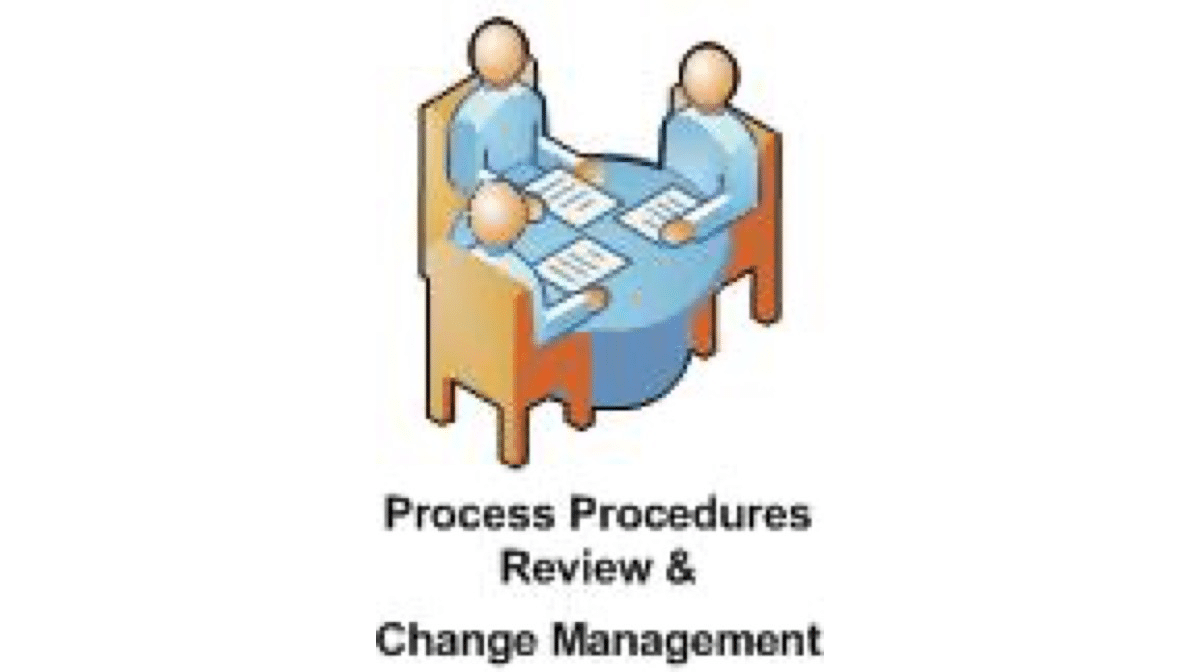
Reviews, meetings, and inspections should address a specific risk or decision. For each review, record what can be approved or rejected, who has the authority, and what evidence is required. Ask yourself whether another element, such as a self-inspection checklist, could replace a duplicate review where the risk allows it. Keep the controls that protect quality, compliance, safety, or financial authority. A documented policy review process helps distinguish a necessary control from a habitual checkpoint.
7. Your Procedures Cover a Long Period of Time
Long elapsed time can hide waiting, rework, and stalled decisions. Separate working time from waiting time, then identify the event that starts and ends each period. Where a delay is necessary, state the expected duration and the person responsible for restarting the work. Where it is not necessary, reorganize the procedure around time-based stages that readers can follow. Review how process delays affect the complete path before removing a control.
8. Your Procedures Encompass Asynchronous Activities
Loosely related activities that occur on different schedules are difficult to coordinate when their dependencies are unstated. Tie activities together with shared milestones, required inputs, deadlines, and the conditions that allow the next activity to begin. A common start time is not always possible, so use an explicit signal such as an approved record, completed checklist, or status change. The goal is to synchronize the handoff, not force every activity onto the same clock.
9. Your Procedures Leave Out Important Information
Simplification does not mean deleting information that people need to work safely and correctly. Test the procedure with someone who knows the role but did not write the document. Record every point where that person must guess about an input, decision, exception, system, or expected result. Add the missing information in the shortest useful form, or place it in a controlled supporting resource and link it at the exact step where it is needed.

10. Your Procedures Use Big Words and Long Sentences
Long sentences and unfamiliar words make instructions harder to scan, especially when a reader is completing the work at the same time. Federal plain-language guidance recommends shorter words, short sections, active voice, and present tense. Replace abstract phrases with direct verbs, keep one main action in each step, and break dense paragraphs into short units. You can also add verb power by naming the actor and the action clearly.
How Can You Use a Process Simplification Worksheet?
Use the worksheet below during a process walk-through. Complete one row for every stage that appears too long, fragmented, delayed, or unclear. The example is hypothetical and shows how to turn an observation into a controlled change.
Worked example: Invoice approval
Complexity signal: Three repeated reviews.
Evidence: The same fields are checked by the supervisor, finance analyst, and controller.
Simplification test: Define risk thresholds and keep controller review only above the approved threshold.
Owner: Finance manager.
Your process stage: Name the stage under review.
Complexity signal: Record length, steps, references, jargon, handoffs, reviews, delay, timing, missing information, or wording.
Evidence: Add an observed example, elapsed time, error, question, or rework.
Simplification test: Decide whether to remove, combine, clarify, reorder, automate, or move detail to a controlled resource.
Owner: Name the responsible role.
Change one source of complexity at a time, verify that the required control still works, and test the revised procedure with a representative user. If the change improves navigation but creates missing information or unclear ownership, revise it before release. The simplest procedure is not the shortest document. It is the clearest reliable path from the required input to the intended result.