How Do You Engage Employees Through Your Company Vision?

Have you ever taken over a new job only to find that the former manager had nothing documented? What happens if there is a disaster, a key person quits, or the team suddenly needs policies and procedures covering disaster recovery, computer and network use, email use, and other recurring work?
A company vision cannot guide daily decisions when employees have to guess how work should be done. Business process examples give people a practical starting point, helping you engage employees, protect continuity, and turn broad direction into repeatable action.
What Are Business Process Examples?
Business process examples are documented models of recurring work. They can include policies, procedures, forms, checklists, controls, workflows, responsibilities, and records that show how a company expects an activity to be completed. The difference between a policy, process, procedure, SOP, and work instruction matters, but these documents work together to make expectations usable.
The policy explains the rule or intent. The process shows how work moves from an input to a result. The procedure explains the sequence, responsibilities, and controls. Supporting forms and checklists capture evidence that the work was completed. Together, they define best practices that employees can follow, managers can review, and the organization can improve.
Start With Familiar Company Policy Examples
It can be daunting to create company policies for acceptable internet use, email use, or computer asset acquisition. A set of editable company policies and procedures in Microsoft Word can provide a starting structure, so the team does not have to stare at a blank page.
The example is not the final answer. Each company still needs to adjust scope, ownership, approval paths, systems, risks, and records to fit its business needs. A useful example shortens the drafting process while keeping responsibility for the final process with the organization that will use it.
Use Common Department Practices as a Baseline
Consider a data center. Most data centers rely on computers, network security standards, technology specialists, help desks, network operations, and system administration. The exact equipment and roles vary, but many controls, handoffs, and support practices are similar. Starting with a proven example lets the team focus on the differences that make its environment unique.
This approach is especially useful when continuity matters. A documented process helps the next manager understand why a control exists, who performs each step, what record is created, and when a problem should be escalated. It reduces dependence on knowledge that exists only in one person’s memory.
How Do Business Process Examples Help Employees Carry Out Your Company Vision?
Do you have a vision for your company that employees never seem quite able to carry out? Managers and employees may hear what you are saying, but do they understand it? Do they consistently translate your words into actions? Do they consistently get the results you and your customers desire?
The gap usually appears between a broad statement and a daily decision. A vision might call for dependable service, faster delivery, or safer operations, but an employee still needs to know which action to take, what standard applies, who owns the next step, and how success is measured. Documented processes connect those decisions to the result the company wants.

What may be needed is a way to define best practices that ensures employees’ actions stay in sync with company vision. ISO’s quality management principles connect leadership, engagement of people, and the process approach. The practical lesson is simple: leaders establish direction, then the management system makes that direction actionable throughout the organization.
Translate Vision Into Roles and Decisions
A strong process example names the process owner, the people who perform the work, required inputs, decision points, controls, expected outputs, and records. It also shows what happens when normal conditions change. Employees can act with more confidence because the process explains where judgment is allowed and when management review is required.
Managers reinforce the connection by explaining how the procedure supports a company objective, training employees on the current method, and reviewing whether the planned result occurred. That is how managers use procedures as operating tools instead of treating them as documents stored for an auditor.
Build a Business Process Library
A business process library gives employees and managers one organized place to find approved policies, procedures, supporting forms, resources, and references. Pre-written sample policy and procedure examples can help the company get started, as long as each item is modified to fit the way the business actually operates.

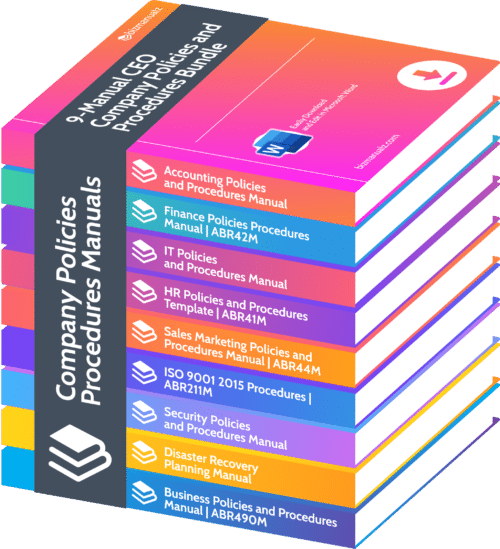
The CEO Company Policies and Procedures collection illustrates how a process library can cover nine key areas within a company:
- Accounting Controls
- Financial Compliance
- Computer & IT Security
- Sales & Marketing
- Business Sampler
- Human Resources
- ISO 9001 Quality
- Security Planning
- Disaster Recovery
The value comes from the relationships among those areas. A sales commitment may create accounting, delivery, security, or staffing work. A computer asset acquisition policy may involve finance approval, IT security standards, vendor records, and disaster-recovery requirements. An end-to-end view makes those handoffs visible before a missed step becomes a customer problem.
How Can You Turn Company Vision Into Repeatable Action?
Whether the company goal is to raise sales, increase profits, reduce time to market, or obtain ISO 9001 certification, you need a plan to improve the odds of realizing your goals. Many organizations produce realization plans and still do not achieve the results they hoped for because ownership, measures, resources, and follow-through remain unclear.
NIST’s Baldrige Excellence Framework treats leadership, strategy, workforce, operations, and results as parts of one system. That systems view helps leaders move beyond announcing a goal. The company must connect the goal to the processes people use, the resources they need, and the evidence managers review.

Assign an Owner and Define the Result
Every critical business process needs an owner who can answer for its design, training, controls, records, and results. The owner should understand the company objective the process supports and the customer or internal team that receives its output. Without that accountability, a procedure may describe activity without ensuring that the activity produces value.
Document Handoffs and Exceptions
Most failures happen at a handoff or when normal conditions change. A useful process identifies who receives the work next, what information must travel with it, the acceptable time frame, and the escalation path. It also covers common exceptions so employees do not have to invent a response under pressure.
Review Results and Improve the Process
Documentation should reflect the best-known method, not freeze the business in place. Managers compare actual results with the target, ask employees where the method creates friction, and revise the procedure when evidence shows that training, tools, staffing, controls, or responsibilities need to change.
Business process examples make it easier to begin, but engagement comes from showing employees how their work contributes to the company vision. When expectations, ownership, handoffs, and results are visible, people can carry out the vision with less guesswork and improve the system as conditions change.
Frequently Asked Questions
What Are Business Process Examples?
Business process examples are adaptable models of recurring work. They may include policies, procedures, forms, checklists, controls, responsibilities, and records that show how an organization expects work to be completed.
How Do Business Processes Help Employees Understand Company Vision?
Business processes translate broad direction into specific roles, decisions, standards, handoffs, and measures. Employees can see how their daily work contributes to the results the company wants.
Which Business Areas Need Documented Policies and Procedures?
Common areas include accounting controls, financial compliance, IT security, sales and marketing, human resources, quality, security planning, and disaster recovery. Companies should prioritize processes where inconsistency, risk, or key-person dependence would cause significant harm.
Can Pre-Written Process Examples Be Adapted to a Company?
Yes. Pre-written examples can provide a useful starting structure, but the company must adapt ownership, approval paths, systems, risks, controls, and records to match the way it actually operates.
How Do Documented Processes Reduce Key-Person Risk?
Documented processes preserve operating knowledge when a manager or specialist is unavailable. They show the next person what to do, why a control exists, which records are required, and when a problem should be escalated.