How to Motivate Employees About Process Improvement

How do you motivate employees about process improvement? Treat each change as organizational news: explain what changed, why it matters, what employees should do, and when you will report the result. A recurring Process Improvement News program makes improvement visible and gives people a practical reason to participate.
You still have to get the word out so others can benefit from the changes and improvements you have made. The difference is that useful communication does more than announce a decision. It connects the improvement to daily work, invites questions, recognizes participation, and closes the loop with evidence.
Why Do Employees Tune Out Process Improvement?
Many companies appear to run relatively smoothly under the status quo, so organization improvement can feel optional. Minor product inconsistencies or customer complaints may be treated as isolated events instead of evidence that a process deserves attention.
Employees also tune out when a change arrives without context. A new procedure can sound like extra work if nobody explains the problem it solves, the customer quality it protects, or the rework it removes. Small changes can reduce waste and quality problems, but the benefit becomes credible only when the organization reports a verified result.
Process Improvement News
Could you communicate improvements like a news show? The communications activity should be planned and coordinated. You need a news staff to write, produce, and distribute useful news materials. Your Process Improvement News show can have a schedule, a regular time slot, a consistent format, and an editor or anchor who keeps the program moving.
The goal is not to imitate a television studio. It is to create a dependable rhythm. Employees should know where updates appear, who can answer questions, and when the next result will be shared. AHRQ’s implementation guidance recommends defining the audience, message, timing, communication method, and person responsible for each change.
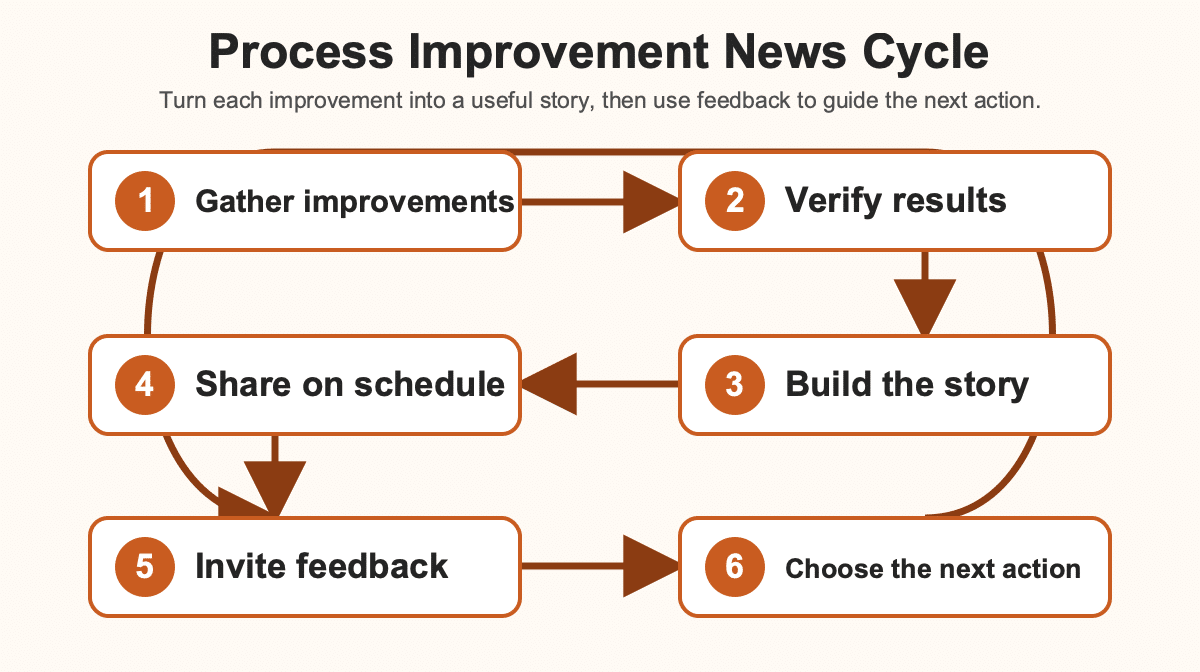
The cycle has six steps: gather improvements, verify results, build the story, share on schedule, invite feedback, and choose the next action. The final step returns to the first because each response can reveal another improvement opportunity.
What Should Your Process Improvement News Cover?
Run feature stories about training events, Kaizen of the month, progress on major changes, and improvement objectives. Show the problem, the action, the owner, and the result. If the result is not available yet, say what will be measured and when employees can expect an update.
Choose a format that suits the audience and the message. You can produce videos, a newsletter, a change wall, a magazine format, or skits for a training event. The format should make the change easier to understand, not make the communication program harder to maintain. Use the same editorial discipline whether the story is a one-minute update or a detailed demonstration.
What’s Your Communication Program Budget?
Major software changes in IT often require new software and software customization. Communication, training, and reinforcement also require explicit resources. Budget the time needed to collect a verified result, prepare the story, review it for accuracy, distribute it, and respond to feedback.
If you do not have a formal in-house communications program, begin with a small repeatable commitment. Assign one owner, choose one channel, and publish on one dependable schedule. A polished monthly update that employees trust is more useful than an ambitious program that disappears after two editions.
Show Your Commitment to Change and Improvement
Identify a Process Improvement News staff whose job is to get out the word on change and improvement. A small company may need only an editor or anchor, a subject-matter owner, and a manager who removes obstacles. A larger company can divide the work among people who write, produce, verify, and distribute the update.
Visible follow-through matters. Leaders show management commitment to change when they make time for updates, respond to concerns, recognize useful contributions, and report what happened next. NIST’s Baldrige guidance places communication, engagement, and follow-through among senior leaders’ responsibilities during change.
Change and process improvement are not one-time events. ISO describes improvement as an ongoing activity, not a one-time project. A regular news program turns that principle into a visible operating habit and helps employees understand how one completed change leads to the next.
What’s Your Knowledge Management Program Budget?
Your knowledge management program requires a serious commitment to change and improvement. You demonstrate that commitment through the time and money budgeted for communication, the quality of the Change and Process Improvement News Show, and the care used to preserve what employees learn.
Each story should leave behind reusable knowledge: the changed procedure, the reason for the change, the result, the owner, and the place where employees can ask questions. That record prevents a good improvement from remaining inside one team. It also gives future employees a clear explanation instead of an unexplained rule.
A Simple Process Improvement News Run Sheet
Use this compact run sheet to prepare each edition. The example is hypothetical and shows how a training update could move from a local change to a useful company story.
| Run-sheet field | Hypothetical monthly update |
|---|---|
| Story or process change | New receiving checklist after repeated labeling errors |
| Owner or editor | Warehouse supervisor and Process Improvement News editor |
| Employees affected | Receiving, inventory, and customer-service teams |
| What changed | Receivers verify the label before stock enters inventory |
| Why it matters | Fewer identification errors and less downstream rework |
| Employee action | Use the checklist and flag an unclear label before shelving |
| Feedback channel | Team huddle and shared improvement form |
| Next result to report | Labeling errors found before shelving during the next month |
Start with one real improvement and one reliable time slot. Make the first story specific, give employees a place to respond, and report the result in the next edition. Then repeat the cycle. That consistency helps motivate employees because participation produces a visible response rather than disappearing into a suggestion box.
Frequently Asked Questions
How Often Should Process Improvement Updates Be Shared?
Use a predictable cadence that your team can sustain. A short weekly update can suit fast-moving operations, while a monthly edition may work better when results need time to develop.
Who Should Own the Communication Program?
Assign an editor or anchor who owns the schedule and verifies each story with the process owner. The role can belong to an operations manager, quality lead, trainer, or another trusted coordinator.
What Should Each Update Include?
State what changed, why it matters, who is affected, what employees should do, where they can respond, and which result will be reported next.
How Can Leaders Encourage Employee Participation?
Invite questions, recognize useful ideas, answer concerns, and show what happened after employees contributed. Participation grows when people can see that their input receives a considered response.
How Should a Small Company Start?
Start with one owner, one channel, one real improvement, and one regular time slot. Use the run sheet, report a verified result, collect feedback, and choose the next action.