The Complete Guide To Internal Audit Checklists

Internal audits rarely fail because an auditor forgot to ask a single question. They fail when the scope is vague, evidence is inconsistent, testing is not documented, or findings disappear into a report with no owner. A practical audit checklist turns those weak points into visible control steps.
An internal audit checklist gives the audit team a repeatable way to plan the engagement, test controls, record evidence, communicate findings, and verify corrective action. It supports consistency without reducing professional judgment to a box-ticking exercise.
Use this guide to choose the fields and tests your checklist needs, copy a worked worksheet structure, adapt it by audit type, and document evidence, findings, and follow-up without turning the engagement into a box-ticking exercise.
What Is an Internal Audit Checklist?
An internal audit checklist is a controlled list of questions, tests, evidence requirements, and recording fields used to evaluate whether a process, control, department, or management system meets defined criteria. It guides the audit from preparation through follow-up while creating a consistent record of what the auditor reviewed.
The checklist is not the audit itself. It is one part of the audit program, alongside the scope, objectives, criteria, sampling approach, working papers, interviews, observations, findings, and final report. An experienced auditor uses the checklist to organize judgment, not replace it.
Checklist, Audit Plan, and Audit Program
An audit plan describes the purpose, scope, timing, resources, and approach for one engagement. An audit program may cover a larger schedule of audits, responsibilities, methods, and reporting expectations. The audit checklist translates those plans into specific questions and tests that can be performed and documented.
Criteria, Condition, and Evidence
Every strong checklist item connects three ideas. The criteria state what should happen, the condition records what actually happens, and the evidence supports the auditor’s conclusion. Without all three, a check mark communicates very little.
Criteria may come from policies, procedures, contracts, regulations, standards, customer requirements, risk controls, or approved performance targets. Evidence may include records, system data, interviews, observations, calculations, approvals, reconciliations, or a reperformance of the control.
Why Does an Internal Audit Checklist Matter?
A checklist creates a common baseline across auditors, locations, departments, and audit cycles. That baseline makes the work easier to review and helps management compare findings without wondering whether each auditor used a different standard.
Consistent Coverage
Auditors can follow a repeatable structure for governance, risk, control design, operating effectiveness, records, exceptions, and corrective action. The same structure also helps the organization understand audit effectiveness: what auditors should examine, not merely whether a document exists.
Visible Accountability
A useful quality audit checklist records the process owner, control owner, evidence source, result, finding, corrective-action owner, and due date. These fields prevent an issue from becoming an anonymous observation that nobody is expected to resolve.
Better Review and Follow-Up
Supervisors can review the logic behind each conclusion and identify missing evidence before the report is issued. On later audits, the team can trace repeated findings, overdue actions, changes in risk, and areas where a control has improved or deteriorated.
Quality Through Repeatability
Consistency does not mean forcing every audit into identical questions. It means using a controlled method for deciding what to test and how to document the result. That principle reflects how repeatable processes support consistent quality while still allowing risk-based judgment.
What Should an Audit Checklist Include?
A complete audit checklist template should capture enough context to make each test understandable months later. It should also be easy to use during interviews, walkthroughs, sampling, observation, and document review.
Audit Identification
- Audit title, reference number, and audit type
- Business unit, location, process, or system under review
- Lead auditor, audit team, and responsible process owner
- Planned and actual fieldwork dates
- Reporting date and follow-up date
Objectives, Scope, and Criteria
State why the audit is being performed and which boundaries apply. Name included and excluded locations, periods, systems, transactions, products, and departments. List the policies, procedures, standards, regulations, contracts, or control objectives used as audit criteria.
Risk and Control Reference
Connect each major checklist section to the risk it addresses and the control expected to manage that risk. This turns the document from a generic questionnaire into a risk-based testing tool. It also helps reviewers understand why a question matters.
Questions and Test Procedures
Questions should prompt evidence, not yes-or-no assurances. Replace “Is the process followed?” with a test such as “Select a sample of completed transactions and verify required approval, supporting documentation, accurate entry, and timely review.”
Sampling and Evidence Fields
Record the population, sample-selection method, sample size, items tested, evidence location, exceptions, and conclusion. The IIA’s Global Internal Audit Standards call for relevant, reliable, and sufficient information to support analysis and potential findings. Completing a procedure is not enough unless the resulting evidence supports the conclusion.
Results and Finding Details
- Result: conforming, effective, partially effective, exception noted, or not applicable
- Condition: what the auditor observed or identified
- Criteria: the requirement that was not met
- Cause: why the condition occurred, when supported by evidence
- Effect or risk: the actual or potential consequence
- Evidence: records and procedures supporting the finding
- Owner and due date: accountability for corrective action
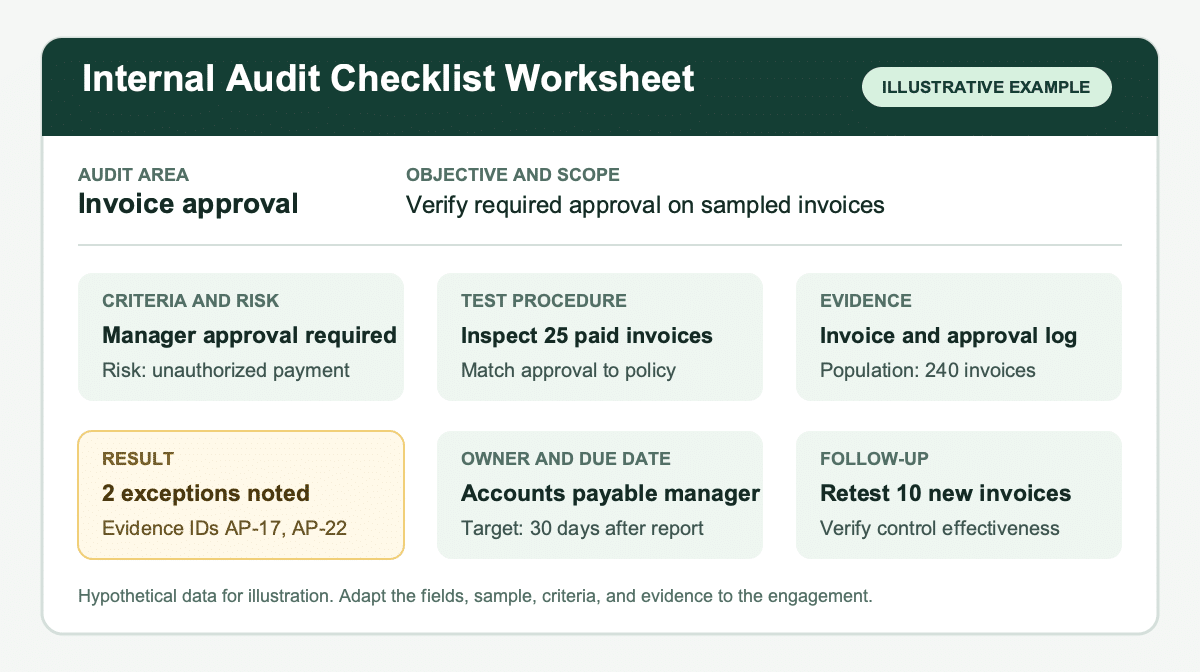
Internal Audit Checklist Worksheet Example
Copy these fields into a spreadsheet, document, or audit platform. The hypothetical invoice-approval row shows how a requirement becomes a test, evidence, a result, and a follow-up action. Replace the example with criteria, risks, samples, and evidence that fit the engagement.
| Objective and scope | Criteria and risk | Test procedure | Population and sample | Evidence and result | Owner and due date | Follow-up |
|---|---|---|---|---|---|---|
| Verify required approval on paid invoices. | Policy AP-03 requires manager approval. Risk: unauthorized payment. | Inspect paid invoices and match approval evidence to policy. | Population: 240 invoices. Sample: 25 selected across the period. | Approval log and invoices. Two exceptions: AP-17 and AP-22. | Accounts payable manager. Target: 30 days after the report. | Retest 10 new invoices and record whether the control operates effectively. |
How Do You Build an Internal Audit Checklist?
Start with the audit objective and the real risks in the process. A downloaded audit checklist template can provide useful formatting, but it cannot know your organization, controls, evidence systems, regulatory obligations, or prior findings.
Step 1: Define the Audit Objective
Write a clear statement of what the audit must determine. Objectives may address compliance, control design, operating effectiveness, data integrity, financial accuracy, process efficiency, supplier performance, product quality, or corrective-action effectiveness.
Step 2: Map the Process and Risks
Review the process flow, roles, inputs, outputs, systems, handoffs, records, and known failure points. A checklist should follow how work actually moves, which is why established workflow checklist design principles are useful when organizing the sequence. Teams can use compliance workflow tools to route tasks, approvals, and evidence in one place.
Step 3: Identify the Audit Criteria
Collect the approved documents and requirements that define acceptable performance. Confirm the version, effective date, owner, and applicability of each source. Do not test against an obsolete procedure or an informal expectation that management never approved.
Step 4: Convert Controls Into Tests
For each important control, decide how the auditor can verify design and operation. Methods include inquiry, observation, inspection, recalculation, confirmation, data analysis, and reperformance. State what evidence is expected and how exceptions will be recorded.
Step 5: Add Risk-Based Flexibility
Mark core tests that every audit must perform and conditional tests triggered by risk, exceptions, organizational change, complaints, prior findings, or unusual data. Include space for follow-up questions so the auditor can pursue evidence beyond the original list.
Step 6: Pilot and Approve the Checklist
Test the draft with an auditor and a process owner. Remove duplicate questions, clarify ambiguous wording, confirm evidence can be obtained, and estimate the time required. Assign an owner, version number, approval date, and review cycle before general use.
How Do You Use an Audit Checklist During Fieldwork?
Fieldwork should combine the checklist with active listening and professional skepticism. The auditor follows the planned tests, but also notices conflicting explanations, missing records, unusual workarounds, repeat exceptions, and controls that exist only on paper.

Begin With a Walkthrough
Ask the process owner to demonstrate the work from start to finish using a recent example. Compare the walkthrough with the documented procedure and checklist. Record where the actual process differs and determine whether the difference is approved, necessary, risky, or ineffective.
Separate Inquiry From Verification
An interview explains what should happen and why. Verification determines what did happen. Use records, system logs, transaction samples, physical observation, reconciliations, or reperformance to support important conclusions.
Document Exceptions Immediately
Record the item tested, expected result, actual result, evidence, responsible role, and initial explanation while the details are available. Do not rely on memory at the end of the engagement. Distinguish an isolated error from a control failure by expanding testing when appropriate.
Use Not Applicable Carefully
A not-applicable result should include a reason. Otherwise, the designation can hide a skipped test or misunderstood requirement. Reviewers should be able to tell why the criteria did not apply to the audited scope.
Hold a Clear Closing Discussion
Discuss factual accuracy, evidence gaps, preliminary findings, ownership, and expected response dates with management. The closing discussion should not negotiate away valid evidence, but it should correct misunderstandings before the report is finalized.
How Should a Checklist Change by Audit Type?
The core structure can remain consistent, but the criteria, risks, evidence, and procedures must fit the engagement. A checklist designed for a financial control should not be reused unchanged for workplace safety, supplier quality, cybersecurity, or management-system auditing.
Operational Audit Checklists
Operational audits examine whether processes use resources effectively, manage risk, meet performance expectations, and produce reliable outcomes. Checklist items may cover roles, handoffs, cycle time, bottlenecks, error rates, capacity, approvals, system controls, service levels, and management review.
Compliance Audit Checklists
Compliance audits begin with an authoritative requirement. The checklist should identify the exact obligation, applicable population, required evidence, responsible role, testing period, and exception treatment. Auditors should confirm that the cited requirement is current and actually applies to the organization.
Financial Control Checklists
Financial control testing may address authorization, segregation of duties, completeness, accuracy, cutoff, valuation, reconciliation, access, review, and retention. The checklist should specify the population and sample, connect each procedure to a control objective, and distinguish control testing from substantive analysis.
Quality Audit Checklists
Quality audits evaluate documented requirements and process effectiveness across inputs, controls, outputs, records, measurement, nonconformity, corrective action, and improvement. Questions should follow the process and its interactions instead of reproducing a standard as a disconnected list.
Maintaining controlled modules can make adaptation easier. A common core can cover planning, evidence, findings, reporting, and follow-up, while approved modules address the specific risks and requirements of finance, quality, safety, information technology, suppliers, or individual departments.
How Does an ISO 9001 Audit Checklist Differ?
For organizations applying ISO 9001:2026, an internal audit checklist should evaluate the quality management system against applicable requirements and the organization’s controlled processes. It should examine how the system produces intended results, manages risk, controls documented information, monitors performance, addresses nonconformity, and improves.
The ISO 19011:2026 guidelines for auditing management systems address audit principles, audit-program management, audit execution, and auditor competence. ISO 19011 provides guidance rather than certification, and it supports a checklist that covers preparation, evidence, reporting, and follow-up instead of merely restating standard clauses.
Follow Processes, Not Only Clauses
A clause-by-clause list can miss the way customer requirements, planning, operations, measurement, corrective action, and leadership decisions connect. Follow a product, service, order, complaint, change, or corrective action across process boundaries to see whether the system works as intended.
Test Effectiveness and Conformity
Conformity asks whether the organization meets a requirement. Effectiveness asks whether the control or process achieves the intended result. A quality audit checklist should prompt both questions and capture objective evidence for each conclusion.
Connect Findings to Corrective Action
ISO-oriented internal audits should support a controlled cycle of evidence, reporting, cause analysis, corrective action, and verification. A structured ISO internal audit process keeps the checklist connected to that larger management system.
How Should Audit Findings Be Documented and Followed Up?
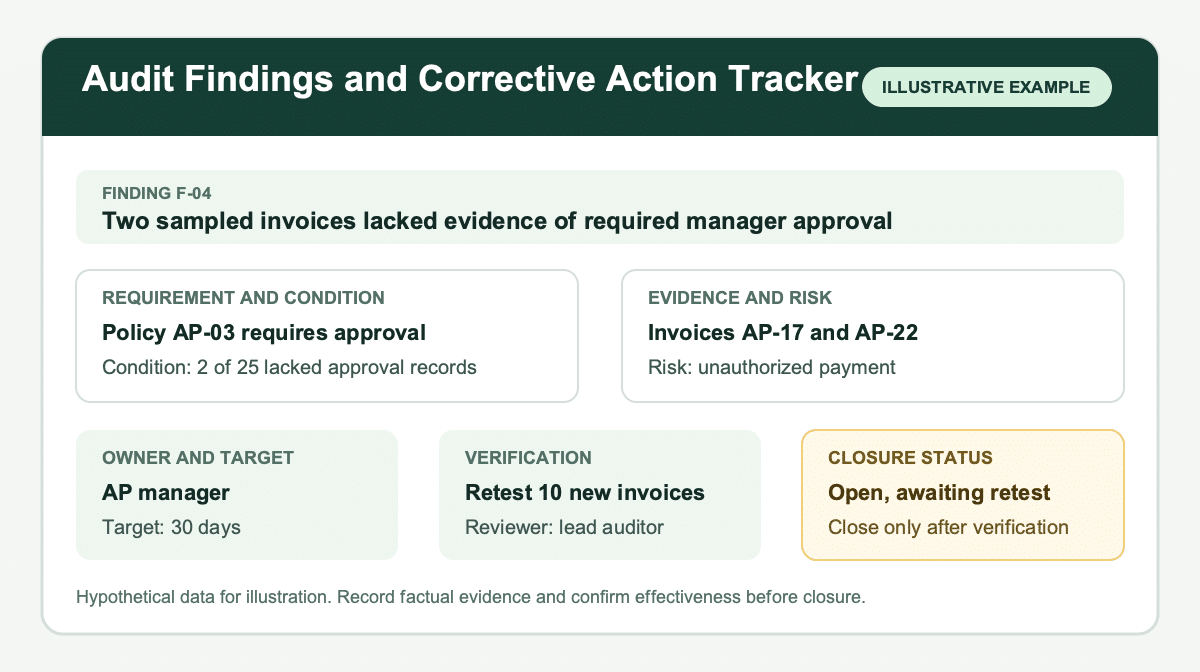
A finding should be specific enough for someone who did not attend the audit to understand the requirement, observed condition, evidence, risk, and needed response. Labels such as “documentation issue” or “control weakness” are too vague to drive corrective action.
Write Evidence-Based Findings
State the applicable criteria, the factual condition, and the evidence supporting the condition. Describe the risk or effect without exaggeration. Separate confirmed facts from management explanations and from the auditor’s analysis of likely cause.
Agree on Ownership, Not the Solution
Management owns the corrective action because management operates the process. The auditor can evaluate whether the response addresses the risk and cause, but should avoid becoming the designer and later auditor of the same control.
Verify Completion and Effectiveness
Closing a task is not the same as resolving a finding. Verify that the action was implemented, the related records exist, affected employees understand the change, and the control now operates effectively. Repeated findings may indicate that the original response addressed a symptom rather than the cause.
Distinguish Internal and Financial Audit Purposes
Internal audits may address operational, quality, compliance, technology, governance, and risk objectives. That scope differs from the purpose of a financial audit, which centers on financial statements and related assurance. The checklist should make the engagement’s objective unmistakable.
What Common Audit Checklist Mistakes Should You Avoid?
Using a Generic Template Without Adapting It
A generic template may omit the organization’s highest risks and include irrelevant questions. Adapt the checklist to the process, criteria, controls, prior findings, systems, locations, products, and regulatory environment before fieldwork begins.
Writing Only Yes-or-No Questions
Binary questions invite unsupported answers. Add a test procedure, expected evidence, sample field, result, exception detail, and conclusion. The auditor should be able to show why each answer is reliable.
Confusing Documentation With Effectiveness
A procedure can be approved and still fail in practice. A checklist can be complete and still record weak testing. Ask whether the process is understood, followed, controlled, measured, and producing the intended outcome.
Letting the Checklist Limit Professional Judgment
The auditor should pursue significant evidence even when it falls outside the planned questions. Provide space for additional procedures and require documentation when scope, sample size, or testing changes during the engagement.
Failing to Control the Template
Assign an owner and version to the audit checklist template. Review it after process changes, new requirements, major incidents, repeated findings, or lessons from completed audits. Remove obsolete questions and preserve the reason for material revisions.
A good audit checklist makes disciplined work easier to perform and easier to review. It connects objectives, risks, controls, tests, evidence, findings, ownership, and follow-up in one usable structure. The strongest checklist remains controlled and repeatable while leaving room for the auditor to follow the evidence.
Frequently Asked Questions
What Is the Purpose of an Internal Audit Checklist?
An internal audit checklist organizes the questions, tests, evidence, results, findings, and follow-up needed for a consistent audit. It helps the auditor cover the approved scope while creating a reviewable record of the work performed.
What Should Be Included in an Audit Checklist?
Include the audit objective, scope, criteria, risks, controls, questions, test procedures, sampling details, evidence, results, exceptions, findings, responsible owners, due dates, and follow-up status. Each important item should connect a requirement with a test and a supported conclusion.
How Often Should an Internal Audit Checklist Be Updated?
Review the checklist before each audit and whenever processes, risks, systems, requirements, responsibilities, or prior findings change. The controlled template should also have an assigned owner and a scheduled periodic review.
Can One Audit Checklist Be Used for Every Department?
A common structure can be used across departments, but the criteria, risks, controls, evidence, and test procedures should be adapted to each process. A single generic list is unlikely to provide sufficient coverage for every function.
What Is the Difference Between an Audit Checklist and an Audit Program?
An audit program governs the broader schedule, responsibilities, methods, and reporting approach for one or more audits. An audit checklist is the engagement-level tool that guides specific questions, procedures, evidence collection, and documentation.