The Complete Guide To Outsourced Accounting and Bookkeeping

Accounting problems rarely announce themselves as accounting problems. A late close looks like a reporting delay. An unreconciled account looks like a cash surprise. A busy owner who approves bills from memory looks efficient until a duplicate payment or missed obligation appears. Ask whether the business has an accounting capacity problem, a control problem, or both.
Outsourced accounting bookkeeping gives a business access to people, systems, and routines without building every finance role internally. The arrangement can cover basic transaction processing, a complete monthly close, management reporting, controller oversight, or a fractional chief financial officer. The value depends less on the word outsourcing than on defining exactly what work leaves the company, what authority stays inside, and how both sides verify that the numbers are right.
This guide explains the available services, benefits, risks, costs, provider selection criteria, transition plan, and management controls. It is written for owners and managers who need reliable accounting support but do not want to trade one overloaded internal process for an invisible external one.
What Is Outsourced Accounting and Bookkeeping?
Outsourced accounting and bookkeeping is an arrangement in which an external provider performs defined finance activities for a business. The provider may work as the whole accounting department, add capacity to an internal team, or supply higher-level review and analysis that the business does not need as a full-time position.
Bookkeeping records and organizes daily transactions. Accounting turns those records into reconciled statements, explanations, controls, and decisions. Understanding the difference between bookkeeping and financial accounting prevents a common buying mistake: hiring a transaction processor when the business actually needs a controller.
Three Common Service Levels
Most arrangements fall into three levels. The first is outsourced bookkeeping, which handles transaction entry, bank feeds, invoices, bills, and reconciliations. The second is outsourced accounting, which adds accruals, close management, financial statements, schedules, and management reporting. The third is controller or CFO support, which adds policy, forecasting, cash planning, board or lender reporting, and decision support.
The levels can be combined. A business may keep accounts receivable inside because customer relationships matter, outsource accounts payable and reconciliations, and use an outside controller to review the close. Another may outsource nearly everything while the owner retains payment approval and banking authority.
The purpose of accounting in business is not merely to record history. Reliable accounting supports planning, compliance, resource allocation, and decisions. An outsourcing arrangement should be judged by how well it serves those purposes, not by how many entries a provider can process.
What Services Can an Outsourced Accounting Team Provide?
The service menu can be broad, but the contract should be specific. The SBA’s small-business finance guidance identifies the practical areas where a business may seek help from a bookkeeper, CPA, or online accounting service, including accounts receivable, accounts payable, cash management, bank reconciliation, and payroll.

Daily and Weekly Bookkeeping
- Recording sales, expenses, receipts, deposits, and journal entries
- Maintaining customer and vendor records
- Processing bills and preparing payment batches for internal approval
- Applying customer payments and following an agreed collections process
- Reconciling bank, credit card, loan, and merchant accounts
- Maintaining the general ledger and supporting schedules
These are recurring tasks, so timeliness matters as much as accuracy. A reconciliation completed six weeks late may be technically correct and operationally useless. The service agreement should state the cutoff, processing cadence, exception procedure, and person responsible for missing documentation.
Monthly Close and Financial Reporting
A complete monthly close usually includes reconciliations, accruals, prepaid expenses, fixed assets, payroll liabilities, debt schedules, revenue recognition, inventory adjustments where relevant, and review of unusual balances. The provider then prepares an income statement, balance sheet, cash flow statement, and management schedules.
Reporting should explain the numbers rather than simply deliver them. Useful monthly packages compare actual results with budget and prior periods, identify material variances, describe unresolved issues, and state which estimates or assumptions management approved. A business can use its core accounting processes as a checklist for deciding which work to outsource and which work to retain.
Controller and CFO Services
Higher-level accounts outsourcing may include accounting policy, internal controls, cash forecasting, lender reporting, budgeting, scenario analysis, board packages, system design, audit coordination, and supervision of bookkeepers. The AICPA’s explanation of client advisory services recognizes that these engagements can extend to controllership, financial statement preparation, and outsourced CFO responsibilities.
Tax returns, audits, reviews, and legal opinions may require separate licensed professionals and separate engagement terms. Do not assume that an outsourced accounting firm performs every regulated service. Confirm the scope, credentials, independence requirements, and referral relationships in writing.
What Are the Benefits and Risks of Outsourcing?
The business case for outsourcing is usually a combination of capacity, expertise, continuity, and cost structure. A provider can assemble bookkeepers, accountants, controllers, and specialists behind one engagement, which may be difficult for a smaller business to recruit and retain internally.
Potential Benefits
- Scalable capacity. Support can expand during growth, cleanup projects, audits, or seasonal peaks without a permanent hiring cycle.
- Role coverage. A team can provide separation between preparation, review, and approval rather than leaving one employee to do everything.
- Process discipline. Established providers often bring close calendars, document requests, checklists, review routines, and reporting templates.
- Continuity. The work does not stop because one internal bookkeeper takes leave or resigns, provided the provider documents assignments and cross-trains its own staff.
- Access to experience. Specialists can address revenue recognition, inventory, multi-entity consolidation, system migration, or lender reporting when those needs arise.
- Variable cost structure. The business buys a defined service level instead of building every role, benefit, tool, and management layer internally.
Material Risks
- Loss of context. An external team may record a transaction correctly and miss the operational meaning behind it.
- Weak access control. Poorly designed permissions can expose banking, payroll, customer, vendor, or employee data.
- Unclear accountability. Work can stall between the provider and internal staff when nobody owns exceptions, approvals, or missing information.
- Provider concentration. Documentation, credentials, and history may become difficult to recover if one vendor controls the systems and process knowledge.
- Quality variation. A strong sales team does not guarantee an experienced delivery team. Work may be shifted to junior or offshore staff without clear review.
- False savings. A low monthly fee can become expensive when cleanup, catch-up, tax support, extra entities, or custom reporting are billed separately.
Outsourcing transfers work, not management responsibility. Owners and officers remain responsible for the business, its filings, its payments, and the representations made to banks, investors, tax authorities, and employees. The safest model preserves internal approval, oversight, and access even when execution is external.
When Should a Business Outsource Accounting?
Outsourcing becomes attractive when the accounting workload or required expertise grows faster than the internal team. The signal is not simply that people are busy. It is that financial information arrives late, controls depend on one person, management cannot answer basic questions, or growth creates work the existing structure cannot absorb.
- The owner is still categorizing transactions, chasing invoices, or reconciling accounts
- The monthly close takes more than two or three weeks and produces repeated adjustments
- One employee creates vendors, enters bills, releases payments, and reconciles the bank
- The business has outgrown cash-basis reports or needs accrual accounting
- Multiple entities, locations, currencies, sales channels, or inventory flows have appeared
- A lender, investor, board, buyer, or grant program needs consistent reporting
- The company has turnover in a key finance role and no documented backup
- Management needs forecasting and analysis but not a full-time CFO
A temporary project may be enough if the problem is a backlog, system migration, or one-time cleanup. Ongoing outsourcing makes more sense when the business needs a recurring operating rhythm. The broader question of why outsourcing can be good for a business comes down to whether an external specialist can perform defined work more reliably while management protects the strategic and control-sensitive decisions.
How Much Does Outsourced Accounting Cost?
There is no useful single price because scope varies from a few hours of bookkeeping to a complete finance function. Providers commonly charge hourly rates, fixed monthly packages, transaction-based fees, or a hybrid retainer with separate project pricing. A business should compare total service cost, not the advertised starting price.
What Drives the Fee?
- Monthly transaction volume and number of bank or credit accounts
- Number of entities, locations, currencies, and reporting dimensions
- Cash or accrual accounting and the complexity of the close
- Payroll, inventory, fixed assets, deferred revenue, debt, and intercompany activity
- Frequency and depth of management reporting
- Cleanup required before recurring work can begin
- Provider response times, meeting cadence, and senior review level
- Systems included in the fee and integrations that need maintenance
Ask for the assumptions behind the quote. A monthly package may include ten accounts and two entities but charge separately for additional reconciliations, sales-tax filings, year-end support, or custom dashboards. Require an example invoice for a business of similar complexity and a written list of out-of-scope work.
Compare the fee with the fully loaded internal alternative: salary, payroll taxes, benefits, recruiting, training, supervision, software, coverage, and the cost of specialist help. Then compare outcomes such as close time, error rate, collections, cash visibility, and management hours recovered. Cheap bookkeeping that leaves the owner rebuilding reports is not cheap.
How Do You Choose an Outsourced Accounting Provider?
Provider selection should resemble hiring a finance leader and reviewing a critical vendor at the same time. Evaluate competence, operating method, security, communication, and commercial terms. A polished proposal is useful, but evidence of how the team actually closes books is better.

Start With a Written Scope
List every recurring deliverable, deadline, input, approver, and exception path. State who owns the chart of accounts, vendor setup, customer credits, journal approval, payment release, payroll changes, tax filings, and financial statement approval. If the responsibility is not assigned, it will eventually sit between teams.
Ask Operational Questions
- Who will perform the work, who will review it, and who is the escalation contact?
- What accounting credentials and industry experience does the assigned team have?
- How many clients does each team member support?
- What is the standard close calendar and review checklist?
- How are unusual transactions documented and approved?
- Which systems will the provider access, and how are permissions reviewed?
- Where is data stored, and which subcontractors or offshore teams can access it?
- How does the provider cover absence, turnover, and disaster recovery?
- What reports, meetings, and response times are included?
- How can the business export its data, documents, and process history at termination?
Request a sample close checklist, redacted reporting package, security overview, certificate of insurance, references, and the proposed responsibility matrix. Confirm that the contract addresses confidentiality, data ownership, breach notification, subcontracting, service levels, termination assistance, and return or deletion of data.
How Do You Transition Accounting Work Safely?
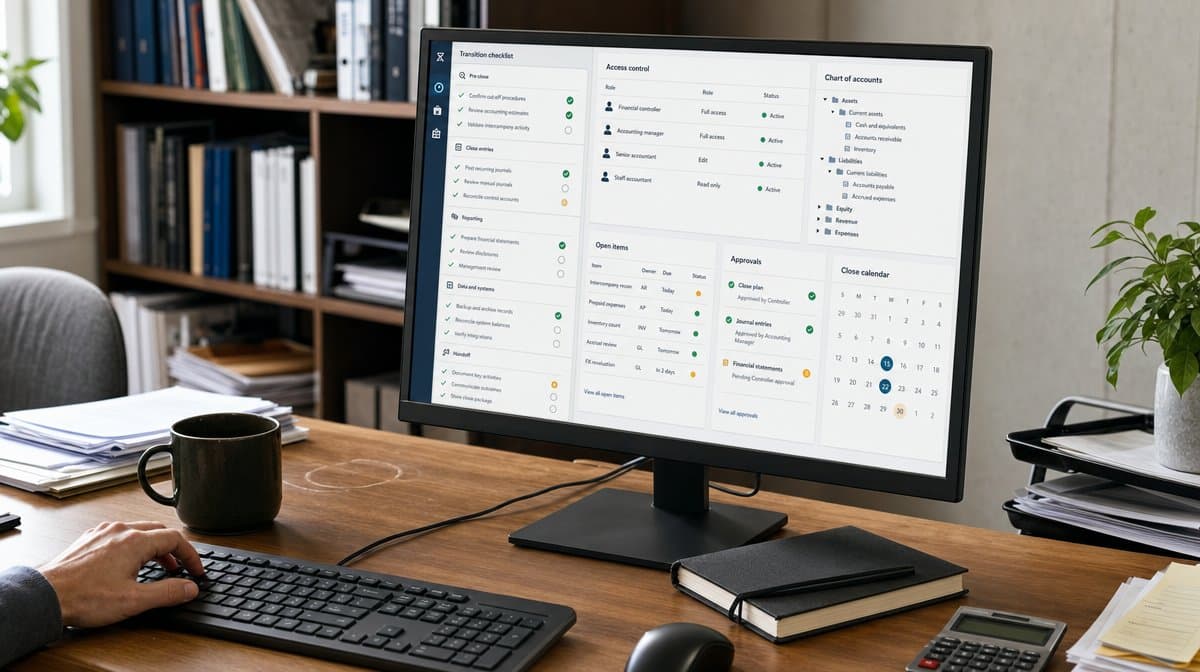
A rushed handoff creates the exact uncertainty outsourcing is meant to remove. The transition should be a controlled project with an inventory of systems, accounts, open items, recurring entries, approvals, reports, deadlines, and known problems. Do not begin by handing over passwords and hoping the provider discovers the process.
Build a Responsibility Matrix
For each process, name the person who prepares, reviews, approves, and receives the output. Preserve internal approval for bank payments, payroll changes, new vendors, customer write-offs, manual journal entries above a threshold, and changes to user access. The provider may prepare an action without receiving authority to execute it.
Document the Accounting System
Provide the chart of accounts, entity structure, accounting policies, close calendar, recurring journal entries, reconciliation formats, materiality thresholds, reporting definitions, tax calendar, and contacts. A clear description of what an accounting policies and procedures manual should contain gives the transition team a durable reference instead of relying on calls and memory.
Run a Parallel Close
When practical, have the outgoing or internal team and the provider work through one close together. Compare balances, schedules, unresolved items, and reports. A parallel close reveals differences in definitions and expectations before the provider operates alone.
Track transition issues in one log with an owner and due date. Separate known historical problems from errors introduced during the handoff. Management should formally accept the opening balances, outstanding items, and first completed close before declaring the transition finished.
How Do You Manage an Outsourced Accounting Relationship?
An outsourced team needs active management, especially after the initial cleanup is complete and attention fades. Establish a weekly operating contact, a monthly financial review, and a quarterly service review. The meetings serve different purposes and should not be collapsed into one vague status call.
Monitor Service and Accounting Quality
- Days to close the month
- Percentage of reconciliations completed on time
- Number and age of unresolved exceptions
- Post-close adjustments and repeated errors
- Accounts receivable aging and collections follow-up
- Vendor or employee inquiries answered within the agreed time
- Reports delivered complete and on schedule
- Control exceptions, access changes, and security incidents
Metrics need context. A longer close may be justified during an acquisition or system migration, while a fast close that carries unreconciled balances is not success. Review the exceptions, root causes, and corrective actions rather than rewarding speed alone.
Keep Ownership and Access Inside
The business should own its accounting system subscription, banking relationships, document repository, reporting definitions, and administrator access wherever possible. Keep an internal copy of contracts, close packages, reconciliations, supporting documents, policies, and credentials. Test the exit process before an exit is necessary.
Revisit the scope as the company changes. A provider that was appropriate at ten employees may not be appropriate after the business adds inventory, international operations, institutional capital, or a regulated reporting obligation. Outsourcing is an operating design decision, not a permanent verdict about where accounting must live.
Is Outsourced Accounting Right for Your Business?
Outsourced accounting services work best when the work is recurring, the expectations are documentable, and management remains engaged. They are especially useful for businesses that need more capability than one bookkeeper can provide but do not yet need every finance role on payroll.
Do not outsource a broken process without naming the break. Decide whether the immediate need is cleanup, routine bookkeeping, a reliable close, stronger controls, management reporting, or strategic finance. Build the scope around that need, choose a provider whose delivery team can demonstrate the work, and preserve approval and oversight inside the business.
The strongest arrangement is transparent. Everyone knows which records are required, when the books will close, who approves sensitive actions, how exceptions are resolved, and how the company can take its data and process back. That structure turns accounting outsourcing solutions from a staffing shortcut into a controlled finance function.
Frequently Asked Questions
What Does an Outsourced Bookkeeper Do?
An outsourced bookkeeper records transactions, maintains customer and vendor details, processes bills, applies receipts, reconciles accounts, and keeps the general ledger current. The exact duties should be defined in the service agreement, including cutoffs, approvals, and exception handling.
How Much Does It Cost to Outsource Bookkeeping?
Cost depends on transaction volume, number of accounts and entities, accounting complexity, reporting requirements, cleanup work, and the seniority of the team. Compare the complete recurring and project fee with the fully loaded cost and expected outcomes of an internal alternative.
What Is the Difference Between Outsourced Bookkeeping and Outsourced Accounting?
Outsourced bookkeeping focuses on recording and organizing daily financial activity. Outsourced accounting adds close management, accruals, financial statements, controls, reporting, and analysis, while controller or CFO services add oversight and planning.
What Should You Look For in an Outsourced Accounting Provider?
Look for relevant accounting and industry experience, a documented close and review process, clear staffing, strong access controls, useful reporting, defined response times, transparent pricing, and a practical termination and data-return process.
Can a Small Business Outsource All of Its Accounting?
A small business can outsource most accounting execution, but management should retain approval authority, system access, data ownership, and oversight. Officers and owners remain responsible for the company’s filings, payments, statements, and decisions.