What Are the Benefits of Translation Services?

Translation services can help a business control costs, keep terminology consistent, improve project visibility, strengthen quality assurance, and protect sensitive information. Those benefits are strongest when you match the provider and workflow to the purpose, audience, risk, and required quality of each translation.
Before selecting a translation agency or a freelance translator, define what the content must accomplish. A product page, employee procedure, contract, safety instruction, and internal memo do not carry the same consequences if wording is unclear. The right service combines language skill with a repeatable process for files, glossaries, review, delivery, and feedback.
What Are the Benefits of Translation Services?
If localization strategy matters to your business, you may use an agency, a freelancer, in-house language skills, machine-assisted workflows, or a combination. The practical value does not come from converting words alone. It comes from organizing source material, approved terminology, qualified translation, review, quality checks, and delivery so the work can be controlled and reused.
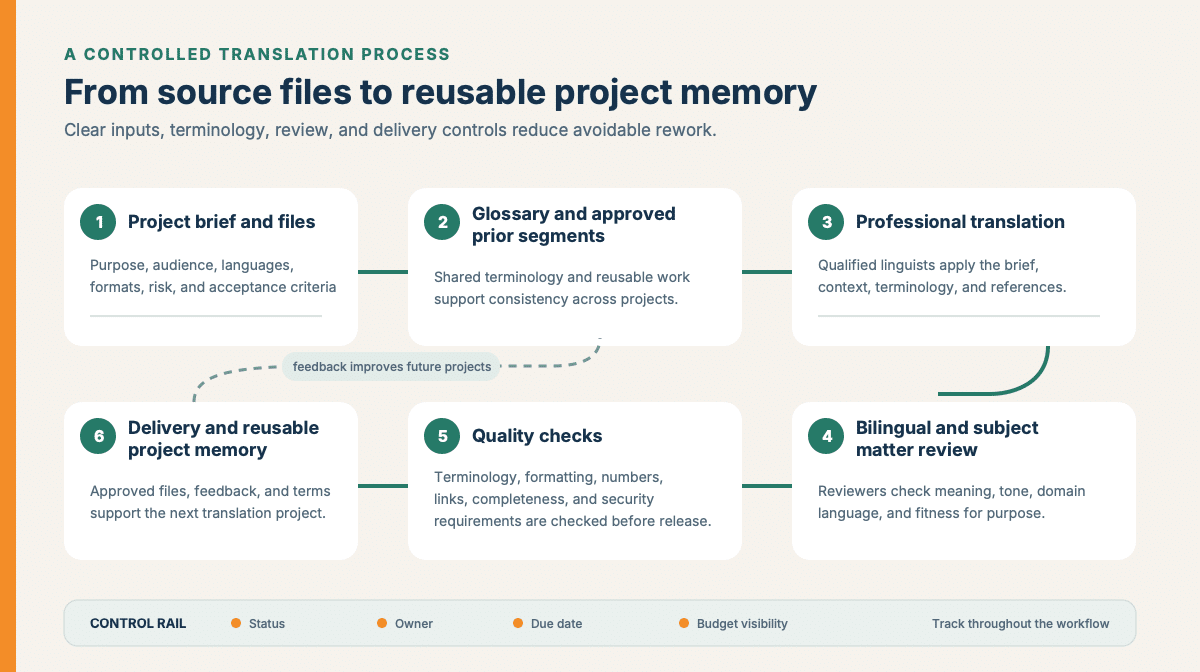
A controlled workflow moves through six stages: define the project brief and source files; provide a shared glossary and approved prior segments; complete the professional translation; conduct bilingual and subject-matter review; check terminology, formatting, numbers, links, completeness, and security requirements; then deliver approved files and retain useful project memory. Status, owner, due date, and budget visibility should be tracked throughout the process.
Savings on Translations
Previously translated texts and segments can be reused. Names, characteristics, descriptions of goods and services, phrases, and standard sentences may repeat from time to time. Reusing previously translated material means the same job does not need to be done twice. A translation memory stores approved source and target segments so a translator can identify identical or similar material in a new document. The European Commission explains that translation memories let translators retrieve and reuse identical or similar passages, which can improve efficiency and help keep terminology consistent.
Reuse can reduce duplicate work and help international expansion costs, but there is no universal discount rule. When a match is appropriate and reviewed, reuse can simultaneously reduce the working time of the translation company, help your business save money, and support consistent wording. The most effective way to capture these benefits is to agree on the process before the first order. Savings vary with the quality of the match, language pair, file format, subject matter, required review, and provider pricing. Ask each provider who owns the translation memory, how exact and partial repetitions are priced, whether every reused segment is reviewed in context, and how approved changes return to the shared resource.
Easier to Manage Your Budget
Imagine that several departments use translation services, each department works with its own contractor, and each pays for services from its own budget. Translation processes are scattered, and the company does not have uniform information about suppliers and costs. It is challenging to receive volume discounts, while translation resources such as glossaries and translation memory are only partially used or become dead weight. One team may pay to solve a terminology question that another team already resolved.
A unified system can implement, control, and optimize translation processes. It contains information about costs, suppliers, projects, languages, deadlines, and reusable resources. That makes it easier to forecast demand, compare quotes, manage and distribute the translation budget, and coordinate work such as app content translation. Centralization does not require one permanent partner, but it does require shared records and clear ownership.
You Can Control the Translation Process
When a company sends a document through an email-only workflow, it may not know whether the translator has started, who is carrying out the project, how much has been completed, or what remains. To find out, an employee has to contact the project manager, wait for an answer, and step away from the main activity.
A defined workflow or translation management system can improve process control by collecting projects in one place and assigning owners, due dates, review stages, and completion status. When a provider offers this capability, the system shows whether the contractor has started the project, how much has been done, and how much is left. The data may be updated online and available at any time. Verify these capabilities rather than assuming every translation company provides them. The provider should explain how your team submits work, asks questions, approves terminology, handles changes, and accepts final files.
You Can Build Quality Into the Service
Quality is not guaranteed merely because a person or a machine produced the translation. It depends on the brief, translator competence, subject knowledge, approved terminology, revision, technical checks, and acceptance criteria. ISO says its ISO 17100 standard defines requirements for the core processes, resources, and other aspects needed to deliver a quality translation service that meets applicable specifications.
Machine translation can help with speed and volume, while professional review remains important when errors could affect customers, employees, contracts, compliance, safety, or brand meaning. ISO 18587 specifies requirements for full human post-editing of machine translation output and for post-editor competence. Ask the provider which content will be machine-assisted, who reviews it, what quality checks occur, and what level of revision is included.
Confidentiality and Clear Guarantees
Translation files may contain employee records, contracts, product plans, financial information, customer data, or unreleased marketing material. Confidentiality therefore needs more than a generic promise. The FTC advises small businesses to put vendor security requirements in writing and establish a process to verify compliance.
Use the contract or a non-disclosure agreement to define permitted access, data storage and transfer, subcontractor use, retention and deletion, security incident notification, intellectual-property ownership, deadlines, acceptance criteria, revisions, remedies, change control, and payment terms. These provisions vary by provider and project. Review the actual terms instead of assuming every company offers the same guarantees or requires the same prepayment.
How Should You Compare Translation Providers?
The American Translators Association recommends defining the target audience, providing style guides, glossaries, previous translations or translation memories, setting a deadline and budget, and designating a contact person. Turn those inputs into a consistent scorecard so an attractive quote does not hide gaps in review, security, or project control.
| Criterion | What to verify | Weight |
|---|---|---|
| Purpose and expertise | Target audience, language pair, subject knowledge, file types, and relevant experience | 25% |
| Quality process | Translator qualifications, revision, terminology control, technical QA, and acceptance criteria | 25% |
| Security and confidentiality | Access, storage, transfer, subcontractors, retention, deletion, and incident notification | 20% |
| Workflow visibility | Owner, status, questions, due dates, approvals, change control, and delivery records | 15% |
| Commercial terms | Pricing method, match bands, minimum fees, rush work, revisions, remedies, and payment schedule | 15% |
Score each provider from 1 to 5 for every criterion, multiply the score by the weight, and divide the total by 100. For example, a hypothetical provider scoring 4, 4, 5, 3, and 4 earns 4.05 out of 5. Keep the notes behind each score so the decision remains auditable. A lower-cost provider may still be the right choice for low-risk repetitive content, while a specialized provider may be more suitable for legal, technical, safety-critical, or customer-facing material.
Whether you choose a translation agency, a freelance translator, or build capacity by hiring international employees, start with the purpose and quality you require. Then choose the workflow, review level, controls, and contract terms that fit the risk.
Frequently Asked Questions
What are the main benefits of translation services?
The main benefits are more consistent terminology, less duplicate work, clearer budget and project visibility, a defined quality process, and written controls for confidential information.
How does translation memory help reduce costs?
Translation memory helps a translator find approved identical or similar segments instead of recreating every sentence. The actual savings depend on match quality, review needs, language pair, file type, and the provider’s pricing method.
Should you use an agency or a freelance translator?
Use the option that fits the language coverage, subject expertise, volume, review needs, security requirements, and project-management support you need. A freelancer may suit focused work, while an agency may be useful for multiple languages or larger coordinated projects.
Is machine translation enough for business content?
Machine translation may be useful for speed, volume, or low-risk internal understanding. Use qualified human review when an error could affect customers, employees, contracts, compliance, safety, or brand meaning.
What should a translation-services contract include?
The contract should define scope, languages, deadlines, pricing, review, acceptance, revisions, confidentiality, data handling, subcontractor rules, ownership, incident notification, remedies, change control, and payment terms.