Is Business Success a Random Event or a Learned Behavior?

Where does business success come from? Are great quarterbacks born as great football players, or did they have to learn how to play? A great player practices all week for the game on Sunday. But what does that player practice? The plays. The reads. The footwork. Football procedures, run again and again until they are automatic. So ask yourself the honest version of the question in the title: is business success a random event, or is it a learned behavior?
The evidence points hard toward learned. In business, employees are expected to perform their job all day long, yet almost no time is allocated to practicing that job or to writing down how it is supposed to be done. Great teams do not leave the outcome to chance. They build a playbook, rehearse the plays that work, and repeat them. The companies that treat success as a discipline you can document and rehearse tend to win. The ones that treat it as luck tend to gamble. This article makes the case that you can engineer the odds in your favor.
What Is a Business Playbook?
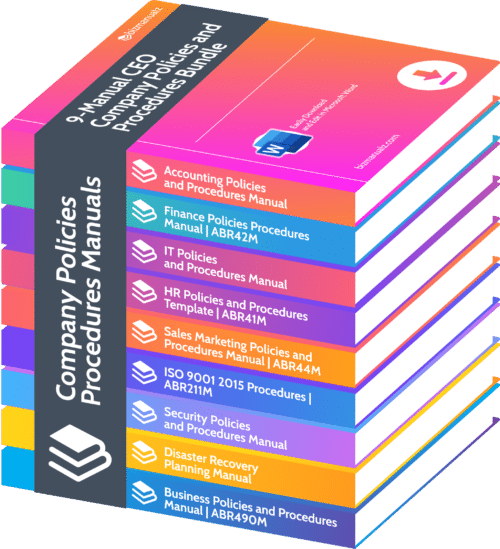
A business playbook, sometimes called a business manual, is the documented system that defines how your organization actually runs. In football, teams have a playbook that defines, step-by-step, every player’s job on every play. The team practices each play until it is executed correctly, and only then are they ready for the game on Sunday. A business playbook does the same thing with step-by-step procedures, job descriptions, reports, and forms for every role. It answers one question for every employee: do you know exactly what is expected of you for the company to succeed and keep its customers happy?
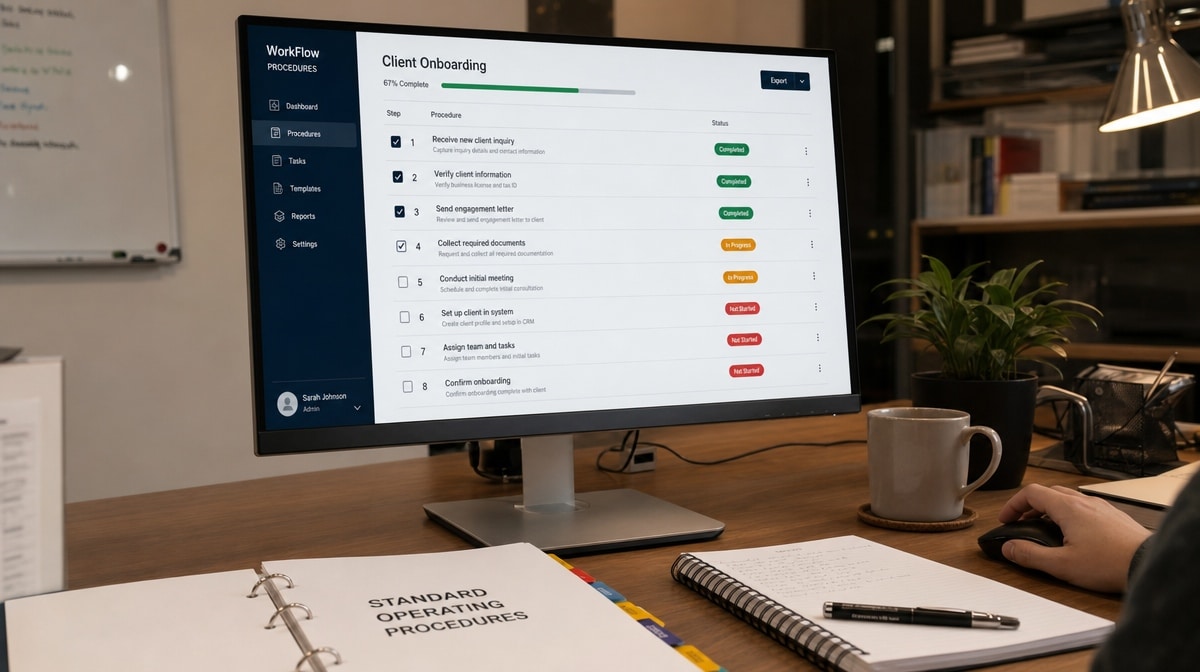
Without that documentation, work becomes improvisation. People guess at the steps, results vary, and the same mistakes repeat. With it, the knowledge of how to win lives in the system rather than in one person’s head. The SBA’s guidance on writing a business plan makes a similar point: the act of writing the plan down is what turns intention into something you can execute and measure.
A real playbook is more than a stack of paper. It usually combines a handful of working parts: process maps that show how a task flows from start to finish, step-by-step procedures that anyone can follow, job descriptions that make ownership unambiguous, and the reports and forms that capture the result. Together those pieces answer who does what, in what order, to what standard, and how you will know it worked. When a new hire can open the playbook and perform a job to standard on day one, you have proof the knowledge is in the system rather than trapped in someone’s experience.
Is Business Success a Random Event or a Learned Behavior?
All large organizations have a playbook or business manual. Is that how they got large? In large part, yes. They standardize business processes to eliminate inefficiencies, they find the plays that work, and they use them over and over to succeed. That is not luck. It is a learned behavior, refined through repetition. Success that can be repeated on purpose is success you have learned to manufacture.
Why Repetition and Practice Drive Results
A great player is already great and still practices the plays every week, because skill decays without repetition and execution drifts without a standard. The same is true of a business. When a process is written down and rehearsed, it becomes the baseline everyone returns to. When it is not, every person performs a slightly different version, and the company’s results scatter. Clearly defined policies and procedures are too often an afterthought to starting a business, when they should be the foundation you build the rest of the company on.
Standardize First, Then Improve
There is an order of operations here that owners often get backward. You cannot improve a process you have not standardized, because there is nothing stable to measure or compare against. Standardization comes first: agree on the one best-known way to run a play, write it down, and have everyone run it the same way. Only then can you see clearly which steps add value and which create waste. Large organizations standardize precisely so they can eliminate inefficiencies and then keep refining the plays that work. Each cycle of standardize, measure, and improve makes the next result a little more predictable, and predictability is what separates a business that compounds from one that lurches.
How Documented Policies and Procedures Create Success
Here is the part most owners underrate: your policies and procedures are your business. Return policies, credit procedures, sales and service policies, and policies on vacation, healthcare, and sick leave are not paperwork off to the side. Documented or not, your policies communicate your strategy, your vision, and your understanding of the market to your employees and your customers. It is not what you say. It is what you do, repeatedly and reliably, that is the essence of your company.
Turning Strategy Into Daily Execution
How many points could your team score if there were no playbook and positions were not clearly defined? How would you even communicate in the huddle what you wanted to get done? Chaos would develop, and the team that was better organized would win. A documented playbook is how strategy stops being a slide deck and becomes the behavior people actually perform every day. It turns a good intention into a repeatable result.
Documentation also protects the customer experience, which is where strategy is ultimately judged. A return policy that every employee applies the same way builds trust; one that changes depending on who is at the counter erodes it. Credit procedures that are followed consistently keep cash flowing and risk contained. Even your people policies on vacation, healthcare, and sick leave quietly signal what kind of company you are. None of this is incidental. The way you handle the routine, repeatable moments is the brand customers and employees actually experience.
What Are the Costs of Not Having Policies and Procedures?
Treating success as a random event is not free. It carries real, recurring costs that quietly compound:
- Opportunity costs. Lost sales or goodwill from the uneven treatment of customers. McDonald’s requires that all food served at its thousands of franchises tastes and is served exactly the same. Would you keep eating there if it did not? Consistency is the product.
- Inefficiency costs. Time spent correcting tasks that were performed or documented improperly. As the old line goes, if you do not have time to do it right the first time, when will you have time to fix it?
- Legal liability. How much does a company pay its lawyers to defend itself when policies and procedures are unclear, someone gets damaged, and people sue? Clear, documented procedures are also a compliance asset; OSHA’s recordkeeping requirements are one example of why written, consistent process is not optional.
Building Your Playbook: From Random Chance to Repeatable Wins
Start where the work already has a rhythm. Take sales: do your salespeople have a quota to fill? Do they have call sheets to complete, month-end status reports, and 30-60-90 day forecasts? That level of process detail is exactly what makes a sales team predictable instead of streaky, and every other function in your company needs the same treatment. Document the play, rehearse it, measure it, and improve it.
You do not have to document everything at once, and you should not try. Pick the plays that matter most first: the handful of processes that touch revenue, risk, or the customer directly. Map how each one actually runs today, not how you wish it ran, then tighten it into a clear procedure with an owner and a simple measure of success. Rehearse it with the team that performs it, watch where they hesitate, and fix the gaps. When that play is reliable, move to the next one. A playbook built this way grows in the order of business impact, so the effort pays for itself long before the binder is finished.

Keep the Playbook Live, Not a Binder on a Shelf
The most common failure is not skipping the playbook; it is writing one and then letting it die. A procedure no one updates becomes fiction, and a team that catches the playbook being wrong once will stop trusting it entirely. Treat your documentation as a living system: review the high-stakes plays on a schedule, fold in what you learn when something breaks, and make it effortless to find the current version at the moment of work. When the playbook is genuinely live, practice has somewhere to point, onboarding gets faster, and the wins you booked last quarter stay repeatable this quarter.
Companies that operate without clearly articulated policies and procedures are gambling. They do not know whether they will succeed. Successful companies do not take chances with success; they practice, honing their skills and focused on winning through a process of well thought out policies and procedures. Not only do policies and procedures solve business problems, they can be the deciding factor between business success and failure. Success is not a random event. It is a learned behavior, and the playbook is how you learn it.
Frequently Asked Questions
Is business success a random event or a learned behavior?
Success is overwhelmingly a learned behavior. Companies that document their winning processes, rehearse them, and repeat them produce consistent results, while those that rely on luck see their outcomes scatter. A business playbook is how you turn success into something you can repeat on purpose.
What is a business playbook?
A business playbook, or business manual, is the documented system that defines how an organization runs: step-by-step procedures, job descriptions, reports, and forms for every role. Like a football playbook, it tells each person exactly what is expected on every play so the team can execute consistently.
Why do policies and procedures precede business success?
Policies and procedures communicate your strategy, vision, and standards to employees and customers. They standardize how work is done so results become predictable rather than dependent on who happens to do the job. That predictability is what compounds into success over time.
What are the costs of not having documented procedures?
The three big ones are opportunity costs from inconsistent customer experience, inefficiency costs from redoing work that was done wrong, and legal liability when unclear procedures lead to disputes. Each cost is recurring and tends to grow as the company scales.
How do you start building a business playbook?
Begin with the functions that already have a rhythm, such as sales, where quotas, call sheets, and forecasts give you a natural template. Document each process step by step, rehearse it with the team, measure the outcome, and refine it. Repeat across every function until the way you win is written down and teachable.