
Tighten Accounting Controls
Financial internal controls often fail at the handoffs between accounting cycles. Sales books the order, operations fulfills it, finance reports it, and someone must verify the numbers along the way. A practical control framework therefore has to cover the ten core accounting cycles that make up the accounting body of knowledge. Each financial cycle focuses […]
Read more
Do you understand how accounting policies and procedures connect accounting rules, software workflows, source documents, and internal controls into one accounting management system?
Read more
By adopting policies and procedures, organizations can reduce process variability, improve control, and decide whether a process is ballistic, controlled, or adaptive.
Read more
Accounting systems group transactions into revenue, purchase, payroll, and general journal cycles, then post those entries to ledgers and the general ledger for reporting and control.
Read more
Sarbanes-Oxley (SOX) requires an internal control system. Yet recent financial crises show the needed internal controls are not effectively implemented in many companies.
Read more
A Certified Public Accountant (CPA) is a professional who provides financial advice and services to individuals, businesses, and other organizations. Learn more about the duties and responsibilities of a CPA and how they can help you manage your finances.
Read more
10 tips for creating an effective operating budget: understand the purpose, prioritize revenue sources, assess costs, set realistic goals, implement budgeting techniques, allocate resources efficiently, monitor performance, adjust as needed, involve stakeholders.
Read more
Gross sales and net sales are two important terms used in accounting. Learn the difference between gross sales and net sales, including how each is calculated and the implications for businesses.
Read more
Learn about the importance of Form 8379 in filing taxes. Understand how it helps protect your share of the refund and navigate complex filing situations.
Read more
Best Manual Deals
-
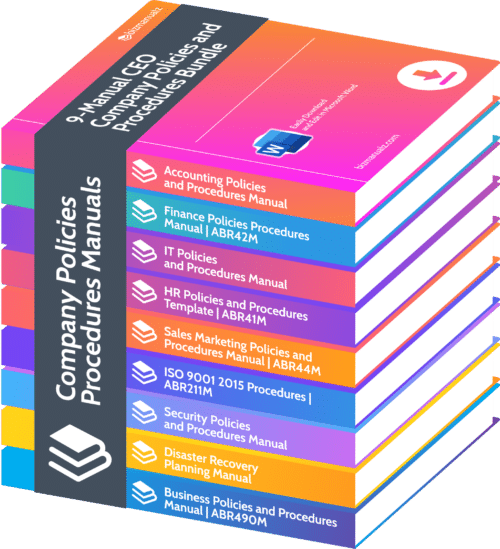 9-Manual CEO Company Policies and Procedures Bundle | Save 45%
$ 2,495.00
-
 ISO 22000 Food Safety Procedures Manual | ABR213M
Original price was: $ 395.00.$ 197.00Current price is: $ 197.00.
-
 ISO 22000 Seguridad de los Alimentos Procedimientos | ABR219M
Original price was: $ 395.00.$ 195.00Current price is: $ 195.00.
-
 ISO 9001 Quality Manual | ABR211MPM
$ 49.99
Business Manuals
-
 ISO 9001 2015 Procedures | ABR211M
$ 495.00
-
 Finance Policies Procedures Manual | ABR42M
$ 495.00
-
 Accounting Policies and Procedures Manual | ABR31M
$ 495.00
-
 IT Policies and Procedures Template Manual | ABR34M Information Security Policy Manual
$ 495.00
-
 HR Policies and Procedures | ABR41M Employees Policy Examples
$ 495.00
-
 Sales Marketing Policies and Procedures Manual | ABR44M
$ 495.00
-
 AS9100 Quality Procedures Manual Rev D | ABR217M Aerospace QMS
$ 395.00
-
 Security Policies and Procedures Manual | ABR32M
$ 395.00
-
 Disaster Recovery Planning Manual | ABR33M
$ 395.00
-
ISO 22000 Food Safety Procedures Manual | ABR213M
Original price was: $ 395.00.$ 197.00Current price is: $ 197.00.
-
9-Manual CEO Company Policies and Procedures Bundle | Save 45%
$ 2,495.00
-
ISO 22000 Food Safety Procedures Manual | ABR213M
Original price was: $ 395.00.$ 197.00Current price is: $ 197.00.
-
ISO 22000 Seguridad de los Alimentos Procedimientos | ABR219M
Original price was: $ 395.00.$ 195.00Current price is: $ 195.00.
-
ISO 9001 Quality Manual | ABR211MPM
$ 49.99
-
 How to Prevent Workplace Violence Manual | ABR32MWV
Original price was: $ 49.99.$ 19.99Current price is: $ 19.99.