How to Manage Working Capital

Working capital is where day-to-day finance discipline shows up first. A company can be profitable on paper and still feel squeezed if invoices go out late, customers pay slowly, supplier terms are unmanaged, or inventory absorbs cash faster than it turns into sales.
Managing working capital means keeping accounts receivable, accounts payable, and inventory under active control. The goal is not to hoard cash or delay every payment. The goal is to release cash tied up in unproductive places while keeping suppliers, customers, and operations moving.
What Is Working Capital?
Working capital is the money available to run your business on a daily, weekly, and monthly basis. It is the cash and near-cash resources used to pay suppliers, cover payroll, buy materials, carry inventory, and keep operations functioning while you wait for customers to pay.
In practical terms, working capital is driven by three operating balances: accounts receivable, accounts payable, and inventory. The old working capital equation in this article still captures the relationship clearly:
Working capital = accounts receivable + inventory – accounts payable
The equation is simple, but the management work behind it is not automatic. The U.S. Small Business Administration’s finance guidance treats accounts receivable, accounts payable, available cash, bank reconciliation, and payroll as day-to-day finance functions that someone must actively manage. Those are the same operating areas that determine whether working capital is available when the business needs it.
How Do You Manage Working Capital?
You manage working capital by setting policies, goals, measurements, and review habits for each of the three major components. Accounts receivable controls how quickly cash comes in. Accounts payable controls how cash goes out. Inventory controls how much cash is sitting in materials, work in process, and finished goods instead of in the bank.
Each area has a different lever. Receivables improve through prompt invoicing and disciplined collection. Payables improve through clear payment terms and reliable scheduling. Inventory improves through turn targets, reorder discipline, and visibility into the full cost of ownership.
The important point is that working capital is not a single accounting line item to glance at after month end. It is a finance process. If the process is slow, vague, or unmanaged, cash becomes trapped in places that do not produce return.
Accounts Receivable

The cash flowing into your business from customer payments is crucial to working capital. Accounts receivable represents credit you have extended to customers, and credit must be measured. Your organization should actively track Days Sales Outstanding, or DSO, which is the average number of days it takes to collect payment after a sale is made.
DSO is commonly calculated as accounts receivable divided by sales, multiplied by the number of days in the period. If you calculate it monthly, the period might be 30 days. If you calculate it quarterly, the period might be 90 days. The exact calculation matters less than whether the business reviews the trend and acts on delays.
One key to managing accounts receivable is removing delay in invoicing customers after shipment of an order or delivery of a service. These delays consume cash available as working capital. Set a goal to invoice customers immediately after fulfillment.
If it currently takes ten days to invoice a customer, the first goal might be five. If it currently takes five days, the next goal might be two. Reducing DSO frees cash formerly tied up in receivables so it can be used to provide return, support operations, or fund growth.
Prompt invoicing is one of the most direct methods to reduce DSO because it is inside your control. If your business sends invoices slowly, customers receive an unspoken message that payment timing is not urgent. A clear accounts receivable procedure should define invoice timing, responsibility, collection follow-up, escalation rules, and measurement.
Accounts Payable

Accounts payable may look like the easiest working capital process to control because it involves paying bills. But paying bills should not be left to chance. Clear policies and goals should direct when invoices are approved, when payments are scheduled, and when exceptions require management review.
The Golden Rule applies. Treat others’ invoices as you want others to treat your invoices. That generally means paying according to agreed terms. There may be no advantage in paying early, but purposely paying late as a working capital tool is unprofessional and can negatively affect service levels, supplier trust, and future pricing.
You may think you are getting away with late payment, but if the organization you are paying has its own controls in place, delayed payment can eventually lead to stricter terms, higher prices, or reduced willingness to prioritize your orders. Working capital management should strengthen operating relationships, not damage them.
Your accounts payable policy should state that payment will be made according to terms. A practical goal might be to mail payment five business days before the due date or transfer funds on the due date for electronic payments. A supporting measurement should show performance against that goal.
The policy should also define when invoices may be paid early. Early payment may make sense for an earned discount, a strategic supplier relationship, or a critical shipment. Without a policy, however, early payment can drain cash before the business has received a meaningful benefit.
Inventory Management

Including inventory as a finance function sometimes causes confusion. There is no doubt, however, that inventory consumes financial resources. Purchased materials, parts, work in process, and finished goods are all cash that is not available for other uses while it sits in stock.
The purchasing representative may believe they are getting a good deal by buying one year’s worth of parts, and perhaps the unit price is lower. But the decision still affects the financial resources consumed by inventory, especially when you include warehouse space, utilities, maintenance, financing cost, personnel, equipment, shrinkage, obsolescence, and insurance.
The responsible financial authority should stay informed of inventory performance and set clear goals for managing inventory levels. Useful metrics include Inventory Turns, Days Inventory, Average Inventory, and Cost of Ownership. These measurements help show whether inventory is supporting operations or quietly absorbing too much cash.
The overarching goal should be to reduce unnecessary inventory while ensuring operational needs are met. As with accounts receivable, the benefit is cash release. Cash tied up in nonproductive inventory can be redirected toward growth, debt reduction, supplier stability, or other uses that improve return.
What Policies Help Control Working Capital?
Working capital improves when finance policies turn good intentions into repeatable behavior. A receivables policy defines when invoices are issued, who reviews aging, and when collections escalate. A payables policy defines approval authority, payment timing, early payment rules, and exception handling. An inventory policy defines reorder points, cycle counts, ownership cost review, and obsolete stock controls.
These policies should be connected to objectives. For example, a company might set a DSO target, a percentage of supplier invoices paid according to terms, and an inventory turns target by product category. The policy then describes how work is done, while the objective shows whether the process is improving.
Managing working capital processes is just as vital to business success as producing products and services that customers want. Businesses that do not actively manage working capital may find too many resources consumed in unproductive ways, including growing accounts receivable balances, missed supplier terms, and excessive inventories.
Easily Customizable Financial Procedures
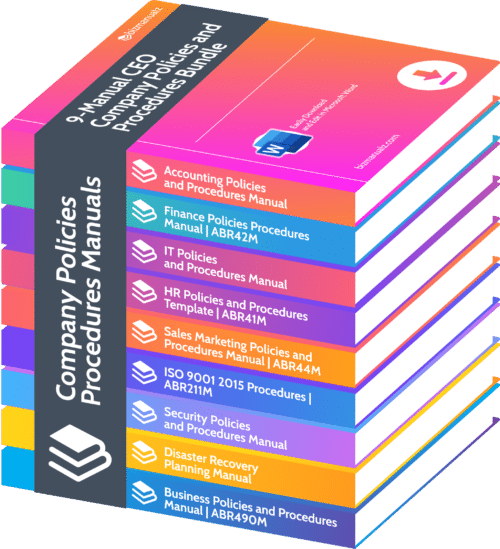
Why start from scratch when writing financial procedures to implement internal controls? By researching best practices and key compliance activities, Bizmanualz has done much of the work for you. Besides providing policies and procedures in a hard cover manual, the materials are also provided in Microsoft Word format so you can adapt and customize them to fit your organizational needs.
Although specifically designed to help small and medium sized businesses, which often lack the resources to create documentation frequently called for by internal control systems, the Bizmanualz Finance Policies and Procedures can help companies of many sizes with compliance efforts. The Finance Manual covers important functional areas including Raising Capital, Treasury Management, Financial Reporting and Analysis, Auditing and Controls, and Financial Administration.
Prewritten Financial Procedures Templates for Compliance and Improvement
Since SOX became law, finance and accounting departments in businesses of many kinds and sizes have worked to develop the required internal controls. Bizmanualz developed the Finance Procedures Manual as more than a how-to book. It provides financial processes in the form of customizable financial procedure templates so your documentation can remain dynamic and changeable.
With SOX and other regulatory requirements, the main goal of internal control is compliance. The SEC’s internal control reporting rule connects management reporting on internal control over financial reporting to the Sarbanes-Oxley Act and recognizes the need for evaluative criteria. Companies that build controls only for compliance, however, may miss an improvement opportunity.
Control systems are a practical way to manage by objectives and drive performance upward. A well-defined process does more than document activities. It can incorporate objective setting, result review, corrective action, and continual improvement directly into the way finance work is performed.
Speed Your Finance Policies and Procedure Development
Strengthen compliance, enhance performance, and speed the development of your financial procedures. If your organization is still building an internal control system to support Sarbanes-Oxley, GAAP, or other financial reporting requirements, the Bizmanualz CFO Policies and Procedures Manual can provide a practical starting point.
Whether your goal is compliance, performance improvement, documented procedures, or all three, financial policies and procedures help turn working capital management from a monthly concern into a repeatable operating system. For related templates, visit the free policies and procedures page.



Frequently Asked Questions
What Is Working Capital?
Working capital is the money available to run daily operations. It is affected by accounts receivable, accounts payable, inventory, and the timing of cash flowing into and out of the business.
How Do You Manage Working Capital?
You manage working capital by controlling invoice timing, customer collections, supplier payment terms, and inventory levels. Policies, goals, and regular measurements help keep each area visible.
Why Is Accounts Receivable Important To Working Capital?
Accounts receivable affects how quickly sales turn into cash. Slow invoicing or weak collection follow-up increases DSO and leaves cash tied up in unpaid customer balances.
Should A Business Delay Supplier Payments To Improve Working Capital?
A business should pay according to agreed terms. Delaying supplier payments may create short-term cash relief, but it can damage supplier relationships, service levels, pricing, and reputation.
How Does Inventory Affect Working Capital?
Inventory affects working capital because purchased materials, work in process, and finished goods use cash before they produce revenue. Inventory turns, days inventory, and ownership cost help show whether stock levels are productive.