What Policies and Procedures Lessons Can You Learn from the IRS?

Every set of policies and procedures eventually meets a moment of real load: a regulator’s deadline, an audit, a public-facing rollout, a transition between leadership. How the documents perform under that load tells the organization something it could not learn any other way. The Internal Revenue Service lives in that moment continuously. Its policy library is one of the most heavily used in the country, and the Government Accountability Office has documented, year after year, where the seams come apart: drift between revisions, language that defeats the people who must use it, and training that does not match the document on the desk.
The patterns are not unique to a federal agency. They appear in any organization whose written rules have outpaced the people who have to follow them, and they appear at every scale. Seven of those patterns are worth naming, and each one points to a small change in how policies are reviewed, written, and maintained that any operations leader can apply to their own work.
What Can the IRS Teach Us About Policies and Procedures?
The IRS administers a policy library that touches almost every individual, business, non-profit, and governmental entity in the United States. Its official website publishes thousands of forms, instructions, and publications, and the underlying tax code has grown across decades of accumulated amendments. Studies conducted by governmental and private organizations consistently find that the resulting body of policy is difficult to apply consistently, and the GAO has repeatedly documented where those difficulties show up in practice.
What makes the IRS useful as a case study is not its mistakes but its scale. The same failure modes that produce confusion at federal scale, stale documentation, dense language, weak training, and missing records, also produce confusion in mid-sized companies and small teams. Studying the federal version of the problem makes the smaller versions easier to recognize. The seven lessons below translate the IRS’s most consistent missteps into practical policy and procedure takeaways any operations leader can apply.
7 Policies and Procedures Lessons from the IRS
1. Review Your Policies and Procedures Regularly
The last major revision of the US Tax Code was in 1986; before that, it was 1954. Twenty-five years between major rewrites is far too long for any policy system, and the gaps in between are filled with amendments that have to interlock with documents written in a different decade. Even with the Tax Cuts and Jobs Act adding a substantial amendment package in 2017, the underlying structure shows the strain of long review intervals.
For a business, review means a calendar-driven re-read by a named owner, with explicit sign-off. It is not an open-when-broken posture. A workable cadence assigns annual review to every active policy, with a quarterly review for any policy tied to a regulated process such as HR, finance, IT security, or workplace safety. An event-triggered review fires whenever the underlying regulation, tool, or workflow changes materially.
Each document needs a policy owner of record. That owner is the named person responsible for triggering the review, collecting input, and signing off on whether the document stays as written or gets revised. Without a named owner, reviews quietly fall to no one. The IRS itself models this at smaller scale through its continuing public update cycle: forms and instructions are revised annually, and the change is dated, attributed, and published in a predictable place.
The anti-pattern to avoid is treating review as a one-time cleanup project. Review is a recurring obligation tied to a named owner and a calendar, not a campaign that runs once and is declared complete.
2. Make Sure Your Policies and Procedures Are Clear and Concise
Do not make policies so large and cumbersome that the people who have to use them cannot understand them. Reduce complexity and you reduce the opportunity for error. The federal government has codified that principle as the Plain Writing Act of 2010, and the IRS itself publishes plain-language guidance under it.
A policy is clear when an employee who has not seen it before can read it once and execute the relevant step without needing to ask for clarification. Two operational tests are useful. The readability test targets a plain-language reading level no more advanced than the audience actually requires. The single-action test asks that each procedural step describe one action with one owner, not a paragraph of conditional logic.
Structural conventions help: short sentences, numbered steps, one decision per branch, and no nested exceptions inside exceptions. A useful reference for the underlying mechanics is writing standard operating procedures that hold up across teams.
The trade-off worth naming up front is that clarity sometimes requires more words, not fewer. Compression is not the same as clarity. A shorter document that lacks structure is simply a shorter unclear document. The discipline is structural before it is editorial.

3. Cover the Details but Don’t Obsess over Them
Trying to address every possible circumstance, sometimes known as “paralysis by analysis,” generally causes much more trouble than it solves. The right level of detail in a procedure is enough that a competent employee can execute the relevant work, no more. Procedures are not novels. They describe the path, not every landmark adjacent to it.
An 80/20 approach to policy writing works in most operational settings. Cover the cases that occur eighty percent of the time in depth, and refer the remaining twenty percent to a named decision-maker or an escalation path. Edge cases live in an exceptions log, not as embedded clauses in the main procedure. The log is reviewed periodically to see how often each exception actually fires, and exceptions that fire often enough get pulled back into the main procedure.
The IRS’s own Internal Revenue Manual is the canonical example of what happens when a policy library tries to address every circumstance inline. The IRM runs to thousands of sections, and most of its users rely on summaries and topical references rather than reading the manual end to end. There is a difference between regulatory documents, where exhaustiveness may be mandated, and internal SOPs, where it is not. Internal policy writers benefit from drawing that line explicitly.
The failure mode to avoid is writing a policy that anticipates every imaginable variation. The result is a document no one finishes reading, and new ambiguity in the cases that actually occur.
4. Train Your Personnel
Train them carefully and thoroughly. Retrain them regularly. A policy describes what should happen. Training is how the organization makes sure it does. A document without a training plan is, in practice, a wish.
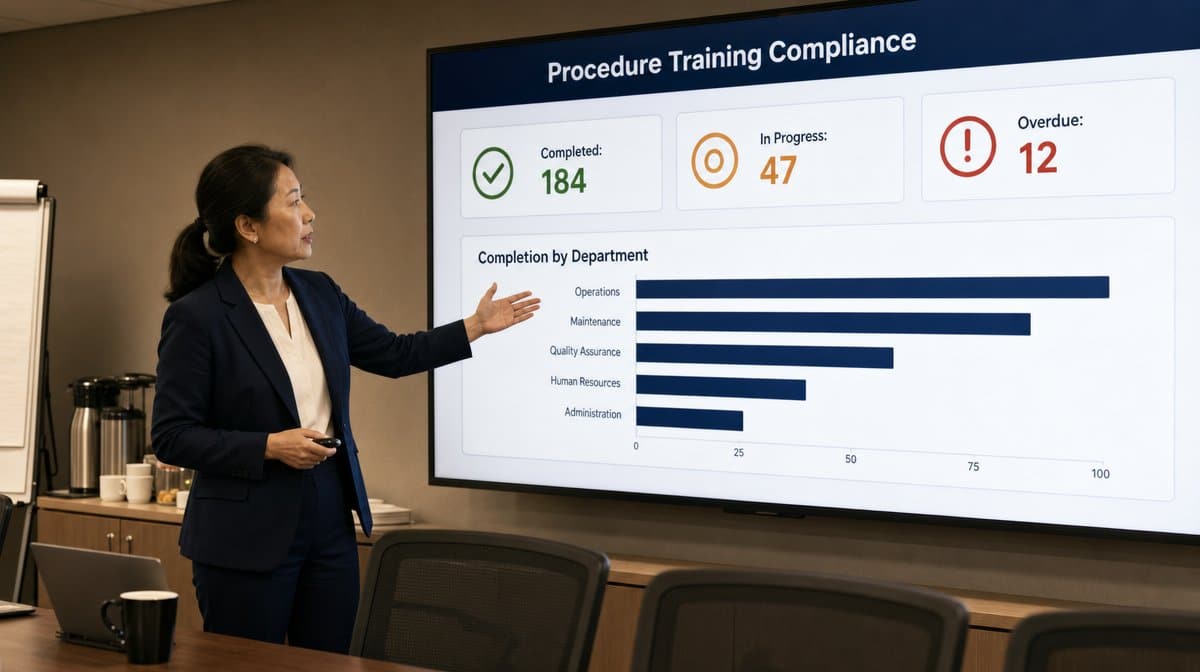
A tiered training model fits most operational settings. Onboarding training brings every new hire to a baseline. Refresher training on a schedule (annual is a common baseline, more frequent for regulated processes) keeps the existing workforce current. Event-driven training fires whenever a policy materially changes, ahead of the change taking effect rather than after it. The right way to train employees on procedures stitches all three together rather than treating any one as sufficient on its own.
Competency-based assessment matters: training is complete when the employee can demonstrate the required behavior, not when attendance has been recorded. The IRS itself models this with its continuing-education requirements for enrolled agents and tax preparers, where mandatory recurring training is paired with a periodic exam.
When a documented policy is not being followed, training failure is the most common root cause. The policy is rarely the problem; the gap between the document and the people executing it is. Do not treat training as a one-time onboarding event. The policies that govern a job almost always change faster than employees re-encounter them.
5. Get a Variety of Inputs
Involve the people who are subject to a policy in its design phase, long before implementation begins. Policies written without input from the people who will execute them tend to be elegant on paper and impossible in practice.
Three input layers usually suffice. Subject-matter experts who know the regulation or technical context anchor the document in fact. Operators who will execute the procedure daily anchor it in reality. An outside reader, someone not embedded in the work, anchors it in clarity by spotting ambiguity that insiders have stopped seeing. The structured-feedback cycle that ties them together looks like this: a draft, a defined review window with named reviewers, a written response to each piece of feedback, and a documented decision on what changed and what did not.
Federal regulators model structured input at scale through the Federal Register’s notice-and-comment process. Proposed rules are published, comments are collected, and the final rule includes a written response to the substantive feedback. The mechanism is not perfect, but it produces a record of who said what and what changed because of it, which is what makes a feedback cycle defensible.
The failure mode worth avoiding is gathering input only from people who already agree with the draft. The feedback that improves a policy most is almost always the feedback that makes the writer most uncomfortable. Input collected after publication is correction, not co-design, and tends to be expensive.

6. Be Sure Your Eyes and Ears Are Always Open
The discipline matters after publication as much as before. A policy is, in effect, a hypothesis about how work should be done, and the only way to validate it is to watch what actually happens. Get feedback from the people using the document in as many ways as you can, and treat suggestions for improvement as a signal rather than a complaint.
Three feedback channels cover most operational settings. A structured periodic survey of policy users captures the predictable concerns. An always-open suggestions inbox, owned by the policy owner of record, captures the unexpected ones. An audit-driven channel routes deviations found in compliance review back to policy design rather than leaving them as one-off corrections.
Two failure types tend to produce the same surface symptom and require different responses. Policy failures are cases where the document is wrong. Execution failures are cases where the document is right and the work is not. The fix for each is different, which is why feedback channels should record both, not just one. The GAO’s recurring tax-administration work is a useful analog at federal scale: an outside body whose job is to surface where the rules are not working, even when no one on the inside is asking the question.
A quarterly “what surprised us” review of the feedback log closes the loop. Each surprise gets a documented decision: do we update the policy, update the training, accept the deviation as an exception, or escalate. Silence is not a useful signal. Users of a difficult policy tend to adapt around it quietly rather than raising the issue, which is exactly when leadership stops hearing about it.
7. Keep Adequate Records at Every Stage
Records of policy decisions, revisions, and exceptions need to be organized, legible, and accessible. Keep a backup offsite, and keep an audit trail of changes. The records that a policy system needs to maintain include the current version of every active policy, the version history with dated changes and named owners, the exceptions log, the training-completion log, and any audit findings tied to the policy.
Version control is the spine of the record set. Every policy update produces a new dated version, the prior version is retained, and the difference between versions is summarized in a change log. The change log is what makes the policy auditable, and it is what makes a future revision faster because the next reviewer can see what the previous reviewer changed and why.
A retention schedule defines how long each record type is kept, in what format, and where the canonical copy lives. The schedule should match the longest applicable regulatory minimum. The IRS publishes record-retention guidance for businesses in Publication 583, which is a useful starting point for the financial-and-tax-related records that most organizations have to keep regardless of their other obligations.
The practical consequence is straightforward. When a regulator, auditor, or investigator asks why a decision was made, the records are the answer. Verbal recollection is not. An offsite backup, an access list that includes the policy owner and a named backup, and a documented recovery procedure round out the basics. The record you wish you had kept is almost always the one you decided not to keep.

Putting the Lessons to Work
None of the seven lessons above is unique to the IRS. They appear in every organization that runs on documented policies, and they tend to appear in clusters: stale review cycles produce dense documents, dense documents undermine training, weak training drives execution failures, and missing records make the whole sequence invisible to leadership. The work of fixing one usually surfaces the others.
The takeaway is not to mimic the IRS but to use its scale as a magnifier. These lessons can be applied at any size, from a five-person operations team to a federal agency, because the underlying failure modes are the same. The failure modes that take years to become visible inside a federal agency become visible within months at smaller scale, which means smaller organizations have an opportunity to address them earlier. Do you notice any of the same problems creeping into the policies and procedures that govern your own business?
Frequently Asked Questions
How Often Should You Review Your Policies and Procedures?
Active policies should be reviewed at least annually by a named policy owner, with a more frequent cadence (commonly quarterly) for any policy tied to a regulated process such as HR, finance, IT security, or workplace safety. A review is also triggered by any material change to the underlying regulation, tool, or workflow the policy governs.
What Are the Most Common Mistakes Businesses Make with Policies and Procedures?
The most common pattern is allowing policies to drift, that is, leaving them unreviewed while the work they govern continues to evolve. Other recurring failures include writing policies in language too dense for the people who must execute them, omitting structured training, and gathering input from operators only after the policy has been published.
What Is the Best Way to Train Employees on New Procedures?
Effective training combines onboarding training for new hires, scheduled refreshers for the existing workforce, and event-driven sessions whenever a policy materially changes. Training is considered complete when the employee can demonstrate the required behavior, not when attendance has been recorded.
What Records Should Businesses Keep to Document Their Policies and Procedures?
A policy system should retain the current and prior versions of every active policy, a version history with dated changes and named owners, an exceptions log, training-completion records, and any audit findings tied to the policy. Retention periods should match the longest applicable regulatory minimum, and an offsite backup should exist for every record type.
How Do You Make a Policy or Procedure Document Clear without Losing Necessary Detail?
Clarity comes from structure, not from compression. Use short sentences, numbered steps, one action per step, and an explicit escalation path for edge cases rather than embedding every possible exception inside the main procedure.