Are You Solving Problems or Improving the Process?

Are you solving problems or improving the process? When a process breaks, the visible fix often earns immediate attention and reward. But if the same conditions keep producing the same failures, the organization has repaired an event without improving the system that created it.
In other words, if you find a problem in a process and implement change to fix it, did you improve the process? Well, maybe. Solving problems is important, but it is not the same as improving processes. The difference depends on whether the action removes one symptom or strengthens the design, interactions, and outcomes of the whole process.
What Is Problem Solving?
Problem solving is the work of identifying an undesirable event, finding its immediate cause, and taking action to correct it. Traditional training and performance development programs are often framed as a problem-solving technique. In reality, many use gap analysis: examine the current and desired states, find the gap, and figure out how to close it.

There is one big problem with this method when it is applied carelessly: it can notify employees and supervisors that something is wrong, that they have done something wrong, and that someone else is going to fix it. That will be a tough sell. It takes a lot of work to obtain everyone’s buy-in and support when the proposed change begins with blame.
Solving problems is usually focused on resolving local issues. It may fail to account for interactions with other processes or the system as a whole. Fixing the local problem may not produce the desired result and, worse, may create an entirely new set of problems. If you have not considered the effect of your fix on a whole system of processes, you could make the situation worse.
This is why a process owner must ask what happens upstream and downstream before celebrating a quick fix. NIST’s systems approach to process improvement emphasizes linkages among processes, results, and organizational performance. A corrective action can be successful at one workstation while shifting delay, cost, defects, or customer frustration to another part of the system.
What Is Process Improvement?
Process improvement is the disciplined effort to understand the present situation, define better outcomes, test changes, and make successful changes part of the process design. Even the very best people can enhance their abilities when the process gives them clearer information, simpler work, and better control over results.

When adopting a narrow problem-solving method, pressure builds for an immediate solution. A second bite of the apple is rarely taken, so teams may spend a long time double-checking a proposed fix before acting. They still cannot know every consequence because the solution is treated as a one-time occurrence rather than a continuous process.
With a process improvement technique, you’re looking for steady gains over time. You can test out new ideas, compare results, discard those that do not work, and standardize those that do. The Plan-Do-Check-Act improvement cycle formalizes this repeated movement from a proposed change to a measured result. You’re not allowing the pursuit of perfection to get in the way of good intentions, but you are requiring evidence before a temporary experiment becomes the permanent method.
Getting Buy-In for Process Improvement
Who has a greater chance of getting buy-in: the manager who says, “You’re doing things wrong, and I’m going to tell you what you’re doing wrong,” or the manager who says, “I’m here to help you improve on the outstanding work you’ve already done”?
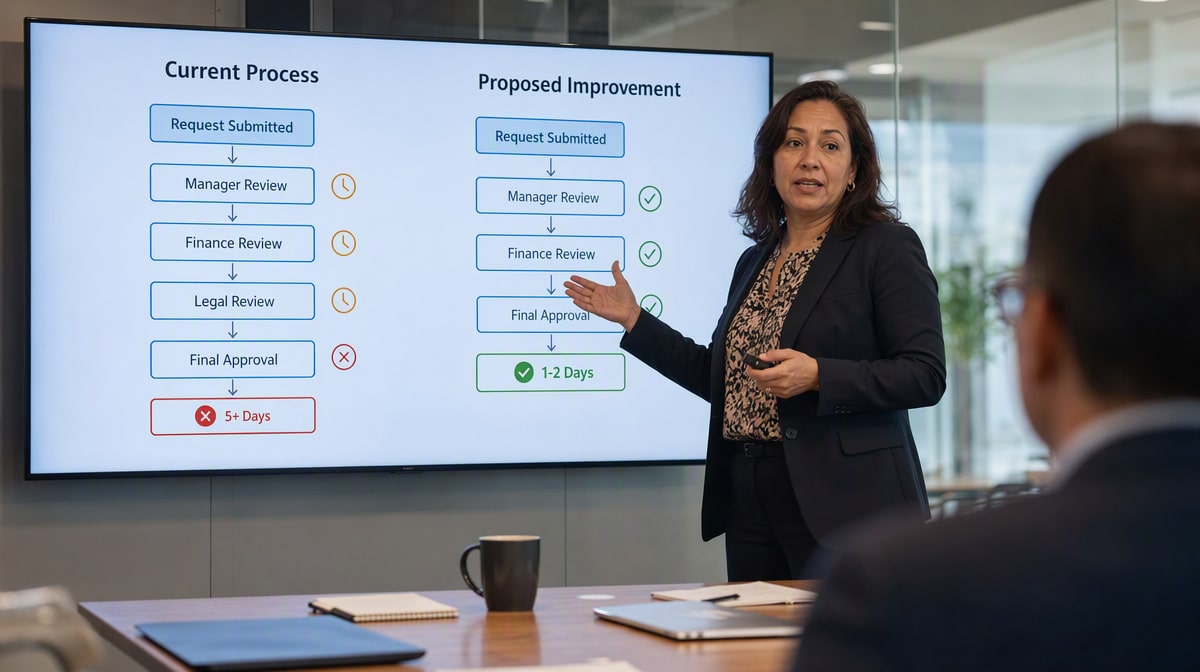
Human nature and many management systems favor the first kind of work. The familiar Pareto principle, or 80/20 rule, is often used as shorthand for the imbalance, but it does not prove that people spend exactly 80% of their time solving problems. The more defensible observation is that solving problems provides a sense of accomplishment, immediate gratification, and visible reward. Many compensation systems recognize problems solved more readily than outcomes achieved.
Consider expenses in a business as a local problem. If a manager reduces expenses, saves money, and controls the budget, that manager may be rewarded for good behavior regardless of the revenue or profit impact. When revenue declines, the damage can be dismissed as a sales or marketing problem because those outcomes are said to be beyond the manager’s control. Process improvement challenges that boundary and asks whether the cost reduction weakened the customer outcome that creates revenue.
Improving a System of Processes
Improving processes is about resolving global issues and improving outcomes for the whole system of processes. It focuses on customers’ outcomes, not merely the easiest local measurement. To improve processes, use a process map: a picture of the process interactions, outcomes, activities, decisions, and handoffs involved from start to finish.
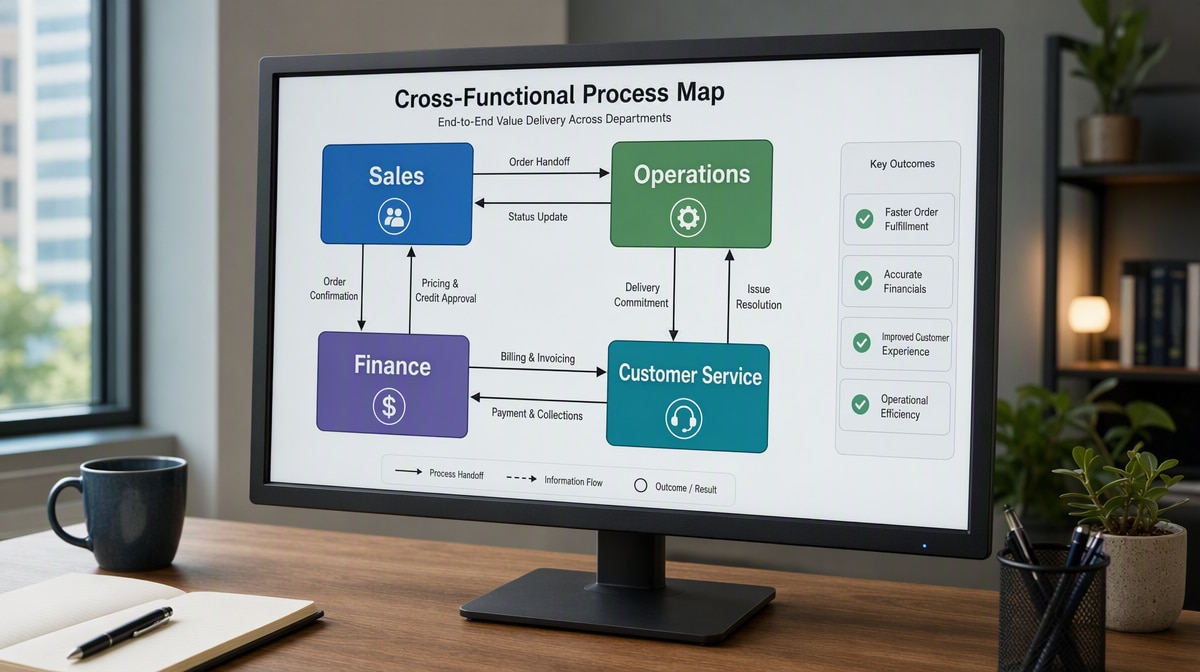
The process map helps you focus on what is important and what is not. It makes inputs, outputs, responsibilities, delays, and customer-facing results visible together. The idea is to analyze the impact of any change on global outcomes and to spend less time optimizing a local problem that does not matter to the larger result.
A system view also changes which problems deserve action. Improving processes is about prioritizing problems and fixing those that improve global outcomes. It is not about fixing every problem that arises. You may be better off leaving some problems as problems because there are more important uses of your time, attention, and investment.
Strategies for Improving Processes
The right strategy depends on what is producing the gap between current and desired results. Three approaches are especially useful: improve the design, prevent recurrence by addressing root cause, and simplify the flow of work. Each approach changes the process instead of adding another isolated patch.
Improving Processes by Design
Improving processes is often a result of changes made to a process’s design. Well-designed processes produce outcomes that are expected, efficient, and more likely to keep customers happy. They make the intended sequence, standards, decision rights, inputs, and outputs clear enough for people to repeat good work.

By comparison, solving problems does not necessarily focus on design. The effort may concentrate on patching the current design, reworking unexpected outcomes, or applying quick fixes to customer unhappiness. And it never ends. You will be constantly patching a bad design until the design itself changes.
Prevention-Based Process Improvement
Root cause is what you are looking for when a bad design keeps producing the same undesirable event. Problem solving is often a reactive approach that seeks to understand and resolve the event. Process improvement is a proactive approach that seeks to understand the cause, change the design, and stop the recurrence.
Many businesses solve problems in reaction to operational events, management directions, tight deadlines, or complaints. In those situations, fixing the problem is all that seems to matter. There is no time to get at the root of the problem and prevent it from reoccurring. The practical answer is not to ignore the urgent correction, but to schedule the deeper analysis after operations are stable and connect the corrective action to a process owner.
Improving Processes Through Simplification
Improving processes is also about process simplification. Reducing defects and variance, shrinking cycle times, and speeding up a process usually involve removing needless activities, time delays, duplicate handoffs, or design flaws. Simplification reduces the number of places where work can wait, fail, or require correction.
On the other hand, solving problems often adds steps. If the response to every failure is another inspection step, more sign-off forms, or an extra approval, you are probably problem solving. Problems do not have to occur simply because they occurred before. Process improvement is about prevention and avoidance, supported by a design that makes the right work easier to perform.
Produce Long-Term Results by Improving Processes
Improving processes is about identifying changes worthy of investment and implementing them permanently. This requires measures tied to customer, quality, time, cost, and risk outcomes. Without those measures, a team cannot tell whether the change strengthened the system or merely moved the problem.

In contrast, problem-solving results can become short-term solutions because of a narrow focus on local problems and a “fix it” rather than “prevent it” approach. Numerous fixes do not automatically add up to significant gains. They may remain isolated solutions with little connection to the organization’s goals.
Problem solving becomes a diversion when urgent activity prevents an organization from making impactful changes. For problem solving to work, it needs to be part of process improvement. Correct the immediate event, learn what the event reveals about the system, test a design change, measure the outcome, and standardize the improvement when the evidence supports it.
Improving Processes or Problem Solving?
Everyone starts by solving problems. But lasting change that affects the bottom line needs a systematic approach focused on the right outcomes. The goal is not to reject fast corrective action. It is to make sure the correction contributes to a stronger process instead of becoming one more disconnected fix.

The steps involved in improving processes are:
- Understand the big picture. Before making changes to a process, understand the whole process from start to end, including suppliers, inputs, customers, outputs, measures, and dependencies.
- Identify the critical path. Examine the critical process steps, constraints, activities, and handoffs between the process’s start and end points for weaknesses and potential problems.
- Prioritize issues affecting outcomes. Rank weaknesses according to their impact on customer, quality, time, cost, and risk results instead of their visibility or inconvenience.
- Communicate change. Collect and analyze data to explain why the change matters, how it will work, and what employees should expect.
- Take action. Test improvements, prevent problems, strengthen weaknesses, measure the result, and standardize changes that produce better outcomes.
A good process-improvement effort makes room for both response and prevention. It restores performance when something goes wrong, then uses the evidence to improve design, simplify work, strengthen buy-in, and produce long-term results across the system.
Frequently Asked Questions
What Is the Difference Between Solving Problems and Improving a Process?
Solving problems corrects a specific undesirable event, often within a local area. Improving a process examines the design, interactions, and outcomes of the whole system so the change produces better results and prevents recurrence.
Why Can a Local Fix Create New Process Problems?
A local fix can shift delay, cost, defects, or customer frustration to an upstream or downstream activity. Reviewing process interactions before implementation helps prevent one department’s improvement from becoming another department’s problem.
How Does a Process Map Support Improvement?
A process map makes activities, decisions, handoffs, inputs, outputs, and outcomes visible in one view. It helps teams identify critical steps and judge how a proposed change may affect the system as a whole.
Why Does Buy-In Matter for Process Improvement?
Employees understand how work actually moves through the process and must apply the new method consistently. An improvement message that respects outstanding work and invites evidence is more likely to earn support than one framed around blame.
What Steps Lead to Long-Term Process Improvement?
Understand the big picture, identify the critical path, prioritize issues affecting outcomes, communicate change, and take action. Then measure the result and standardize successful changes so improvement becomes part of the process design.