How to Implement Lean Thinking

Lean programs often stall for a simple reason: people learn the tools before the organization changes the way it thinks. A team can attend training, memorize the names of the wastes, and still return to the same metrics, constraints, and daily habits that produced the old results.
To implement Lean Thinking, start with the forces already shaping the business. Metrics change behavior, constraints reveal where flow is blocked, and the first improvement event proves whether the organization can turn analysis into movement.
What is Lean Thinking?
Lean Thinking is a management approach for improving flow, reducing waste, and increasing customer value. It is related to Lean process improvement, but it is not just a set of procedures or a collection of workshop tools. It is a way of seeing how work moves through the organization.
The mistake many companies make is treating Lean as a checklist. They run a training session, introduce new terms, and expect the culture to change. Lean Thinking asks a deeper question: what must change in the way people define goals, measure work, find constraints, and make decisions?
That is why the starting point is not a complicated transformation plan. The starting point is a clear position goal. A position goal describes the operational position you want to create, such as changing the metrics, improving the constraint, or holding a focused improvement event. The same logic behind strong position goals applies here: define the target condition before choosing the tool.
Instead of trying to force change from the outside, examine the system from the inside. Look for potential energy, natural forces of flow, and the points where work slows down. Once you understand those flows, you can use them to move the organization toward the result you want.

How Do Metrics Change Behavior?
Metrics are one of the strongest levers for changing Lean behavior because they tell people what the organization really values. If the company rewards local efficiency, people will optimize their departments even when the whole process slows down. If the company measures flow, quality, customer demand, and constraint performance, people begin to see the work as a system.
This is why company metrics deserve early attention in a Lean implementation. Your metrics drive your culture, and your culture drives individual behavior. Change the metrics and you change what managers discuss in meetings, what supervisors inspect on the floor, and what employees try to improve first.
Metrics should be close enough to the work that employees can influence them. Harvard Business Review’s balanced scorecard framework makes a similar point: useful measures connect strategic goals to operational actions people can affect. In a Lean setting, that means tracking items such as cycle time, first-pass yield, waiting time, rework, throughput, and customer response time.
The position goal is simple: change the metrics so they support Lean Thinking. Do not bury the team in twenty measures. Pick a few that expose flow, constraint performance, and customer value. Then review them consistently enough that people understand which behavior matters.
Make Metrics Visible
Lean metrics should be visible where the work happens. A dashboard, whiteboard, daily huddle sheet, or value stream map can all work if the team uses it to make decisions. The point is not decoration. The point is to create shared attention around the work that must improve.
Measure the Flow, Not Just the Department
Department-level measures often hide system-level problems. One department can look efficient while the customer order still waits in a queue. Lean Thinking looks at the full flow from demand to delivery, so the best measures help people see where work waits, loops, or fails.
How Do Constraints Balance Flow?
Constraints show where flow is being limited. A constraint may be a machine, approval step, supplier delay, skill shortage, batch rule, software queue, or management habit. Once the constraint is visible, the organization can stop guessing and focus its improvement energy where it will matter most.
The original lesson still holds: identify, exploit, and elevate the constraint while subordinating everything else to that constraint. In practical terms, this means the team first finds the bottleneck, uses its existing capacity better, then decides whether the constraint needs more support, a process change, automation, training, or investment.
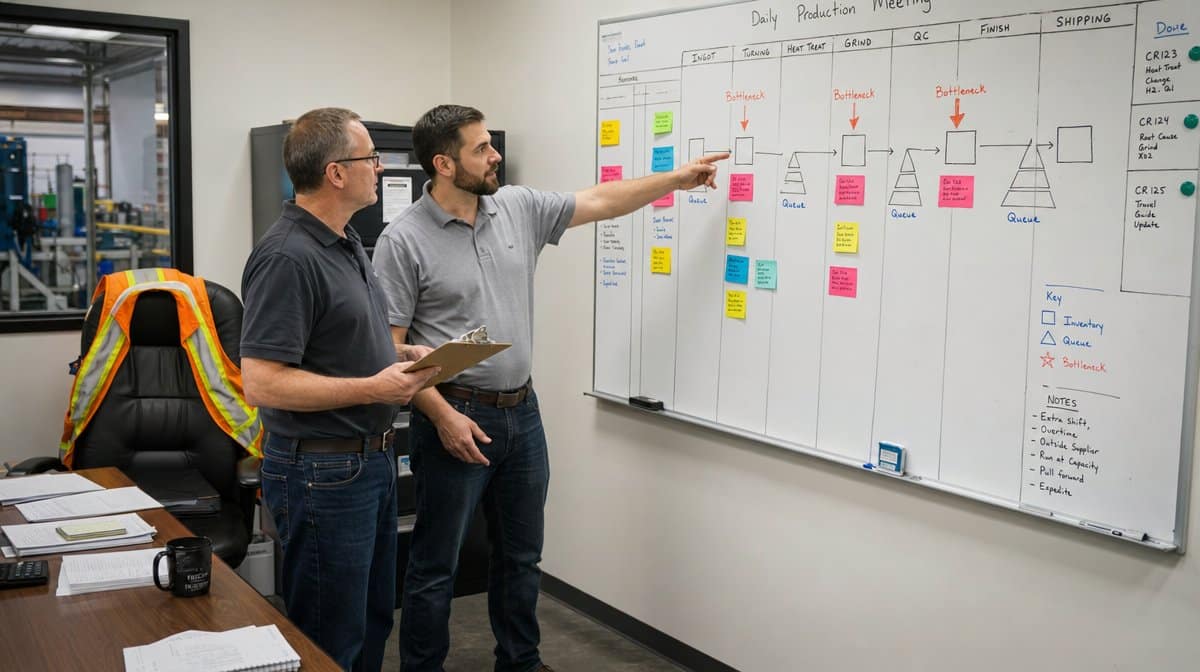
Focusing on the constraint prevents the common Lean failure of improving everything a little and changing nothing important. If the constraint is in order entry, a faster warehouse layout will not improve customer delivery. If the constraint is in inspection, faster upstream production may simply create more inventory waiting for approval.
When you understand the constraint, you can balance the flows around it and reduce the harmful side effects that create waste. This is where Lean Thinking becomes less abstract. The organization stops asking, “What Lean tool should we use?” and starts asking, “What is blocking flow, and what would release it?”
Use the Constraint to Set Priorities
A constraint gives the first improvement event a practical boundary. It tells the team where to look, what data to collect, and which tradeoffs matter. Without that boundary, improvement work spreads across too many areas and loses force.
Subordinate Local Goals
Subordinating local goals does not mean ignoring departments. It means department goals must support the system goal. If a local metric encourages behavior that overloads the constraint, the metric should change.
What Should the First Improvement Event Do?
The first improvement event should be narrow enough to finish quickly and important enough to be noticed. Start from a single point in the system, then connect that point to the wider flow. A successful event builds credibility, gives people a practical example of Lean Thinking, and creates momentum for the next pass.
The event should have a respectable return on investment, alleviate a real constraint, and be completed in days rather than months. It should be simple enough for employees to understand and visible enough that people can see the before and after state. The position goal is to hold an improvement event that proves the new thinking works.
This does not mean the first event must solve the whole system. It means the event should teach the organization how to connect Lean tools to business outcomes. If the team changes a metric, reduces a queue, shortens a handoff, or removes obvious waste, the event becomes a working demonstration of the larger approach.
Start Narrow, Then Show the System
A narrow event keeps the work manageable. The team can define the current state, test a countermeasure, and measure results without getting lost. After the event, connect the result back to the broader value chain so people understand how one improvement affects the whole flow.
Choose a Problem People Recognize
The first event should address a problem employees already recognize: waiting for approvals, reworking forms, searching for materials, expediting late orders, or correcting the same error repeatedly. A visible problem makes the result easier to explain and harder to dismiss.
How Do You Run a First Pass Assessment?
With the position goals in place, perform a first pass assessment. The assessment looks for visible waste, documents current metrics, and follows the order flow from customer demand to customer delivery. It also captures important facts such as cycle time, inventory turns, operational effectiveness, customer demand, and handoff delays.
A first pass assessment should move quickly. For a simple process, it may take a day. For a larger supply chain, it may take longer. The goal is not to collect perfect data. The goal is to get the big picture, see where the work actually flows, and decide where the next detailed analysis belongs.

Value stream mapping is useful in this step because it turns observations into a shared picture. MIT OpenCourseWare’s value stream mapping basics describe the method as a way to sketch the linked actions in a process and evaluate improvement opportunities. For a business team, the same idea applies: map the flow, mark the waits, and separate value-adding work from waste.
Follow the Order Flow
Follow the order flow from the moment demand appears to the moment the customer receives the result. Watch the handoffs, approvals, queues, forms, systems, and rework loops. Ask where the order waits and why.
Document Visible Waste
Visible waste includes waiting, excess motion, extra processing, defects, inventory buildup, overproduction, transportation, and unused talent. Do not worry about finding every example immediately. If you find one waste, others are usually nearby because waste tends to cluster around the same interface points.
Capture the Facts You Can See
Record the facts that are readily available: queue length, cycle time, inventory levels, rework counts, demand patterns, and customer touch points. If a number is missing, note the gap and keep moving. The first pass is meant to guide the next investigation, not replace it.
What Comes After the First Pass?
After the first pass assessment, the team should understand the metrics, flows, constraints, and visible waste well enough to choose the first event. The Value Stream Map gives the team a communication tool. Use it to explain what was seen, why the constraint matters, and how the proposed event supports the position goals.
The next step is a more detailed analysis of the metrics, flows, and constraints. That analysis should not drift into endless study. It should sharpen the first event, define the expected result, and set the measures that will prove whether the event worked.
When you start with the right goals, you work toward the right answers. The result is the right solution to the right problem. If you understand the flows inside your organization, you are halfway to thinking Lean. The other half is learning how to use those flows to achieve the goals that matter.
Frequently Asked Questions
What Is Lean Thinking?
Lean Thinking is a management approach that improves flow, reduces waste, and increases customer value by changing how people define goals, measure work, and solve process problems.
How Do You Start Implementing Lean Thinking?
Start by setting position goals, reviewing the metrics that shape behavior, finding the constraint that limits flow, and choosing a first improvement event that can produce a visible result quickly.
Why Do Metrics Matter in Lean Thinking?
Metrics matter because they signal what the organization values. Lean metrics should expose flow, quality, constraint performance, and customer value instead of rewarding isolated departmental efficiency.
What Is a First Pass Assessment?
A first pass assessment is a quick review of the current process flow, visible waste, key metrics, constraints, and customer touch points. It gives the team enough information to choose the next detailed improvement effort.
What Should the First Lean Improvement Event Focus On?
The first improvement event should focus on a narrow, visible problem connected to the system constraint. It should be simple enough to complete quickly and meaningful enough to build credibility for future Lean work.