How to Optimize SEO for Your Website

Search engine optimization (SEO) helps search engines understand your content and helps people decide whether to visit your site from search results. That practical definition from the Google SEO Starter Guide is more useful than a promise of instant rankings: effective SEO marketing makes a website clearer, easier to discover, and more useful to its target audience.
To optimize SEO for your website, research the language customers use, improve each page, earn relevant links, test performance, and promote useful content. Treat those areas as a repeatable process. Prioritize one important change, record a baseline, and measure the result before moving to the next improvement.
5 Tips and Tricks to Optimize SEO for Your Website
The five steps below preserve the core of a sound website SEO program. They work together: keyword research clarifies intent, page optimization helps people and search engines understand the answer, relevant links support discovery, strong performance improves the experience, and promotion helps the right audience find the content.
Research Your Keywords
Begin with the questions, products, services, and problems your target audience describes. Keyword research allows you to understand your target audience, see what the competition covers, and decide how you can differentiate your page. Separate broad research terms from phrases that show a person is ready to compare, contact, or buy. This prevents a page from targeting a popular phrase while answering the wrong task.
Google Keyword Planner can suggest related keywords and show estimates of average monthly search volume. Other tools like Semrush can also help compare related terms and estimated search volume. Treat all volume figures as estimates, then confirm actual queries, impressions, clicks, click-through rate, and average position in Google Search Console after publication.
After finding the right keywords, optimize the parts of the page that explain its purpose:
- Title tag
- Meta description
- Headings and subheadings
- Anchor text
- The introductory sentence of the page
- Content that completes the reader’s task
The Yoast SEO plugin for WordPress can provide editing checks and feedback on keyphrase use, metadata, text, and links. Use that feedback as a prompt to review the page, not as proof that the page will rank. The goal is to get your website noticed by making the page accurate, specific, and easy to navigate.
Improve Your Website Through Link Building
Website SEO is not only about on-page optimization. Google says links help it discover pages and understand relevance, and descriptive anchor text helps people and Google understand the destination. Its link best practices recommend concise, relevant wording that makes sense in context.
To build links, give another site a genuine reason to reference your work. Useful approaches include original research, a practical template, a detailed resource page, expert commentary, link reclamation, and focused outreach to authority websites in your niche whose readers need the asset. A strong backlink strategy values relevance and editorial judgment over raw link counts, helping qualified readers find the page and potentially increasing referral traffic.
Common link-building lists mention guest blogging, linkbait, resource pages, social media, and press releases. A useful resource page or valuable linkbait asset can attract links because it helps someone complete a task, but those labels are not shortcuts. Google’s spam policies list optimized links in paid articles, guest posts, and press releases as link spam when they pass ranking credit. Publish or pitch something because it helps the audience, and avoid scaled placements created mainly to manipulate rankings.
Ensure Your Website Has Optimal Performance
A slow or unstable page can interrupt the visitor before the content has a chance to help. Core Web Vitals measure loading performance, responsiveness, and visual stability. Google recommends using its Core Web Vitals guidance and Search Console report to identify groups of pages that need attention.
Measure first, then work on the largest verified constraint. The objective is a site that loads quickly for real visitors, not a perfect score in one test. Common improvements include:
- Web host: A quality web host should provide dependable server response and reliability, but check the measurements before assuming the host is the problem.
- Content delivery network: Test whether caching static files and delivering them from servers closer to visitors improves results for the audience you actually serve.
- Optimize your images: Use appropriate dimensions and compression so photos do not slow down the site loading speed unnecessarily.
- Limit plugins and scripts: Remove unused code and test the effect of essential third-party tools.
- Layout: Reserve space for images and embeds so content does not jump while loading.
Serve Up the Best Online Content
Useful content should answer a real question more completely than generic information that does not relate to the audience. Google recommends content that is created primarily for people and leaves readers able to achieve their goal. Its people-first content guidance also asks whether the page demonstrates clear sourcing, expertise, and a satisfying answer. Quality websites use relevant and engaging material to help people complete a task.
For each important page, identify the decision or action the visitor should be able to complete. Add the explanation, example, checklist, image, or next step needed to finish that task. Remove duplicated filler. Review the page when the process, product, evidence, or audience changes so the material stays relevant and engaging.
Use Social Media Sites Strategically
Off-page SEO factors include how a page earns attention and references beyond its own site. Social media can put useful work in front of customers, partners, journalists, and specialists who may visit, discuss, cite, or link to it. Use each network as a distribution and relationship channel, not as a promise of a direct ranking boost.
Promoting blog content on social media works best when you share a specific insight, explain who it helps, and include a link back to the original resource. You can also share relevant articles from other websites when they help the audience. Participate where the target audience already asks related questions, then use referral data and conversions to judge whether the channel is helping. A regular analysis of social media activity can show which topics and communities deserve continued effort.
Optimize SEO for Your Website
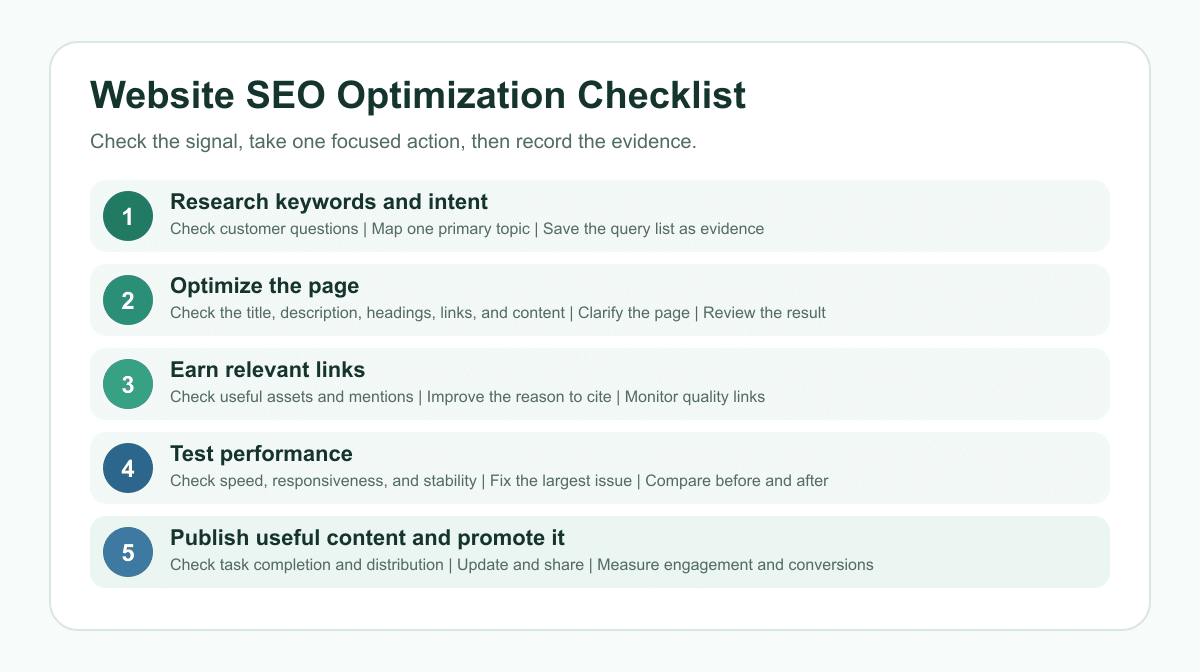
Use this working scorecard to turn the five tips into a repeatable review:
- Keywords: Check whether the page matches a real customer task. Choose one primary topic and supporting questions. Record the query list and current Search Console baseline, then review after enough impressions accumulate.
- Page: Check whether the title, description, headings, links, and answer are clear. Fix the most important mismatch. Keep a before-and-after page review, then check again after the change is indexed.
- Links: Check whether the page gives relevant publishers a reason to cite it. Improve the asset and conduct focused outreach. Record relevant earned links and referral visits each month.
- Performance: Identify the largest measured experience problem. Fix one verified constraint. Compare Core Web Vitals and performance test results after deployment.
- Content and promotion: Check whether the reader can complete the promised task. Update the answer and share it with the right audience. Review engagement, assisted conversions, and qualified feedback whenever the task or evidence changes.
SEO is a lot like a puzzle: the pieces become clearer when you connect each change to evidence and stay up-to-date on the latest changes that affect the reader. Use these SEO techniques to rank your website higher over time. Examine which practices may work for your audience, test several ideas over time instead of changing everything at once, measure the result, and continue improving the site.